My first Christmas stockings were Dad’s socks repurposed for the night. Don’t get me wrong I was not disadvantaged nor was I unusual, it was the 1960’s, and my parents believed Santa was not really what Christmas was about. Despite that, in the weeks leading to Christmas eve, I heard reminders about Santa’s naughty list and the threat of getting a potato and stick instead of an orange in the toe my Christmas stocking.
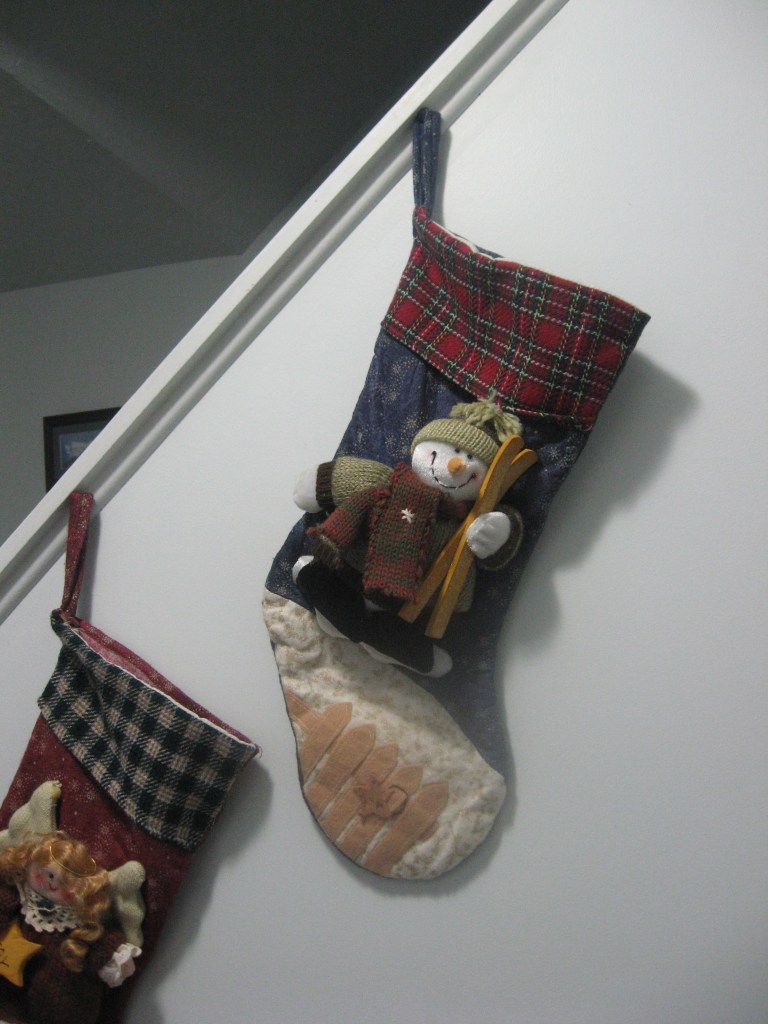
Merry Christmas from our home to yours!
I am not sure how the potato and stick family tradition began, (our family’s version of a lump of coal), but I know it started with my Mum’s family since Dad had no tradition of Christmas stockings. The Walls family of Blackville, NB were a tight knit group who loved to laugh and enjoyed playful interaction even as adults, with potatoes playing their part.
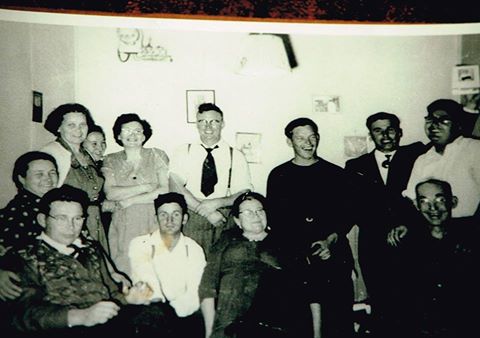
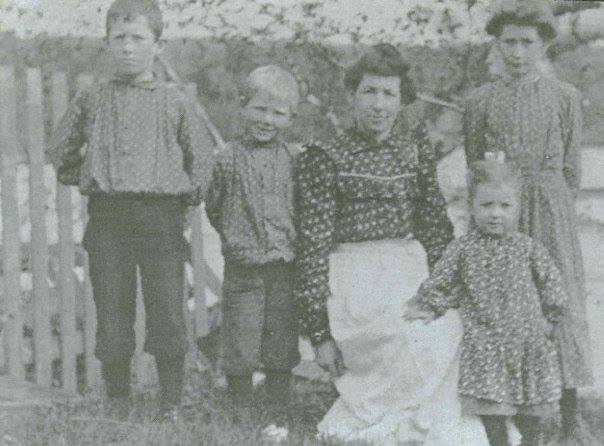
The William and Edith Walls family c. 1955 William (Billy) seated far right; Edith (Edie) seated front center, next to Edie, Ben, and Ted. Second row, left Dorothy, Elsie, Evelyn (peeking over Elsie shoulder) Louise, Royce, George, Steward and Ike.
Of course the potato was a logical choice as a booby prize at Christmas time. The humble and ordinary tuber compares poorly with the treat most often found in my Christmas stocking. Citrus fruits, lemons and oranges are not really ordinary or humble despite their being readily available to us.
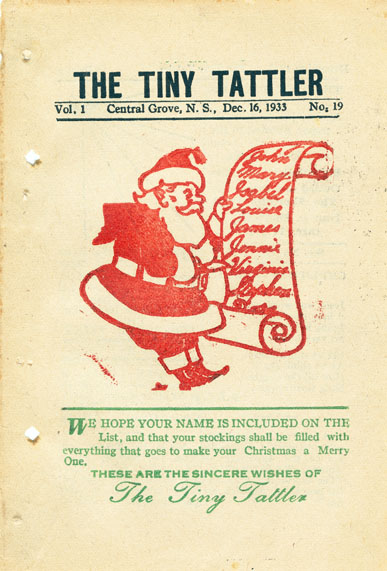
The Tiny Tattler – 13 December 1933 vol 1 issue 19 Photo courtesy of the NS Archives.
The origin story of citrus fruits is a difficult one, there are various theories on where the fruit trees grew naturally and when their spread began. Regardless of where and when we know the sour sweet fruits have been valued and pursued for thousands of years. Citrus trees were introduced to North America early, probably by the Spanish, by the mid 1800’s oranges and lemons were growing in Florida and other southern US states. It would take major developments in refrigeration and transportation for citrus to become the available fruits they are today.
And yet citrus fruits have had a long association with Christmas despite the challenges of transportation and storage. Citron or candied citrus peel appeared in recipes for Christmas cake as early as 16th century. Drying with sugar preserved the fruit but required careful attention to avoid quality issues from variances in temperature and moisture during storage. Available, known and pricy added to their exotic and special nature, helping solidify citrus as prized holiday fare for north eastern North Americans.
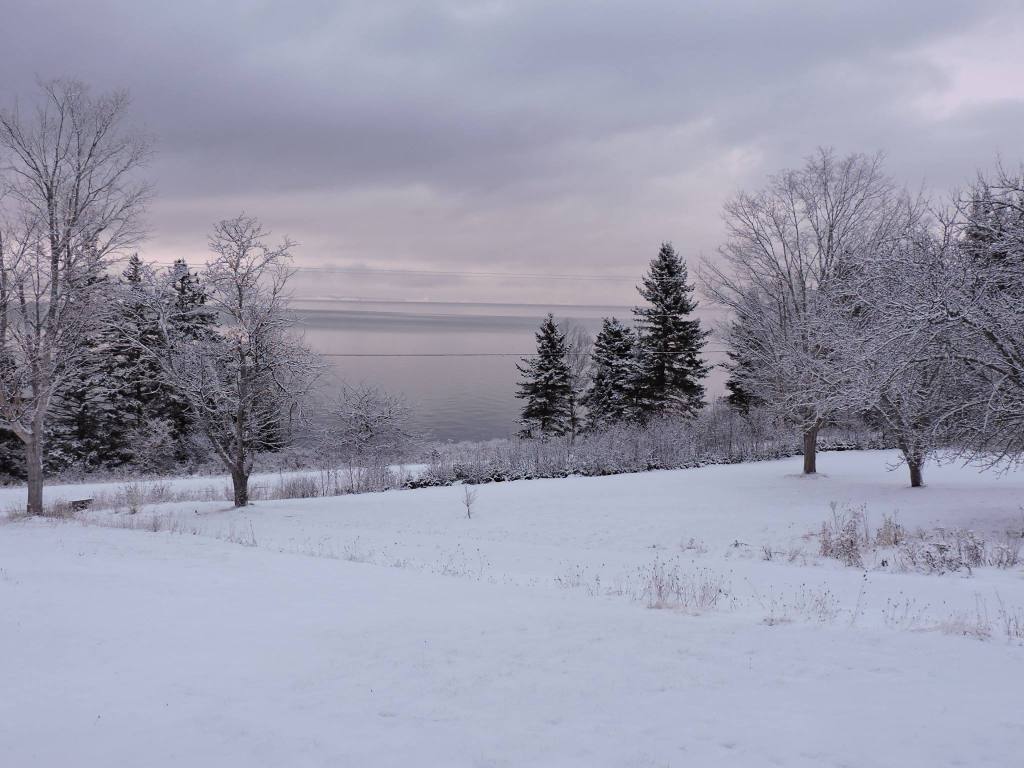
Christmas morning, Irish Cove,, Richmond County, NS c,2015 Elizabeth Lyons Morrison
Potatoes have a world wide prevalence, citrus will never have. Despite being introduced to the wider world much later than citrus, their ability to retain freshness through months of storage made them a logical choice for seafarers. The ease at which potatoes grow in acidic soil made them a logical choice for settlers too. It took time for potatoes to grown in popularity in Europe but in North America need saw potatoes playing a key role in preventing starvation and hunger.
Nicholas Doucette, farmer-fisherman, harvesting his potatoes. Near Mavillette; November, 1950 Photo courtesy of the NS Archives Alexander H. Leighton Nova Scotia Archives 1988-413 negative number 819-d
Growing conditions in Maritime Canada are extremely varied, from province to province, county to county, farm to farm, field to field the variability in soil and weather seriously limits variety and productivity. Microclimates do aid in growing some temperature sensitive crops in specific locations but not lemons and oranges. Potatoes on the other hand grow readily provided the soil is well drained and a bit of sunshine is available.
Of course potatoes do make an appearance at Christmas, even when you have been a good child. They play their role in the traditional turkey dinner, and they are important ingredients in traditional feast foods like Poutine Râpée, Latkes, etc. It is likely that potatoes work well as the consolation Christmas prize in part because of their ordinariness, but the potato’s much darker association with hunger and famine, the Irish potato famine in particular plays a role too.
Four of the six bothers and tricksters – sharing a laugh. Left to right – Royce, Isaac, Ted and Steward Walls
The appearance of oranges, fresh oranges in Christmas stockings had to wait for transportation and temperature controlled storage improvements. By the late 1890’s fresh lemons and oranges began to appear most every where ships and trains served, including central New Brunswick. When Grandmother Edie was preparing for her family Christmas fresh oranges and lemons were well established as Christmas fare. Special and exotic oranges got tucked in to the toes of Christmas Stockings, and fresh lemons got made in to Christmas baking like Lemon Nut Loaf.
Food, Drink and the Pleasures of Eating in Old-Time Nova Scotia Catholic Church Picnic Photo courtesy of the NS Archives Alexander H. Leighton Nova Scotia Archives 1988-413
My Mother’s Cookbook’s
Grandmother Edie’s Lemon Nut Loaf
Ingredients: 5 tbsp melted butter 1 c. white granulated sugar zest of one lemon 1 1/2 tsp baking powder 2 eggs at room temperature 1/2 c. milk 1 1/2 c. all purpose flour 1/2 tsp salt 1/2 c. finely chopped walnuts or pecans 1/4 c lemon juice 1/2 c. sugar Method: 1. preheat oven to 350 degrees F or 177 degrees C. 2. in a medium sized bowl blend butter and sugar 3. add eggs and beat well; 4. in a second bowl sift flour, baking powder, salt; 5. alternate adding flour and milk, (ending with flour) to egg butter mixture, fold gently after each addition; toss nuts in with the last flour addition and mix until blended. Over mixing will cause the loaf to be tough; 6. place in a parchment lined 5 x 9 in loaf pan and bake, until nicely browned and the top springs back from a light touch, about 40 minutes; 7. remove from the oven and let cool only while you mix lemon juice and sugar together in a bowl; 8. using a tooth pick poke holes in the top of the cake and then poor the lemon sugar slowly over the loaf, 9. Let the loaf cool completely before removing the loaf from the pan.
Recently, as I was planning the last bit of baking effort for this Holiday season, I encountered an old list tucked in to a book of recipes. In my dear Mother’s hand, the list carefully laid out the holiday baking she planned. One of the recipes, is one I recognized from the early years of our family Christmas celebrations, but not in recent years? Despite its being a wonderful recipe, delicious and easy, it had been removed from Mum’s Holiday baking list. A closer inspection revealed a number of family food traditions were missing from the list. Where were the butter tarts, the Welch cakes, the Cornish pasties?
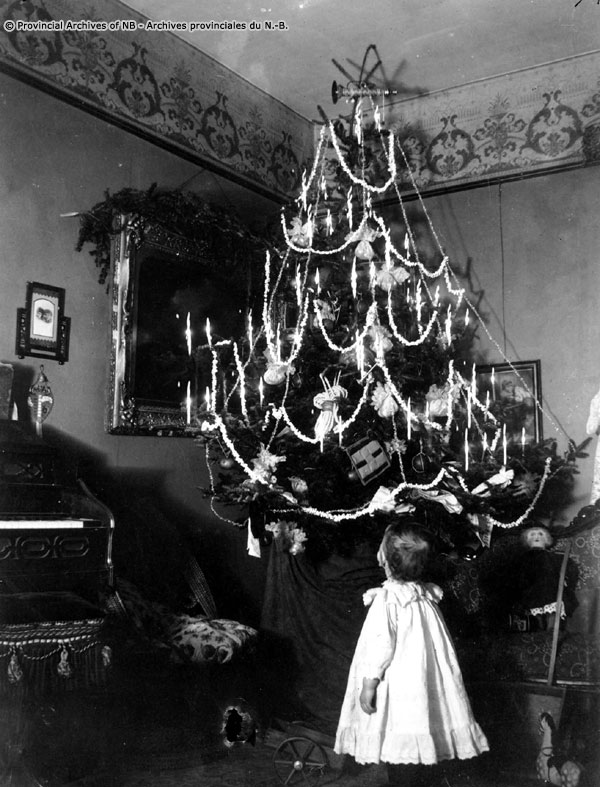
Christmas Tree c. 1942 Photo courtesy of the NS Archives E,A, Bollinger 1975-305 #555-15.
It takes a dab hand to manage traditions, particularly holiday traditions, and more often than not it falls to the home cook. Some may question if it is even possible to manage traditions? And we are not supposed to break them! The old saw is common from home cooks ” I make the same Christmas treats year after year, and if I fail to make one thing all I hear is, ‘where’s the…?’ the one thing I didn’t make, Errrg!”
My Mum was a master at both making and managing traditions, especially at holiday time. Mum’s preparations for Christmas began in early fall, a bit of her time each week dedicated to making the long list of our family’s favourite holiday foods.
At first look, you could be forgiven for thinking her management style was to make everything anyone could ask for…but not really. Over the years new traditions and foods were added, while others no longer made the list. Mum’s talent was how she did it without anyone feeling disappointed.
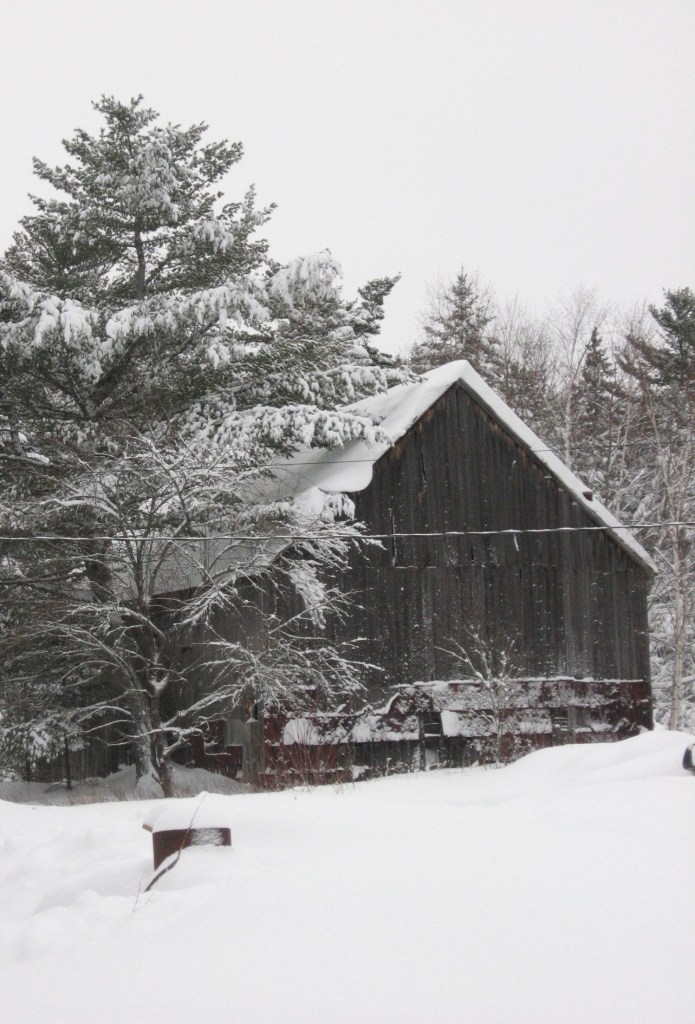
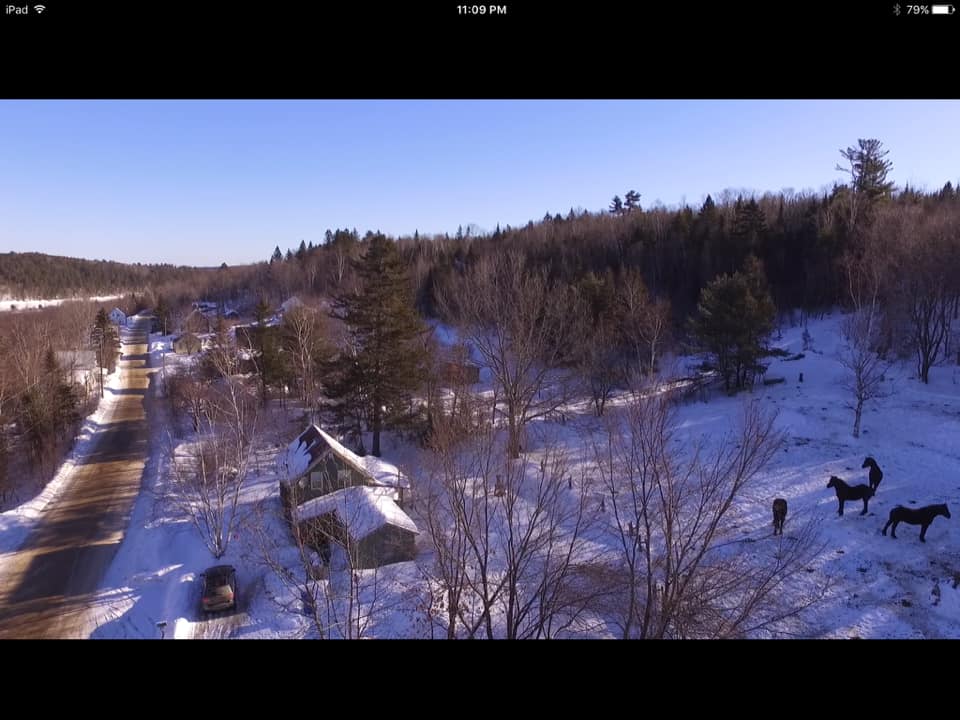
The tradition of snow for Christmas is not guaranteed. c. 2019 Elizabeth Morrison
Mum seemed to understand that despite talk of ‘broken’ traditions… traditions are not fragile. Most long held traditions are amazingly flexible and even changeable. From Christmas trees to Santa Claus, the change is subtle, unnoticed until you go looking.
Home of Frank Hayes and Mary Eloise (Hughson) Hayes, décorated for Christmas, Bloomfield Station, Kings Co., NB ca. 1905 – 1906. Photo courtesy of the PANB HUGHSON – SHERWOOD PHOTOGRAPHS
So, subtle changes in tradition do happen…but is major change possible? I think so, provided it is organic, and flows from the nature of holiday celebration. Since holidays are about spending time with family and friends, changes to traditions are a natural extension of new experiences, new memories, new people to love and care about. Mum understood that creating new memories generates opportunity to manage expectation, insert change and create new traditions…
Christmas 1980, Oxford, NS – the family assembles to share a Maritime Christmas with the newest family member.
I can trace one long held Lyons family food tradition to a specific date and time. The 24 December 1980, Oxford, Nova Scotia my brother Keith, his wife Beverley and their young son Devin who had recently moved to Nova Scotia from Saskatchewan invited Bev’s parents, and our family to spend Christmas with them in their new home. A wonderful and exciting time, grandparents, aunts and uncles coming together to celebrate Christmas for the first time.
Bev was insightful when she planned an activity for the day before Christmas for her guests to share. The prospect of a houseful of family including in laws rattling around the house with nothing to do, required a plan. It was a risky move, bringing four cooks with differing ideas, experiences and opinions together to make one recipe might have gone wrong, but it didn’t. The recipe had just the right mix of challenge, unfamiliar and bit finickity but doable and delicious. It encouraged warm feelings, positive communication, crafted a memory and led to a new family food tradition. Cranberry Croissants have accompanied our Christmas morning coffee ever since.
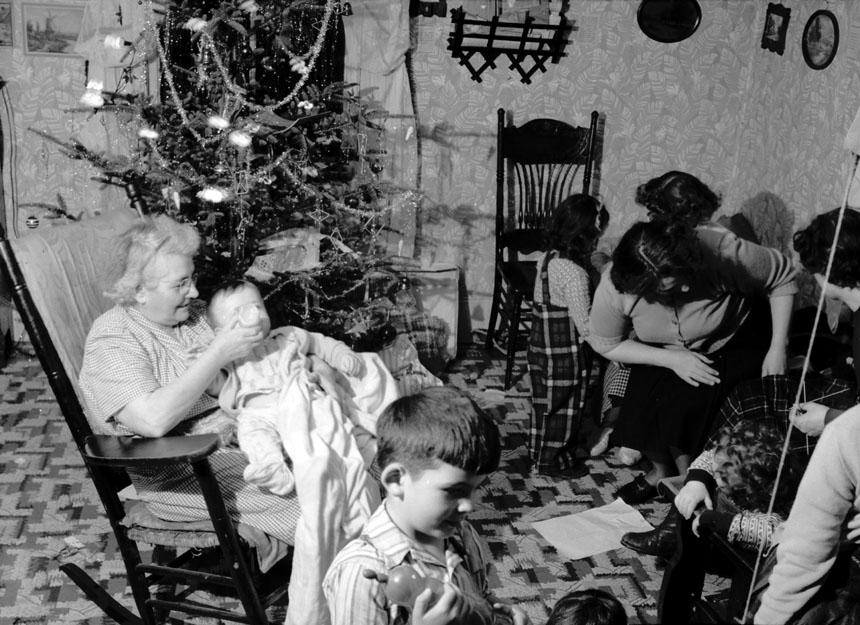
Christmas night at Vian Andrews’. The living room. December 1950. Photo courtesy of the NS Archives Alexander H. Leighton Nova Scotia Archives 1988-413 negative number 2391-d
Of course adding new traditions is easier to manage than removing them…so how do things get taken out of rotation at Holidays? One of the reasons why Bev’s Cranberry Croissants became tradition is because we were open to it. No one expected Christmas of 1980 to be ‘traditional’ in the strictest sense. We knew the basics would be honored but because we expected it, we found it easier to embrace new ideas, experiences and traditions.
Children with their toys around a Christmas tree. Photo courtesy of the NS Archives Buckley Family Nova Scotia Archives 1985-386 no. 441
Mum’s adept management of expectation combined with her keen observation of who liked what, which things disappeared quickly and which lingered too long kept her list of Holiday baking manageable. Her communication, the debate, discussion and reassurance around what she planned to make, changes she suggested and her direct questions about certain foods helped her plan her work and helped manage expectation, her and ours.
Mum’s preparations and baking were a tradition into themselves, the planning, the effort and the results. Regardless of what her list included or excluded, it reflected one fundamental truth. Holiday baking and cooking was her gift of the season to others…peace, love and joy.
My Mother’s Cookbooks – Cranberry Croissants
Ingredients: 2 c. fresh cranberries, washed, dried and chopped fine (or ground); 1 c. sugar 1 tsp orange zest 4 c. flour 6 tsps baking powder 1/2 c. shortening 1/2 c. sugar 2 eggs at room temperature 1 c. full fat cream Method: 1. Preheat oven to 400 degrees F. 2. In a bowl mix flour, baking powder and the 1/2 c. sugar; 3. Using a pastry blender cut the shortening in to the flour mixture to a pea sized crumb; 4. Beat the eggs with the cream in a measuring cup and then add to the dry mixture; 6. Stir to combine, to create a sticky dough (add extra cream as necessary); 7. Turn on to a flour board and knead just until a smooth ball; 8. Cut the ball in to 4 equal pieces, wrap each in plastic, form in to a round disc, set aside in the fridge; 9. In a second bowl mix 1 c sugar, zest and cranberries together and set aside. 10. Roll each ball in to a 12 inch circle, cut each circle in to 8 equal wedges;
11. Place a tsp of the filling on the outer portion of the wedge about 1/8 in from the edge; 12. Beginning at the outer edge, roll each wedge towards its point;
Rolled crescents require a parchment lined sheet pan to assure they don’t burn.
13. Place on a parchment lined baking sheet with the point down, turn the ends to create a crescent shape; 14. Bake for 15 -20 minutes on the upper middle rack, until golden, being careful to avoid the fruit juices burning; 15. Remove from the pan and allow to cool completely on a wire rack. Serve warm or cold. Freeze well.
Are you wondering about the other recipe? The one removed from our Christmas holiday baking list, stay tuned for Christmas Stockings, a potato and Lemon Nut Loaf – it will be released on Thursday 22 Dec 2022.
Cast iron cookware seems everywhere at the moment, although only skillets and frying pans and not the large pots, bake – ovens1 (aka Dutch Ovens) and utensils once common in households. Cast iron cookware retains heat wonderfully, and provided it is properly seasoned is non stick2! Although the newly manufactured variety come pre-seasoned, many people choose vintage cast-iron cookware. Yes, cast iron cookware is durable too.
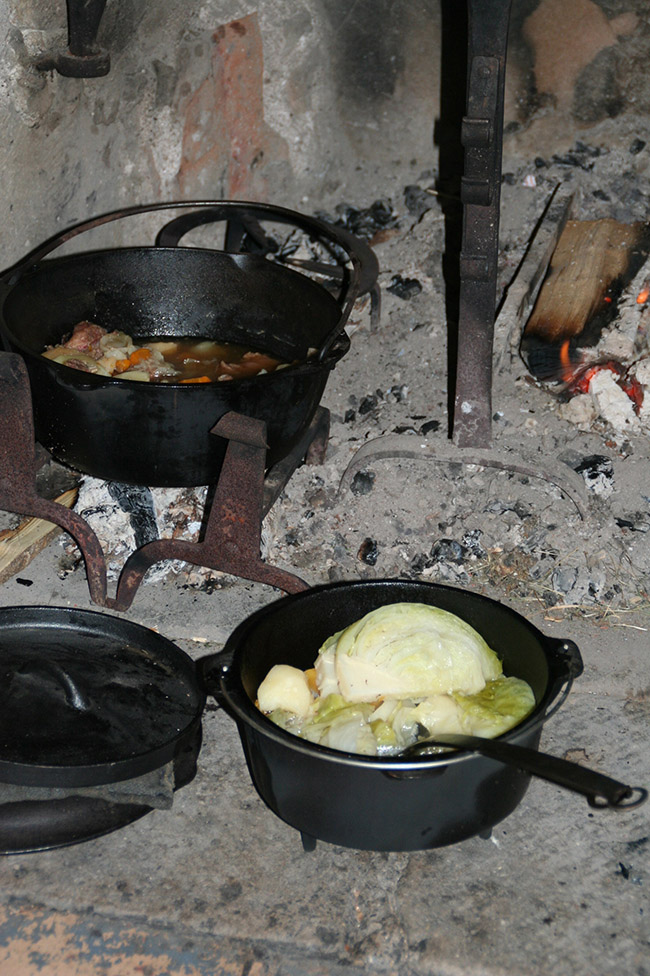
Hearth cooking methods used 1850 – Photo courtesy of the NS Archives Ref: Highland Village Museum H2013.30.37
My Dad and his brother’s learned early to cook, or at least sustain themselves with minimal parental intervention. After my Grandmother Florence died, Grandfather did not remarry despite having 6 young sons to raise. Grandfather Tully was a woodsmen, a teamster with a knack for getting the best from horses. His gentle and quiet style earned him high respect from both man and beast but delivered little in the way of monetary benefit. Most Logging industry Walking Bosses, the successful ones at least, understood good horses and teamsters, were as important as a good cook to a logging operation. That knowledge did not however translate in to high wages for either teamsters or cooks, especially in central New Brunswick of the 1930s.
Lumber camp c.1900 – Photo courtesy of the PANB ERB, Isaac C-Photographs # P11-71
When Betsey and her husband Jeremiah Lyon moved to what would become Carrolls Crossing, Northumberland County, New Brunswick she brought her kitchen furniture with her. The move which ended more than 30 years of displacement for her family3, solidified their dependance on the region’s natural resources, particularly timber.
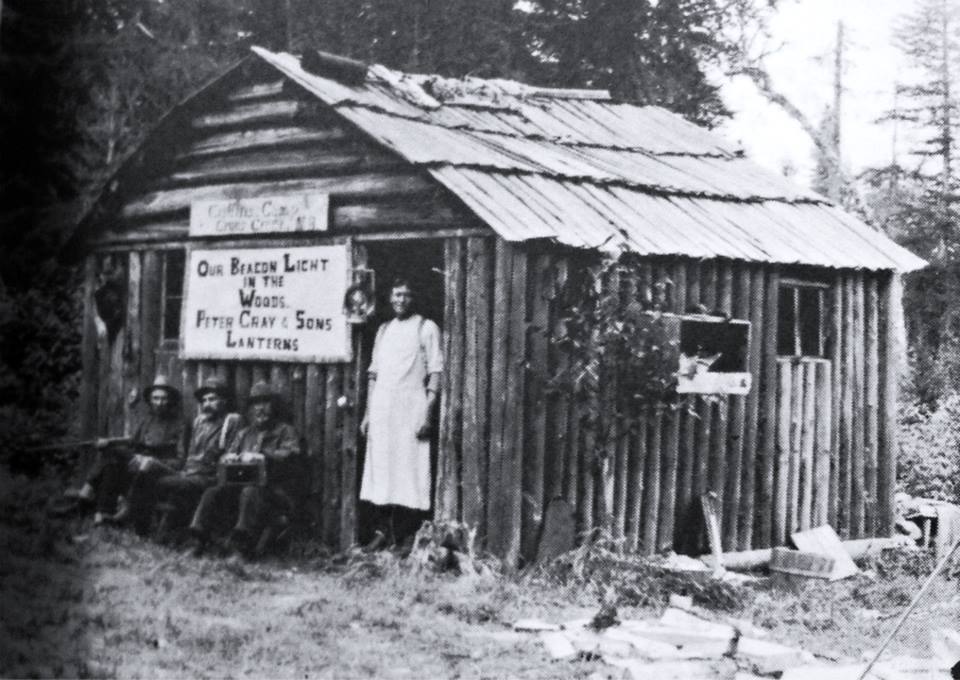
Logging Cook house c. 1900 Photo courtesy of the Our Miramichi Family Heritage FB site – Charles Asoyuf Album
Betsey’s first Miramichi home was humble, made of freshly felled trees and boasting at most a window, door and fireplace. It took a variety of implements, fire irons, utensils, pots and Dutch ovens (aka bake ovens) and lots of know how for Betsey to produce food for her family. Some of the cast iron Betsey depended upon, she might have inherited, since it was common for kitchen ‘movables’ to be included in wills during the colonial period.
Some of the original Jeremiah Lyons land grant of 1809 at Carrol’ls Crossing c.2020. Photo courtesy of Catherine S. Colford on the Family Connections of the Upper Miramichi River Valley, FB site.
By 1809, Betsey’s family had already begun to dabble in the timber industry, harvesting and selling timber, as well as buying and selling timber land, but they did not ignore the other resources the land provided. Food was both foraged and grown, Betsey’s table included fish, game, wild fruits and greens from the natural environment along with buckwheat, oats, barley and potatoes from the land they cleared and farmed.
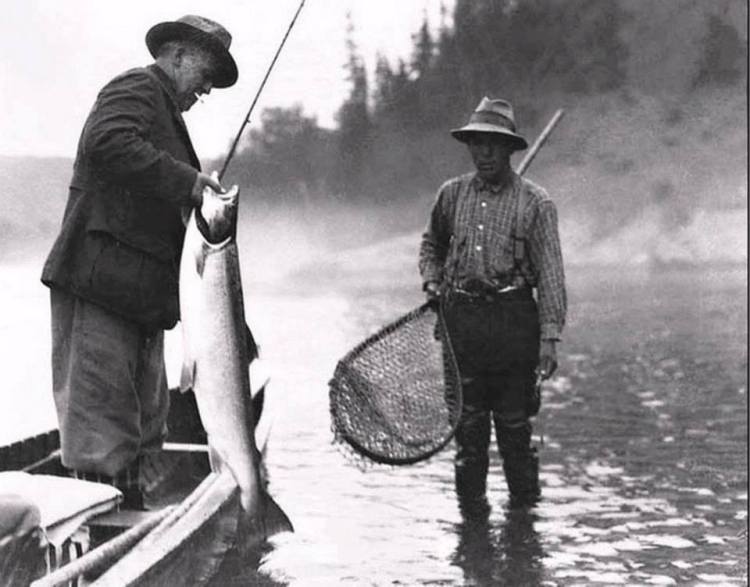
Iconic Atlantic Salmon – The Southwest Miramichi River once teamed with fish, jumping and rolling their way up river to spawn. This photo courtesy of the Our Miramichi Family Heritage FB site – Charles Asoyuf Album
Trade in timber was not the family’s only industry either. When a natural sand stone quarry was discovered on their son Daniel’s adjoining property, they became stone cutters as well as timber harvesters and bosses. For Betsey cash income helped build a permanent wood frame home in a familiar Colonial style, equipped with two fireplaces4. It also meant Betsey was able to purchase familiar food stuffs including spices5 to add variety to their largely monotonous diet.
Fish Stone Quarry at French Fort Cove, Northumberland county, NB. c.1890 Photo courtesy of Our Miramichi Family Heritage FB site – Charles Asoyuf Album
Despite the remoteness of Betsey’s home in Carrolls, ‘industry’ inserted traders and merchants in to the mix, and gave her access to products from all over the world, all be it limited access. Sugar and molasses from the West Indies, rum and corn meal from the United States, indigo from Spain, spices like mace, nutmeg, cinnamon, from the Spice Islands, ginger from South East Asia, were all available provided she had cash (or could arrange credit). Of course access was limited, once or twice a year at most, with cash in hand Jeremiah and their sons would make a trip to the trading centers at the mouth of the river, or to the capital Fredericton to collect supplies for the family.
Interval land along the Southwest Miramichi River at Carrolls Crossing, was included in the land granted to Jeremiah Lyons, 1809. During the spring freshet, interval lands flood as the winter’s snow melt and fills the steep valley. Photo courtesy of Catherine S. Colford on the Family Connections of the Upper Miramichi River Valley, FB site.
For much of the year the absence of roads thru the dense forest meant several days journey, by canoe and portage. In spring however things changed, the melting snow and resulting rise in water levels made the Miramichi river system navigable. The Timber which they had cut and yarded was ‘driven’ down river to the port and awaiting ships. The log drive provided opportunity to pick up a bit of spice which could be tucked in to a pocket for the trip home, but only as money or credit allowed.
Betsey used her stash of spices, dried fruits, wheat flour and other value ingredients to maximum effect, carefully assuring a reserve for the Christmas celebration. In colonial New Brunswick, there was neither the tradition nor capacity for lavish celebrations even at Christmas. The one exception was food, foods too ‘dear’ for daily consumption, were used to make the Christmas season.
What Betsey prepared depended upon what she had available, but it had also to be manageable over a fire. Feast food like pies and cakes required Betsey to use her Dutch Oven (aka bakeoven). The lidded cast iron pot with legs was large enough to accommodate a second pot or pan. Betsey would strategically place the bake oven in to the fire, using the additional insulation it provided the smaller vessel which contained a pie, tart or a cake, to create an oven effect. Betsey’s supplies might well extend to treats like blueberry pie(reconstituted) and mincemeat tarts, but only after the Christmas pudding6 was complete. For plum pudding Betsey’s dutch oven was used as a steam bath, filled with water to surround and moisten the fruit pudding as it cooked.
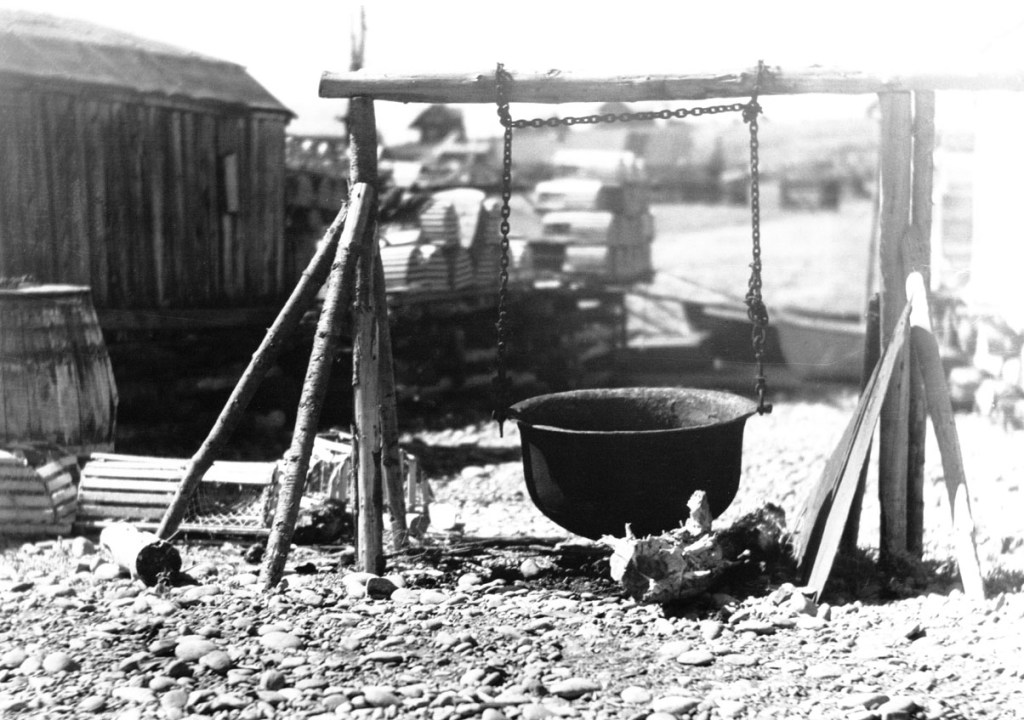
Large cast iron pot on an outside hearth, Gabarus, NS c.1930 Photo courtesy of the NS Archives – W.R. MacAskill NS Archives 1985-452 #4183.
Eventually, the cast iron pots no longer needed legs or hanging handles, fire irons and cranes were removed from the kitchen as cast iron cook stoves appeared in their place. The old style cast iron pots were often modified for use on top of the cookstove. Even the larger pots and bake ovens did not go far, despite their drop in value.
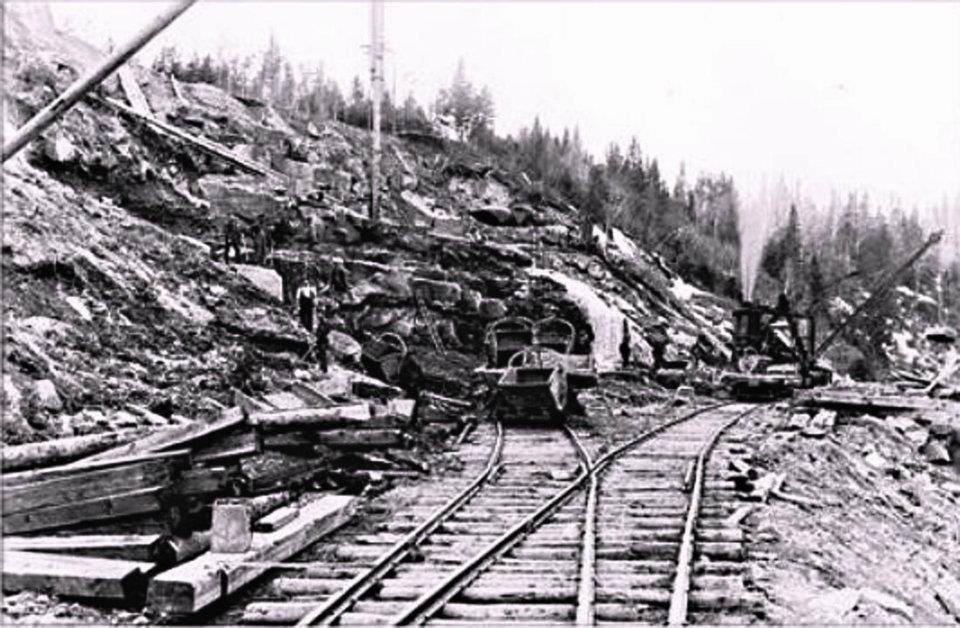
Over time change effected industry too, the timber trade became lumber trade, ships made and sailed out of foreign ports, were replaced with those built in New Brunswick. Eventually, the railway arrived meaning more jobs and local mills producing every thing from shingles to windows. Despite these changes, the industry still demanded a large work force to fell, deliver and process the logs in to lumber.
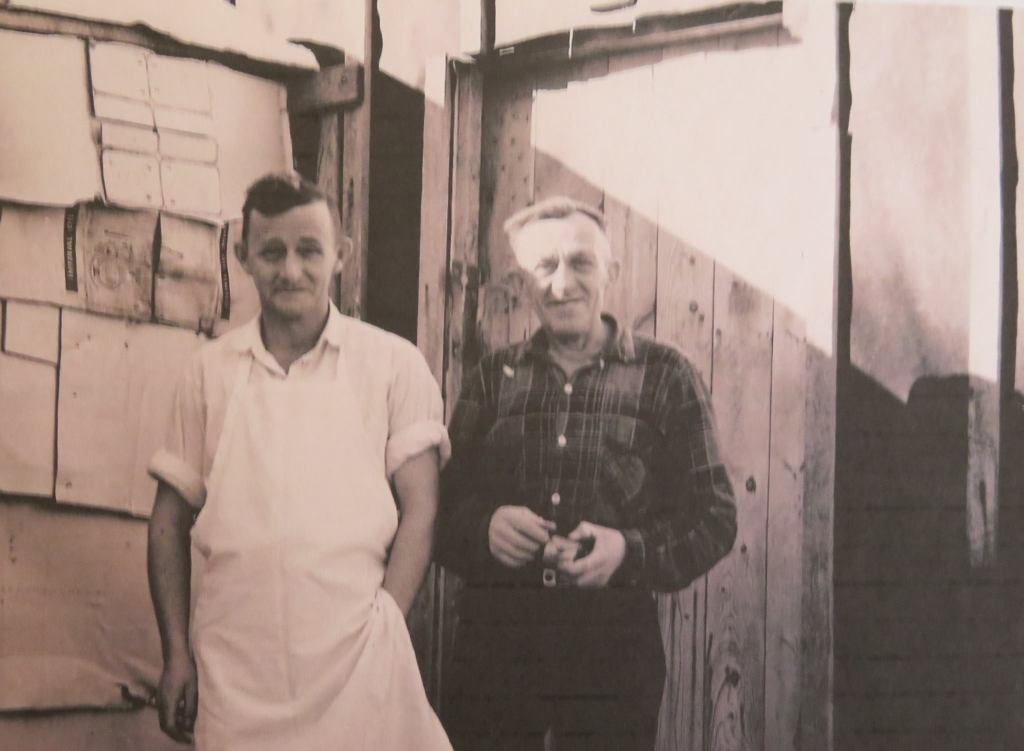
Mill Cook (in white) Bernard Lyons s/o Hollingworth Tully Lyons and Florence O’Donnell Lyons with Tim Story. C. 1947 Photo courtesy of Manny Stewart and the Family Connections of the Upper Miramichi River Valley Fb Site.
By the 1930’s and 40’s when Dad and his brothers were entering the work force, options were few, camp life or mill life. Since Grandfather Tully could not supply them with horses, becoming a teamster was out of the question, that left cooking. Only the oldest Marple avoided a career in the cookhouse, although Dad spent only a short but memorable period as a cookie, before moving on to harvesting and eventually mill work before and for a period after the war.
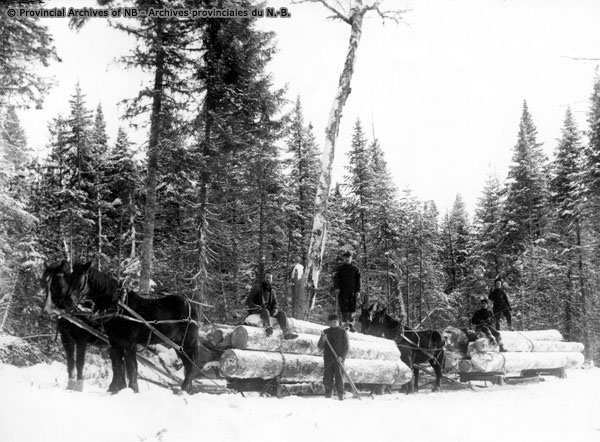
Two teams hauling logs to the yard. c. 1900 Photo courtesy of the PNAB ERB, Isaac Photographs # P11-75.
Lumber camps were hard places, requiring hours of physically demanding work. As Dad loved to point out, working in the cookhouse ‘looked’ like easier work, but it was just a ‘different kind of hard’ work. What his brothers Gerald, Bernard (Bun) and Leonard (Len) avoided in the way of the physical demands of felling, and yarding trees was replaced with long hours spent toiling over a hot fire, driven by deadlines, balancing likes and demands of both bosses and harvesters. The harvest crew worked from just after sunrise to near dark, with meal breaks mid morning, and again at noon, before heading back to camp for supper. Four meals each day were prepared and delivered on time and as necessary on location. The Cook who had to brew the coffee and prepare breakfast before the men rolled out of their bunks for the day, was woken by his cookie who had already built and lit the fire, every man in camp did their part.
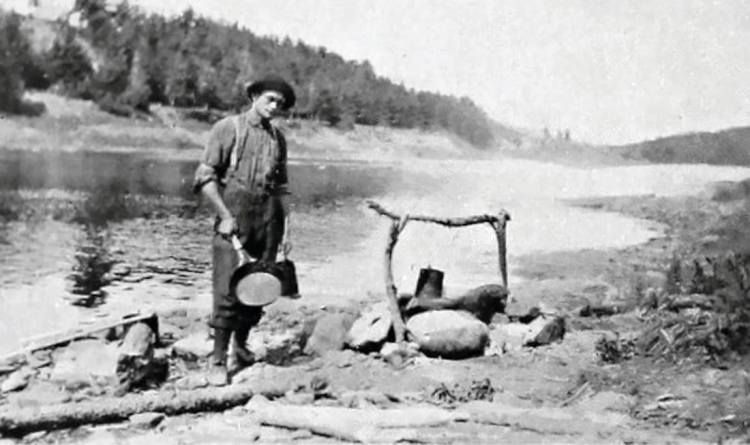
Riverside camp site Photo courtesy of Our Miramichi Family Heritage FB site – Charles Asoyuf Album
As a Cookie, Dad tended fires, peeled potatoes, washed, cleaned and prepared basic foods. Nothing was more ‘basic’ in the diet of lumbermen than baked beans. All day everyday beans were in various stages of preparation. Cheap, high in protein, and carbohydrate, beans played an essential part in fueling the industry for more than 100 years. In camp or on the drive, beans were placed before the crew of more than 20 hungry men at every meal. With pancakes and biscuits for breakfast, with stew at lunch and with meat and potatoes at supper, beans appeared in their huge cast iron Dutch oven. Of course there were also pans of cakes and cookies, biscuits, and bread, because the cookhouse of a the 1940’s had a stove with an oven. So why the continued use of the heavy cast iron?
Camp cooks did not spend time preparing for Christmas. There was no need, weather permitting the men and horses, harvesters, cooks and walking bosses returned home for the holiday season. After Christmas, the harvest would continue until the snow began to melt and the focus became getting the yarded timber to market. The drive presented challenges to everyone, the water was cold, snow, ice and mud combined to make an already perilous job even riskier still. It was no easy feat to produce and deliver sustenance to the crew while afforded the conveniences of a cookhouse, the cookscow was whole new challenge and those old cast iron Dutch ovens played their part.
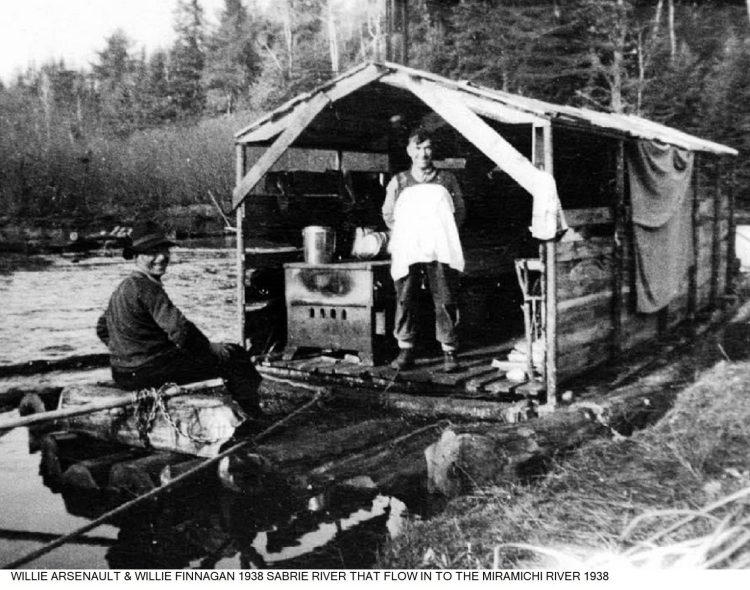
If the logging camp cookhouse was a rough and tumble place, a cook scow was even more so. A cooks scow consisted of a rudimentary cookstove precariously perched on a raft of timber, and covered by a make shift roof and walls comprised in part by canvas. The scow would be pulled along by horses, delivering the cook to the next camp site in time to prepare and deliver the next meal. The cast iron dutch oven filled with beans would stay warm for hours, and could be hung over an open fire when necessary. Although heavy and cumbersome they were durable enough to take the abuse the cookhouse and cookscow entailed.
A Sabbies River(a tributary of the Southwest Miramichi) Cook scow c. 1938 Photo courtesy of Our Miramichi Family Heritage FB site – Charles Asoyuf Album
I make no claim about Betsey’s cast iron being used in her family’s logging operations. There is no doubt that logging and wood camps played an important role in supporting her children, grandchildren, and great grandchildren. Even today many of Betsey’s descendants make their living from harvesting timber. So who was Betsey? The answer is we really don’t know much about her origins. We know her husband Jeremiah was born in Colonial New York, and that he served with the New York Volunteers a Loyalist unit during the Revolutionary war. Hollingworth Tully Lyons descended from two of Betsey’s sons, Joseph on his mother’s side and David on his paternal line. Patterns of marriage and intermarriage with other early Miramichi families assures a bit of Betsey lives on in a large number of us with roots in Northumberland county, the Upper Miramichi River Valley particularly.
My Mother’s cookbook’s Plum Pudding
Ingredients: 1 pint of dried bread crumbs 1 c. all purpose flour 1 c. brown sugar 1 pound seeded raisins 2 c. mixed fruit 2 c. cherries 1 pound dates 1/2 pound of raw suet 1 c. molasses 1 tsp soda 2 Tbsp hot water 2 well beaten eggs at room temp Juice of 1 lemon Method 1. Roll and sift 1 pint of dried bread crumbs, place in a large bowl; 2. Add flour, sugar, fruit, cherries, dates, suet, molasses; 3. Dissolve soda in hot water and add to fruit mix; 4. Add the eggs and lemon juice; 5. Line a heat proof bowl or mold with 3 layers of cheese cloth fill with pudding; 6. Place the bowl in a large Dutch oven; 7. Place Dutch oven in a 280 degree oven, fill the pan with boiling water about 1/2 way up the side of the bowl, cover with aluminum foil and the lid to seal the steam inside, Steam 3 hours, add more water as needed.
References and Sources: 1. Bake – oven also known as a Dutch oven, was a large lidded cast iron pot, with legs which permitted it to be set directly in a fire. The Dutch ovens we know today are very different, they don’t have legs, and are much smaller. Cast Iron Dutch ovens today are almost always lined with ceramic. 2. Seasoning cast iron is required if the cast iron is not lined with ceramic and has not been seasoned. Seasoning involves building up a film of oil on the interior of the pot / pan which is cured with high heat. After use cleaning involves washing the pot/pan, and retreating it with oil and time in a hot oven. 3. Exactly when Jeremiah and Betsey married is as yet unknown. Jeremiah and his wife Elizabeth sold the land he had been granted on the Keswick River in 1787. Since most of the older children were born in the Nashwaak River Valley, York county, NB, it is probable they lived on property owned by Jeremiah’s brother Daniel Lyon in Penniac, NB until relocating to Northumberland county. The brief two years, Jeremiah owned the grant in Keswick represents the only period of land ownership until 1809, the pattern of displacement appears to have haunted the refugee family. 4. The foundations of the first wood framed house on the land grant in Carroll’s Crossing, were integrated into a barn after the house was replaced about 1900. The foundations were removed later and revealed two chimney’s at either end of the house, remeniscent of colonial style homes of the period. 5. Spices and spice routes: https://en.unesco.org/silkroad/content/what-are-spice-routes 6. Christmas Pudding – By 1800 even those with Puritan heritage had begun to celebrate Christmas once again, Plum Pudding and/or its cousin the Christmas Cake (dark fruit cake) was found in most English speaking homes in North America as well as Britain.
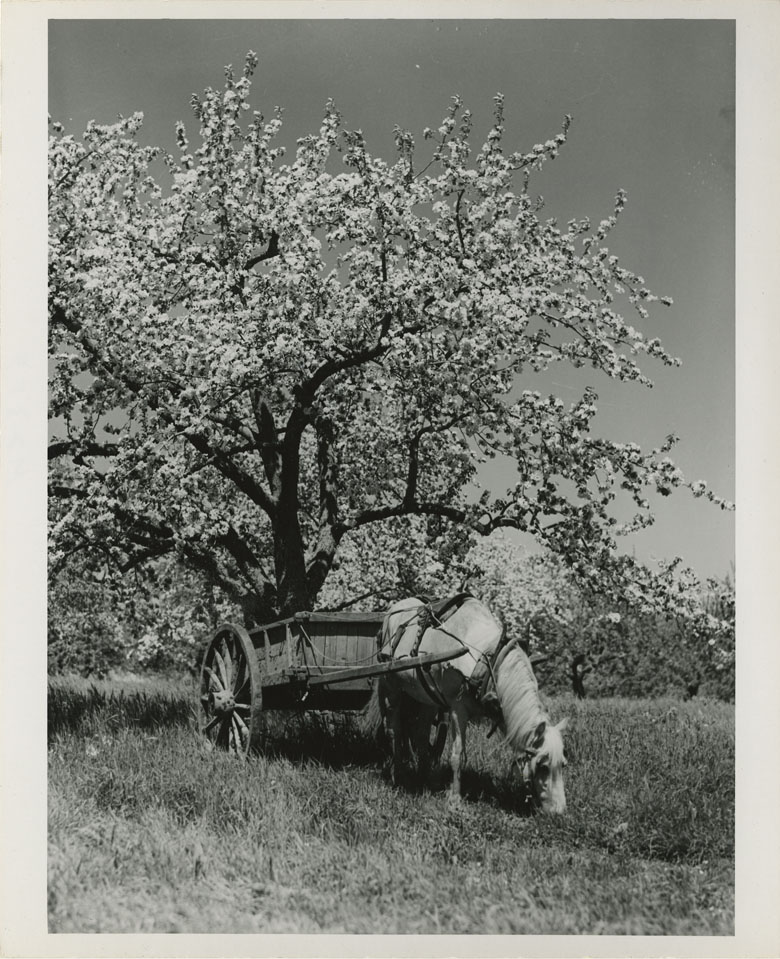
A quick drive thru rural areas of Canada’s Maritime provinces reveals countless abandoned homesteads. Some with remnants of buildings, houses, barns, etc. others are marked by trees, apple trees. Despite filling the spring air with their glorious blossoms these wild apples are mostly, small, sour, and unpalatable.
Photo courtesy of Nova Scotia Archives Photographic Collection c.1950 Image #201603573
You could be forgiven for thinking apples are native to North America, but they aren’t, nor are they native to Europe. Apples originate in Asia, and owe their worldwide prevalence to the Silk/Spice trade routes1, although some say we owe our North American apples to cider.
Apples had an important presence in Abigail Lyon’s life. The daughter of a prosperous farming family in colonial Connecticut, Abigail grew up picking, eating and processing apples. Abigail’s father John raised a variety of crops and livestock, including apples and other tree fruit. Some of the apples Abigail helped to pick, she accompanied to the kitchen for preserving, drying, or made into apple sauce and apple butter. The majority of the apples, those with poor texture, taste and lacking the sweetness of eating apples, were fermented into apple cider and apple cider vinegar2.
Mary Rose Wilkins knew apples too, although in her early years in the newly established Halifax, Nova Scotia her father Walter, purchased them for both his family and his business. The apples and apple cider arrived packed in barrels from New England but not from nearby Acadie.
Old French Apple Trees – Photo courtesy of the Clara Dennis Collection at the Nova Scotia Archives #630
Mary Rose, like most children and adults elsewhere in Nova Scotia; in Virginia; Acadie and New England, drank apple cider with most meals, even breakfast. Loosing her mother at 5 years old, did not hamper Mary Rose learning the skills she would need as a wife and mother. The raids by Mi’kmaq and Acadians3 which occurred with tragic frequency, despite fortifications and military guards meant Mary spent much of her time with the women of the household, watching, helping and learning. Fall was especially busy with lots for Mary Rose to absorb, about important winter preparations, harvesting, preserving, and processing food including apples. By the time of her marriage to Alexander MacKenzie, 16 year old Mary Rose was well familiar with household duties, although not with farm life.
Mary Rose arrived at Stoney Beach4 on the Annapolis river about 1765, 10 years after Acadians had been forced from their land. Only foundations, root cellars and neglected orchards remained of the once vibrant and productive community. Mary Rose and Alexander MacKenzie claimed and eventually built a farm on former Acadian lands.
Farmer plowing among apple trees nearing Canning, NS – Photo courtesy of the NS Archives Image NSIS 6853.
Fortunately apple trees are relatively long lived, maturing around 4 years and remaining productive for 20 or more years, even when neglected. In the early years on the farm Mary Rose and Alexander depended upon the area’s natural bounty of fish, game, greens, and berries but also upon apples trees which had been planted and tended by Acadian farmers. Dykes which had been damaged in storms after the expulsion of Acadians had to be repaired and fertile farm land returned to production. Eventually Alexander and Mary Rose renewed the orchards replacing older trees with younger and more productive ones. Apples, and apple cider along with a range of fruits, vegetables and other farm produce from the region went to market in Halifax, Newfoundland, New England, and eventually to troops and refugees of the Revolutionary war.
In June 1775, the force of political dissent which had turned neighbours and kin against each arrived in Redding Connecticut. Abigail’s father John’s political support of the British Crown saw his land seized and a mob of his neighbours bent on executing him, sent him fleeing for his life. For Abigail, her siblings, and their Mother Hepzibah Betts Lyon their once comfortable life and social status were gone, replaced by threats and insecurity.
Picking apples ca. 1950 Photo courtesy of the Nova Scotia Archives
It would be two years before the family were able to escape Redding, and join John in Lloyds Neck, Long Island, NY where he was garrisoned. The refugee settlement which had grown up around the Lloyds Neck garrison meant improved security, especially since John was available to remove some of the burden of care his wife had born alone.
Strategic importance to supply routes and its natural defenses, made Lloyds Neck5 a logical place for the British military to headquarter. Lloyds Neck was also blessed with reliable sources of food. The waters of Long Island sound provided fresh fish, and shell fish, the surrounding land was rich with wild game, productive wheat fields and farm produce including berries and fruits, pears, plums and apples. Abigail and her siblings helped with gathering food, harvesting, and foraging, but also gathering fire wood, and hundreds of other tasks life now required, all under the watchful eyes of adults.
‘Mother and Children’ Emma Mae Blackmore and her children c.1900 Photo courtesy of Our Miramichi Heritage family.
Life was far from normal, living in tents during summer, sheltering in any available structure in winter, windowless barns, sheds even military structures. The Lloyds Neck refugees did all they could to maintain normalcy, including arranging school for their children. By attending school Abigail and her siblings were able to continue their education, and were provided some distraction from the unrelenting fear of rebel attack. The constant vigilance life in a war time refugee camp required was eased during those hours at school, eased for both the children and Hepzibah.
In the Laboratory – a lesson on apples at McDonald Consolidated School, Kingston, Kings County, NB ca. 1900 Photo courtesy of the
Threats of violence and disease were unrelenting company for the entire 6 years Abigail remained in Lloyd’s Neck. Sadly, it took a tragic toll on the young family, Abigail’s baby brother George, who had been born in the immediate months following his father’s flight from Redding, died at Lloyds Neck, NY in 1780.
In April 1783, with the hope of a crown victory long since gone, the Lyon family along with other Lloyd’s Neck Loyalists embarked the ship Union for Nova Scotia, several weeks later they arrived at Parr town at the mouth of the Saint John River. Eventually, they and a sizable number of former Loyalist refugees made their way to the land they had been granted at what would become known as the Kingston Peninsula, founding the first Loyalist settlement in Nova Scotia (New Brunswick).
The Kingston Peninsula, a fertile isthmus of land between the St John River and the Kennebecasis River represented opportunity but also struggle and hardship. There were houses to build, land to cultivate and apple seeds to plant…
Lower Kingston, Kings County, New Brunswick. c. 1905 Photo courtesy of the Provincial Archives of New Brunswick Image # P61-184.
Abigail and Mary Rose drank and made apple cider, but they also harvested and prepared apples, those with a sweet taste, and good texture, were made into condiments and desserts for their families. Apple sauce, apple butter, pies, tarts, dumplings and brown bettys all made appearance. The My Mother’s Cookbooks recipe for Apple brown betty is a healthier version than the traditional flour, butter, sugar crumb topping. Traditional betty recipes eventually, because of the lack of availability of wheat flour, became ‘crisps’ with the substitution of oats… Abigail and Mary Rose used what they had available, so this combination recipe is close to their experience.
My Mother’s Cookbooks
Apple Brown Betty:
Ingredients: 8 tart apples, remove the core, peel and slice 1/2 c raisins (optional) 1/2 c honey 1/2 c apple cider, apple juice, apple tea or water 1/4 c brown sugar 3 Tbsp all purpose flour 1 tsp cinnamon Topping: 3/4 c rolled oats 1/2 c whole wheat flour 1/4 c honey 4 Tbsp butter, margarine or lard Method: 1) Preheat oven to 350 degrees F; 2) Combine filling ingredients in a bowl, toss to combine and place in a greased 7″ x 11″ baking pan; 3) Combine dry ingredients in a bowl, cut in fat, sprinkle mixture over the apples and bake for 45-50 minutes.
Apple Cider vinegar – Apple cider has long been viewed by historians as the reason why new settlers to North America brought apple seeds with them from Europe. It is true that fermented drinking cider was already well entrenched in European society by the mid 1600s and it took until prohibition to take cider out of daily use. Apple cider was also needed to make apple cider vinegar, an additional step of fermentation and the cider became vinegar. Apple cider vinegar had many uses, as a condiment, a health remedy, a cleaning agent and most importantly to preserve food, vegetables particularly.
The British Crown’s decision to found a fortified settlement in Nova Scotia was unilateral, driven by competition with France, and severed a peace treaty with Mi’kmaq peoples. Raids by Mi’kmaq and their allies the Acadians but supplied out of Louisbourg by the French, were met with retaliation and escalation. The conflict is known as Father Le Loutre’s War. Who was Father LeLoutre? http://www.biographi.ca/en/bio/le_loutre_jean_louis_4F.html
Stoney Beach, Kings County, Nova Scotia is located near Port Royal on the Annapolis River, about 3 km from Melanson’s Settlement. Melanson’s Settlement was settled by Acadians Charles Melanson and his wife Marie Dugas about 1664. The community of Melanson and related families was a sizable settlement until the forced expulsion from their lands in 1755. For more information on Charles and Marie Melanson: https://www.acadian.org/genealogy/families/melanson/
Lloyds Neck, Long Island, New York was home to one of the largest Loyalist refuge camps in New York. Part of the area is now a state park:https://parks.ny.gov/parks/caumsett
the benefits and techniques of collecting and reusing bacon fat.
Perkins house Liverpool, NS Photo courtesy of the Nova Scotia Archives image # NSIS 11439
It wasn’t that Fanny was mean or miserly she just couldn’t afford to be wasteful. For Fanny wasting food now, meant going hungry later. Fanny had the ‘know how’ to assure maximum benefit from food which entered her kitchen. She didn’t really have to learn the skills, she absorbed them, from the experienced women around her.
Of course Fanny had to adapt and change as new foods, new tools and techniques arrived, which they did regularly. Some old habits she cast aside, but some habits Fanny never lost. Tried and true, she kept the techniques which continued to make sense even with modern alternatives. Sure some of the techniques required an investment in time, but Fanny continued to use them because they delivered superior flavour or other benefits.
Buckley Family Nova Scotia Archives -1985-386#192 c. 1960
I think when it comes to food resources Fanny’s frugality, makes more than a little sense, especially today. With the cost of food rising beyond the budgets of many, the challenges of a changing plant and the rising human famine associated, it is the least we can do. A little more frugality in our kitchens will help keep money in our pockets, deliver benefits in food security, minimize negative social and environmental impacts of food waste.
Here is the first of Fanny’s Frugal Food Hacks…Fanny’s Fat Fancy!
I don’t use a lot of bacon, it is not the healthiest choice and since the price has increased more than 30% in recent months it’s less affordable. When I do use bacon I make sure nothing gets wasted. The practice of discarding fat and purchasing it in other forms is neither sustainable nor frugal, so I look to Fanny to guide me. Her advice is clear reuse don’t waste.
Photo courtesy of Our Miramichi Heritage Family – Child and sows, c. 1940.
Of course Fanny didn’t worry about fat clogged pipes of either variety. To Fanny, fat had real value and was not wasted. Although butter was the preferred fat for cooking and baking, it wasn’t always available, and did not keep as well as its most common alternative, lard. In the early years Fanny helped her mother render a variety of animal fats, mostly pork fat. Animal fats were important because it was used for baking and cooking but also for making candles and soap.
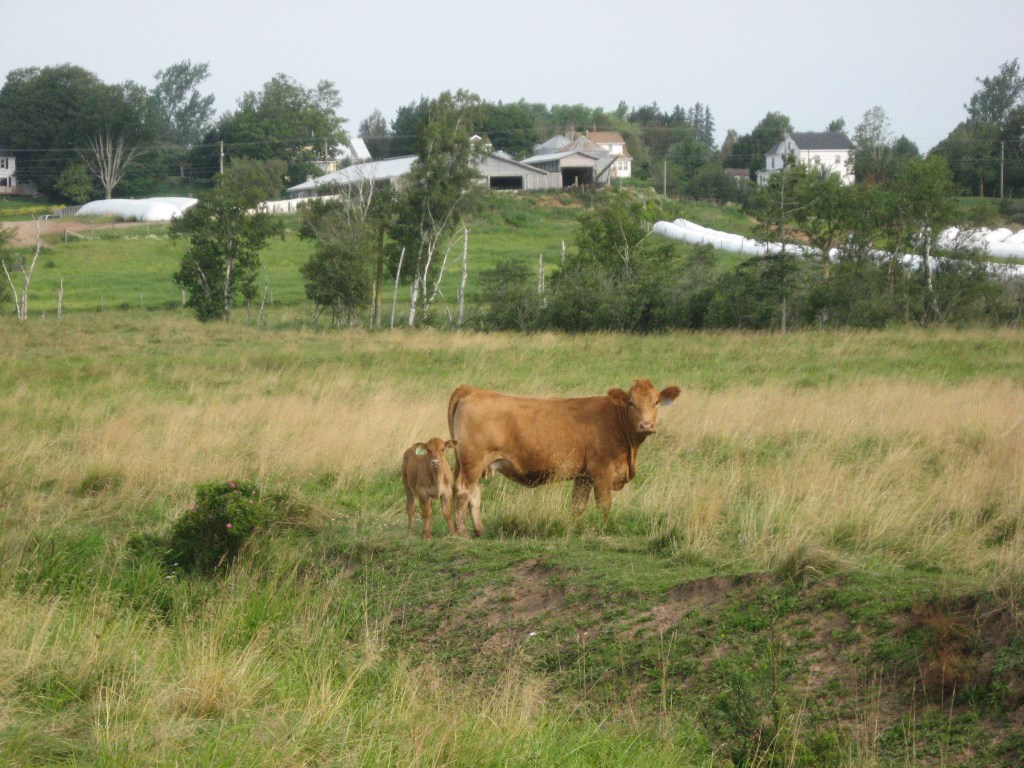
Mama cow and her baby, in Middle Sackville, NB c. 2021. A single cow can not produce milk 12 months of the year. Photo: F. Elizabeth Morrison
For cooking and baking, Fanny preferred butter’s taste over the less intense flavour of lard. Lard had less taste but it’s other properties delivered differences in texture too. Fanny used a combination of lard and butter (when she had it) in her pastry, as does the My Mother’s Cookbook pastry recipe. The higher melting point of lard, when a mix of butter and lard is used creates both a tender and flaky crust. So Fanny reserved some fats for specific purposes, because of their flavour or other beneficial properties.
Of course there was Chicken fat, duck and goose fat, today these fats continue to be used in traditional cultural cuisine, i.e. Duck fat in French cooking and Schmaltz in Jewish cuisine. I can say with some confidence Fanny didn’t use goose or duck grease in fancy preparations like duck comfit. Goose grease was saved for health remedies. Fanny used what she had, so duck grease, chicken fat, beef tallow and lard were all used to prepare and preserve food. Although Fanny probably reserved the silky and flavourful duck grease and chicken fat for her ‘potted meats’ when she could.
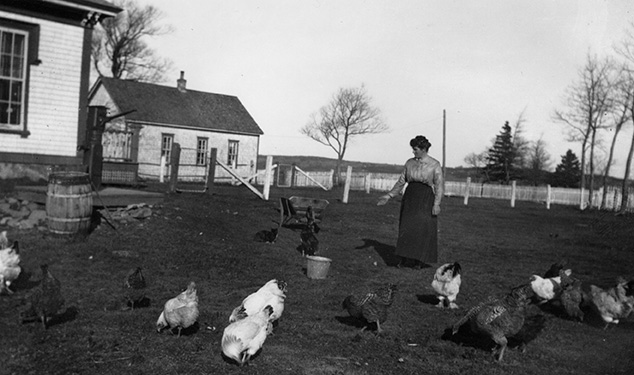
Miramichi Woman and Chickens c. 1890 Photo courtesy of Our Miramichi Heritage Family Facebook site.
Fanny used unrendered animal fat in many recipes too. Unrendered pork fat, both salted and fresh, was found swimming in molasses and bean filled crocks across New England and Atlantic Canada, including Fanny’s. I still prefer to use fresh pork in my Saturday night baked beans. Fanny used suet, unrendered beef fat in rich holiday puddings and pie fillings. My Mother’s Cookbooks plum pudding and mincemeat recipes both call for suet.
Fresh pork, beans and molasses, in a traditional (1940s)bean crock. Photo – F. Elizabeth Morrison. 2021.
Fanny eventually stopped rendering her own animal fat, preferring instead to purchase soap and the much cheaper, machine moulded candles. However, collecting and reusing bacon fat Fanny continued, because it brought important flavour to her table and delivered savings to her pocket book, it can do the same for you.
Fanny’s Frugal Food Hack for collecting and reusing Bacon grease:
Cooking bacon, rendering, and storing Bacon grease: 1. Place bacon in a single layer in a large frying pan, cover the bacon with cold water; 2. Place the frying pan over low/medium heat and bring to a slow boil, reduce heat to a low simmer; 3. Once the water has evaporated, allow the bacon to crisp to your preference; 4. Remove the bacon from the pan and permit the fat to cool about 4 minutes; 5. Strain the bacon grease through a fine meshed strainer filter in to a clean glass Jar and refrigerate.
Reusing Bacon fat: 1. Bacon fat has a higher smoke point (400oF) than butter, it can be used to replace other fats for frying, and roasting, everything from burgers to veggies. 2. Replacing a portion of butter and other lower smoke point fats with bacon fat can help prevent other fats from burning when frying. 3. Replace olive and other oils with bacon fat in salad dressings. i.e. Caesar salad dressing. 4. Solidified bacon grease can be used to replace up to 75% of butter / lard in savory baking. i.e. Scones, corn bread, biscuits.
Bonus Recipe!
My Mother’s Cookbooks (Bacon grease) Cornmeal muffins :
Ingredients: 3/4 c. yellow fine cornmeal 3/4 c. plain yogurt 1/2 c. milk 1 c. all purpose flour 1/3 c. granulated sugar 1 tbsp baking powder 1 egg 2 Tbsp vegetable oil, all oil add 1/4 tsp salt. 2 Tbsp cold bacon grease
Instructions: 1. Preheat the oven to 400oF 2. Combine cornmeal, yogurt and milk together in a bowl, set aside to soak; 3. In a medium bowl sift together the flour, sugar and baking powder; 4. Using a pastry blender, cut the oil and bacon fat in to the dry ingredients to pea sized pieces; 5. Add cornmeal mixture and fold to combine, assuring no dry ingredients remain, but avoid overmixing which will cause the muffins to toughen; 6. Spray muffin tin with cooking spray or line with papers; 7. Fill the tins (3/4 full), place in the upper middle rack of the oven: 8. Bake until the muffins springs back to the soft touch of your finger, and is just slightly browned on top.
If you were in our home at mealtime you were invited to stay…and many folks did. It was the way in Mum’s family home growing up in rural New Brunswick, and it was a practice she and my father honored the whole of their lives.
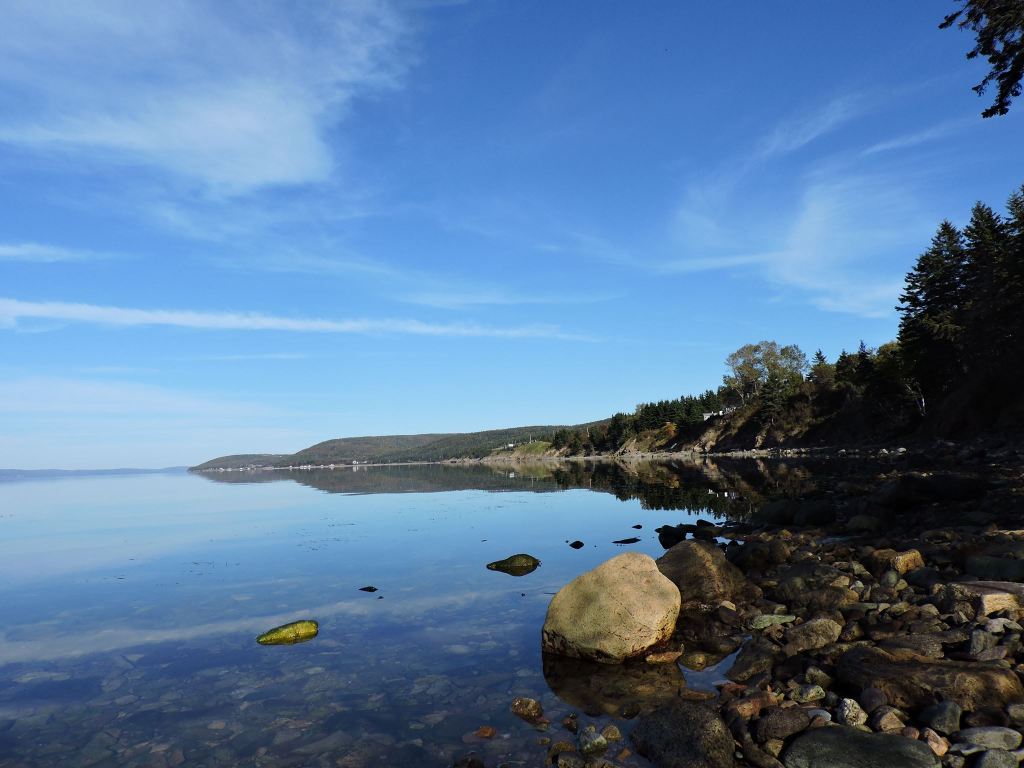
Pitupaq – The Mi’Kmaq name for the Bra D’Or Lakes meaning “the long salt water” refers to the brackish water of the lakes. c. 2017
Saying that everyone is welcome at my table is one thing, delivering a tasty and nutritious meal for unknown number is another entirely. Mum depended upon stretchable one pot meals, soups, stews, and casserole, especially when visitors arrived.
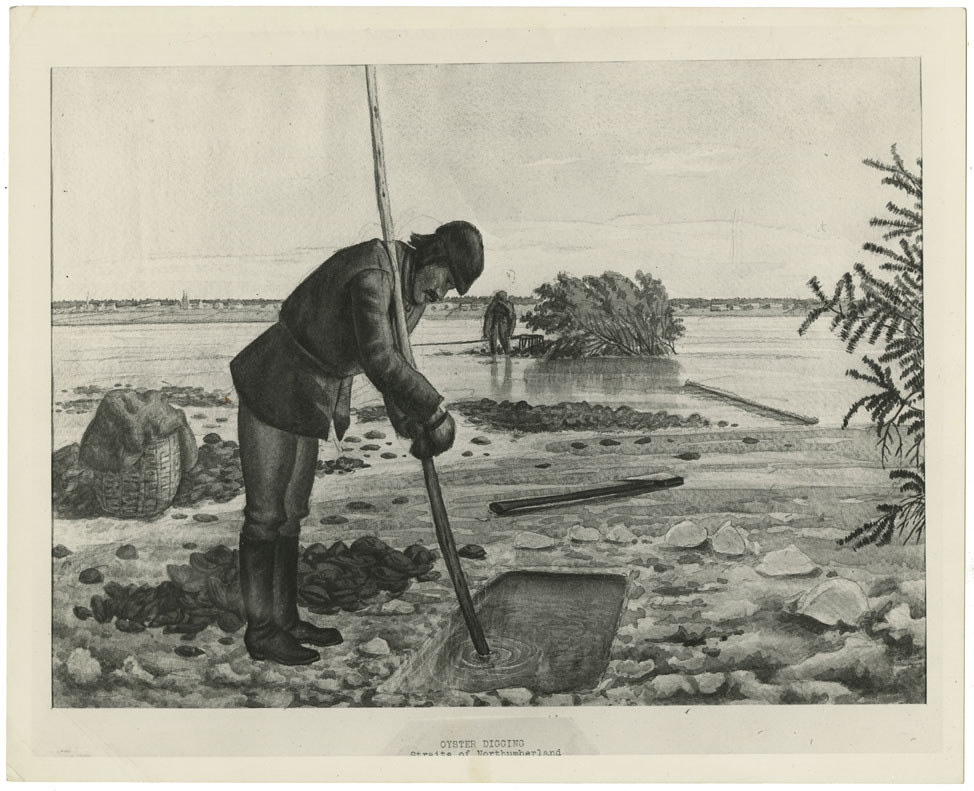
William Hind stetch- Oyster Fishing on the Northumberland strait. Image courtesy of the PANB.
One of the dishes she relied on is a Maritime and New England tradition, chowder. Mum’s chowder, usually clam but occasionally, seafood (mix of fish and shellfish) would be accompanied by a pan of fresh biscuits or a loaf of her homemade bread. I recall vividly the first time I ate clam chowder, it was in September 1968, I was 7 years old, it was also the first time I dug clams1.
Jina Miller and her sister with pails of clams, Bathurst, ca. 1930 Photo courtesy of the Provincial Archives of New Brunswick Image #P61-208
It would be easy to assume everyone in the Maritime provinces or New England for that matter has equal access to good fish and seafood but it is not so. Those who live in the immediate vicinity of the sea shore have a huge seasonal advantage, one which endures despite freezer trawlers and overnight delivery.
When Rebecca MacDougall2, Nancy Ann McDougald and Màiri McAdam’s families left Scotland for St John’s island3 prior to 1800, like most others from the Highlands and Western Isles they were familiar with living near the sea. Some of the setters had been farmers others were sheep herders but they expected to farm in their new North American home.
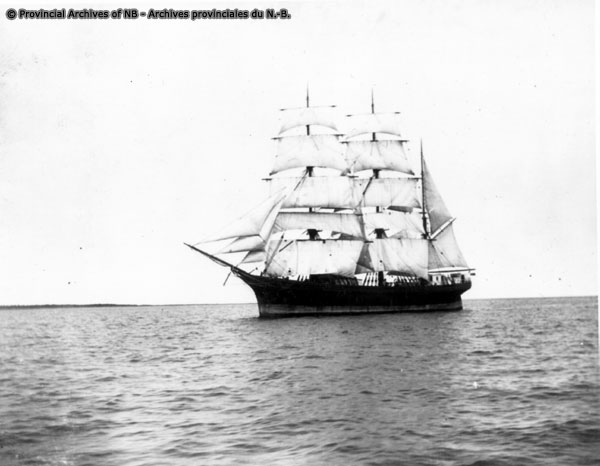
The Norman, Miramichi Bay c.1894 Photo courtesy of the Provincial Archives of New Brunswick Miramichi Historical Society collection image # P204-241
The first sizable group of Scots to immigrate to what would become Prince Edward Island about 1770, were joining settlements of Mi’Kmaq, a small group of Acadians and a smattering of other nationalities. The only uninhabited shelter on the island were those abandoned by Acadians when they were forced to flee, some 20 years earlier. Despite the influence of the ocean their new home was a very different landscape from what they knew at home, trees stretched from hill top to seashore, there were no roads, and no basic services.
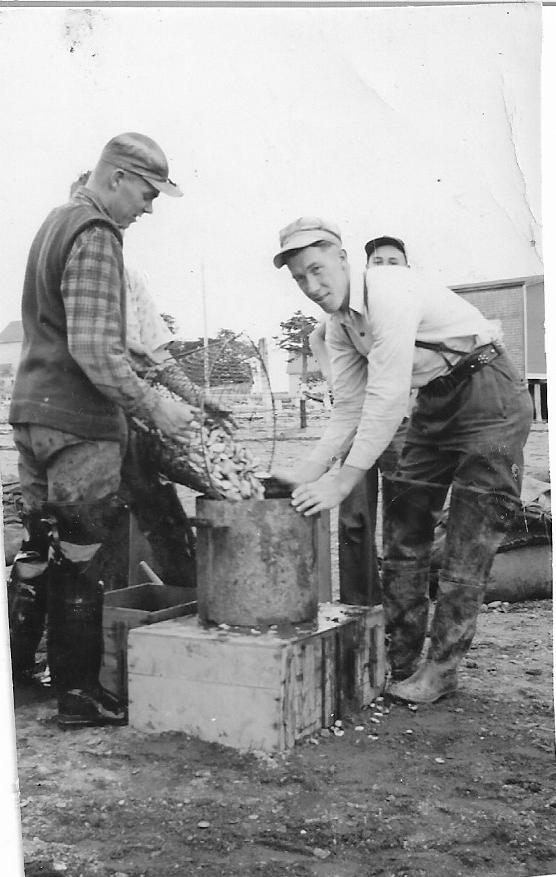
Commercial harvest of soft shelled clams at Advocate Harbour, Nova Scotia c. 1950 Courtesy of Frene Lunn.
Rebecca’s family were among a group of protestant Scots from Argyle Scotland4 who settled on Malpeque bay5 about 1770. The Argyle settlers learned very early how precarious life in St John Island was, while on shore before they had been able to land their supplies a storm destroyed the ship and all of their belongings. The only thing which stood between them and death from starvation and exposure were the natural resources surrounding them and the generosity of the Mi’kmaq and Acadians who sheltered them, shared supplies, and helped the settlers become familiar with living, hunting and foraging for food in a new environment.
Cooking the catch? Commercial harvest of soft shelled clams at Advocate Harbour, Nova Scotia c. 1950 Courtesy of Frene Lunn.
Laird MacDonald Of Glenalladale’s6 decision to acquire land on St John’s island, hire the Brig Alexander, fill it with supplies and settlers of the Western Highlands & Isles was inspired by upheaval. The previous half century or more the political and social structures of Scottish culture had been eroded as the British Crown quashed objection to union.
By 1771 the people of the Highlands had endured years of punishment for their support of a Scottish king. The forced conversion of Roman Catholic Gaels by protestant Landlords is associated with Glenaladale’s decision but it may be a tale borrowed from other locales, regardless McDonald recognized the need to improve life and opportunities for himself and others.
Laird MacDonald envisioned a return to more prosperous times through a familiar arrangement. Settlers would pay for their passage either directly or by indenturing themselves to McDonald. Once they arrived in St John Island they became farm tenants on his land. The fulfillment of McDonald’s property arrangement required him to settle the land and remit taxes from the lease of the lands to the Crown.
Ultimately, the planned community did not pan out quite as McDonald envisioned, the new world offered greater challenge, freedom and opportunity than anyone had anticipated. A core group of tenants did arrange long term leases with McDonald, others abandoned tenancy for good, preferring to purchase land or seek a land grant in other areas of the Maritimes. Many became farmers, others depended upon the sea for their livelihood.
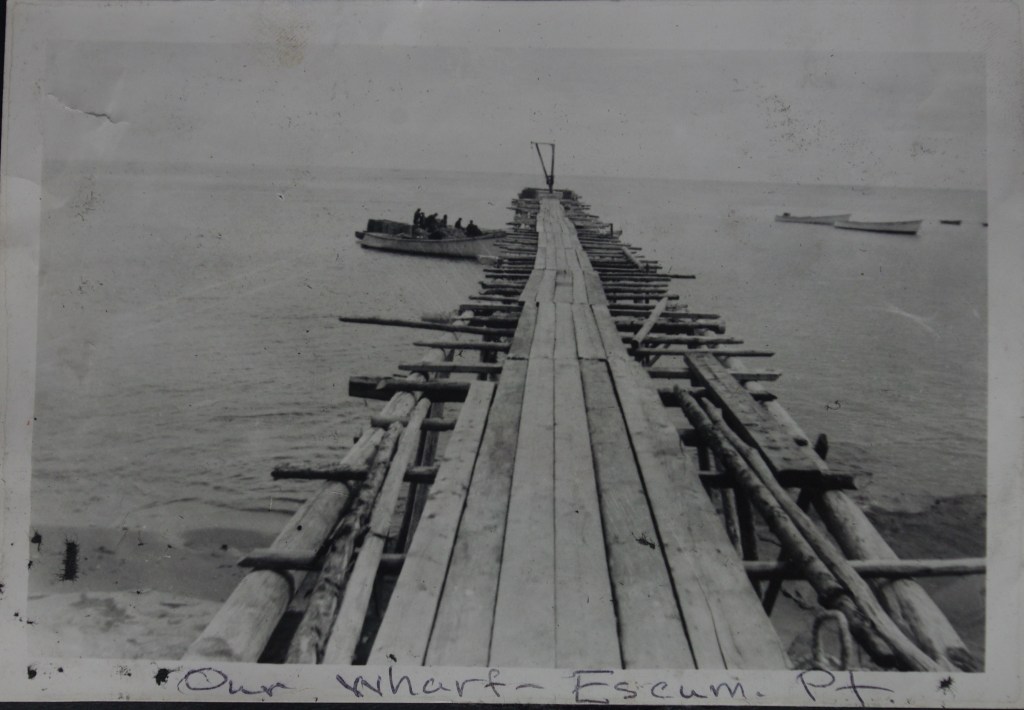
Escuminac, NB c.1930s Photo courtesy of Richard MacDougall
Nancy’s parents began with a lease on McDonald land at lot 36, but ultimately purchased land at Savage Harbour7, where they farmed a seafront lot. The property provided ideal location, familiar neighbours like the MacEacherns8 and transportation access to their children and other kin who had settled in Cape Breton and elsewhere. Its location and access to the bounty of the ocean, clams, oysters, mussels, fish, etc was also no coincidence.
Feeding the sow at Black River, NB Photo courtesy of the Our Miramichi Heritage family FBsite and Roy MacLean.
Màiri’s McAdam family were among the Roman Catholic families who arrived in St John’s island in the period between 1770 and 1800. Chain migration drew other Roman Catholic Scots to the island and to where their kin had settled. The early days of settlement relative isolation and absence of roads assured the communities of settlers had little interaction, and remained religious segregated.
Màiri and her husband Ailean McDougald (Nancy’s brother) moved to Cape Breton about 1814, joining a fledgling community at East Bay. Located on the Eastern end of the Bra D’or lake the community comprised of other Highland Gaelic speaking Scots, and already included Ailean’s sister Margaret Currie and family, and several of Màiri’s McAdam. Fear and suspicion which had challenged friends and neighbours at home lingered, and continued to divide Scots on both religion and language.
Early Shelter typical of those built by Scottish Settlers to the Atlantic region of Canada.
In the earliest years of settlement it was not possible to rely on paid employment, there was little in the way of commercial opportunity. If paid employment was available, time and effort still had to be applied to clearing land, building structures, cultivating land to assure care of livestock, tending gardens and procuring and processing wild food.
Màiri and Allan’s new home at Ben Eoin, was blessed with natural resources including fish, shell fish and water access to other locals. On their farm, they eventually grew oats, and other crops, like cabbage and potatoes. They raised sheep for wool, sows for food and cows for milk.
Picking potatoes in New Brunswick, c. 1950 Photo courtesy of the Roy MacLean and Our Miramichi Heritage Family FBsite.
Like other families Màiri and her children played an important role in many of the homesteads tasks, most aspects of food provision particularly, fell to women and children. Some of the tasks were once or twice a day, like feeding and care of livestock. Other tasks were seasonal and necessary to benefit from the bounty of food in summer and where possible aid in supporting them over winter.
Nothing was wasted or squandered, having a cow meant having a source of milk, butter and even cheese, provided of course the woman had the skill, equipment and a strong back. The extra effort required to separate cream and make butter assured it was valued and used carefully.
Nancy was born about 20 years after her parents moved to St John’s Island, during the ensuing years change had begun to take hold in the once insular communities of the Island. The population grew quickly with the various waves of immigration, especially after the Revolutionary war and the arrival of Loyalists refugees. Even as competition for property grew, so too did economic opportunities in fishing, timber harvest and ship building.
Nancy did not follow the same path as her siblings…her sisters Mary and Margaret and her brother Ailean married in to families well known to the McDougalds. The McEachern, Curry, McAdam and McDougald families had shared history, hardship, culture, language and religion.
Nancy’s decision to marry John MacEachern9 was probably met with opposition from both families. The move of Highland families to the protestant religion, to the use of English instead of Gaelic and the letting go of other traditional ways of living had been a difficult road. It divided families and neighbours, it also engendered social and economic distinction between the two groups of Scottish settlers.
Tabusintac c.1940, Donald MacEachern s/o Nancy McDougald and John MacEachern settled in Tabusintac, NB. Photo courtesy of Charles Asoyuf and the Our Miramichi Heritage Family FBsite.
To a large extent those who adhered to the Roman Catholic faith, and who spoke primarily Gaelic had less economic power and standing with the authorities. How Nancy and John’s divided religious beliefs effected their lives is the matter of some speculation. We know the young couple purchased land in Lot 57 Queen’s county. Some speculate that John was not a natural farmer, others suggest the death of his mother severed an already troubled relationship with John’s siblings, leaving the young family vulnerable. Regardless the cause John and Nancy’s financial troubles would lead to the loss of their farm and their flight to Escuminac, New Brunswick. It did not however end their marriage, nor did it result in one or the other of them converting. Despite their financial struggles, despite tales of John’s intolerance for his wife beliefs they went on to have a large family, some of whom were raised in the Roman Catholic tradition while others were raised in the Presbyterian church.
Spring 2022 on Bay du Vin, NB Photo courtesy of Richard MacDougall (Richard is a descendant of Nancy McDougald and John MacEachern through their daughter Isabell MacEachern McDonald jr.)
The post Revolutionary war period saw growth in fishing and timber industries but also in the new venture shipbuilding. By the 1820s when John and Nancy were relocating to Escuminac the port of Miramichi was one of the top five busiest ports in North America. John did what he needed to do to feed his family, he was carpenter, seaman and finally river pilot. It is likely he continued to fished for both additional income and for food for their family.
By 1845 when Rebecca MacDougall was born on her parents Peter and Elizabeth’s farm in Blissfield, NB, her father Peter had already been living in New Brunswick for more than 25 years. Peter who had been born on Malpeque Bay10, St John Island would become a lumberman and farmer in central New Brunswick, as far from the seashore as one can get in Maritime Canada.
Rebecca grew up on the Miramichi River and although there are species of clams and mussels which grow in the Miramichi river system, they are not in great numbers or seen as a desirable food fishery. Oh there was fish…the world famous Atlantic Salmon teamed in the Miramichi River, but there is no local tradition of Salmon being eaten in chowder either. There is however a tradition of vegetable chowder being served with Atlantic Salmon10.
Dumping day at Escuminac, NB – the first day of the lobster fishing season. c. 1950 Photo courtesy of Charles Asoyuf and the Our Miramichi Heritage Family FBsite.
I can’t say for sure that Nancy, and Màiri made and ate seafood chowder, but they did eat what the ocean and seashore provided them. They dug clams, raked oysters and collected blue mussels, and like Rebecca they were expert at processing milk in to cream and butter. Of course the other primary ingredients in Chowder, potatoes and pork were familiar dietary staples, most families in the region had a sow or two and potatoes grew in every garden.
Clam and Seafood chowder comes is several styles…the variety made with bacon, potatoes, cream and butter is known as Maritime style seafood chowder. Of course every cook has their favourite recipe, some add thickeners like flour, some use the traditional ‘Maritime cream replacement’ canned condensed milk, others prefer the rich sweetness of full fat cream, and butter.
Clams harvested April 2022 at Bay Du Vin – Photo courtesy of Richard MacDougall
My Mother’s Cookbooks Maritime Seafood Chowder
Ingredients: 3 slices of bacon / or 45 g of salt pork fat cut into small pieces 3 potatoes, peeled and pared to bit sized pieces (starchy varieties best) 1/2 cup(125mls) onion, peeled and chopped fine 2 cups (500mls) heavy cream 3 Tbsps (45ml) butter 2 Bay leaf Salt and Pepper 2 lbs (~1 kg) total Shell fish (clams, mussels, etc.); Other fish (haddock, cod, scallops); Lobster or snow crab – cooked, shell removed and meat chopped
Method: 1) Scrub and clean clam, mussel, oyster shells discard any broken shells or those which are opened and do not close when tapped; 2) Place the shell fish in a large pot with about 1 inch water; steam until the shells just open, remove immediately from the water and cool. Remove the meat from the shells and chop larger pieces in to bite size pieces. Decant the juices into a bowl being careful to avoid decanting any sediment in the bottom of the pot, and reserve; 3) Cook bacon in a skillet over med heat, remove bacon and all but 2 Tbsp of bacon fat, add onion and bay leaf saute until onion is tender about 3 minutes; 4) Add potatoes, salt and pepper to season the potatoes; 5) Add the juice from the steamed shell fish and enough water to just cover the vegetables; lay uncooked white fish and scallops on top of the veggies; 6) Bring to a boil, cover and turn to low, allow to cook for 4 minutes the scallops and fish should still have some opaqueness; 7) Add clams and other shellfish, cream, and butter to the pot; 8) Allow the chowder to simmer over low heat until the fish is no longer opaque DO NOT ALLOW TO BOIL; 9) Taste and adjust seasonings, remove bay leaf before serving.
Explanations:
Advocate Harbour, NS became home to our family in 1968, located on the Bay of Fundy, the community is washed by the worlds highest tides, twice each day. At low tide the mud flats offer enterprising folks opportunity to dig soft shelled clams. Scallops are also found off the shores of Advocate and the entire Bay of Fundy. The Gulf shore of PEI, and Northumberland strait offers more varieties of clams, bar clams, quahogs, razor clams to name some of the varieties of shell fish.
For purposes of this blog I use the following spellings to distinguish between families, McDougald refers to the Glenaladale settlers of that name; MacDougall refers to the Argyl family. McEachern refers to the Glenaladale family, which includes Mary McDougald McEachern who married into the Hugh Ban McEachern family. Nancy (Ann) McDougald married John MacEachern of Mull who came to St John’s Island in 1806 with his parents and siblings.
Màiri is a Gaelic name which is translated in English to Mary, while Aliene is translated as Allan. It appears Mairi and Aliene spoke primarily Gaelic and used these spellings.
Abegweit (Cradled on the waves) is what the Mi’kmaq called Prince Edward Island; the French named it St Jean’s Island; the British called it St John’s island until the name was changed to Prince Edward Island in 1799 in honor of the Duke of Kent.
The MacDougall family arrived in St John’s Island from Argyl Scotland on board the Annabella in 1770, the group comprised of some 60 families(~200 individuals) settled on Malpeque Bay on the Western end of the Island. BTW – the worlds best Oysters are “Malpeques”!
John MacDonald, 8th Laird of Glenaladale’s lands in PEI were comprised originally of Lot 36, in the Tracadie Bay area.
Savage Harbour is a rural community in Queens County, PEI. Located on the Gulf coast the name relates to an early French name, the French later used the name Harve de l’angille (Eel Harbour) in honor of the Mi’kmaq eel fishery in the area.
The Hugh Ban McEachern family were neighbours and kin, Mary McDougald married Ewan McEachern; a second son was Reverend Angus Bernard MacEachern, the First Bishop of the Diocese of Charlottetown and spiritual leader of the Glenaladale settlers and other Roman Catholics in the region.
John McEachern family arrived in PEI, in 1806 with a group of protestant settlers. The McEachern family settled on lots in lot 57 Queens county, on the Northumberland strait.
Rebecca MacDougall married widower Charles Walls. In addition to the family she and Charles had together Rebecca helped raise Charles’s family from his first marriage to Mary McKinnon, including my Great grandfather Benjamin Walls.
PEISSHS Alexander Committee 2022. “Glenalladale Settlers 1772 – Scotland to St John’s Island”: Charlottetown, PEI, Prince Edward Island Scottish Settlers Historical Society.
Acknowledgement: I acknowledge that the land on which I live and write about is the traditional unceded territory of the Wolastoqiyik (Maliseet) and Mi’kmaq Peoples. This territory is covered by the “Treaties of Peace and Friendship” which Wolastoqiyik (Maliseet) and Mi’kmaq Peoples first signed with the British Crown in 1725. The treaties did not deal with surrender of lands and resources but in fact recognized Mi’kmaq and Wolastoqiyik (Maliseet) title and established the rules for what was to be an ongoing relationship between nations.
Many of us have happy memories of cookies and the special cooks who made them, my husband included. For most of the last 32 years I have been hearing about “Mrs Bowers” and her molasses biscuits. The warm and special memories Ray has of this kind and caring soul are a child’s memories. During the 1950s and 1960s children did not presume to call an adult (even with invitation) by their first name, so Ray only knew his special friend as “Mrs Bowers”, and her cookies as molasses biscuits.
Cookies go along way in soothing booboos from a hard day at play. Photo courtesy of the Our Miramichi Heritage Family Facebook site.
For most North Americans, biscuits are leavened quick breads, usually savory and made with baking powder or soda. In the UK a biscuit, is the term used for a small flat sweet cake, which we in North America call a cookie. Whatever they are called biscuit, or cookie they share the power.
You know about cookie power, right? Cookies have the power to overcome barriers of age, religion, culture, social class, economic status, and language to build relationships. Cookie power is long lasting too, the scent of caramelized sugar and memories come flooding back, the tastes, the smells, and the cook. Although most any cookie can have cookie power, the power it is independent of flavour or style, the most powerful cookies are homemade by loving hands.
Commercial cookies have a different form of cookie power, but their sheer number and ubiquity assures they have real power in the cookie world. They take their rightly place, as evidenced by how many of us enjoy a couple of Oreos, or Fudgeeos with a glass of cold milk, or a Kookie Kutter1 gingersnap dipped in a cup of King Cole tea. Bakery baked cookies contain most of the usual cookie ingredients, there is lots of sugar and fat. It is just they are missing that that extra special investment by a home cook which makes homemade cookies super charged.
Commercially produced baked goods, biscuits and cookies, the ad from the 1940’s. Image courtesy of the Nova Scotia Archives – E.A. Bollinger Nova Scotia Archives 1975-305 1941 no. 319e
Many of the cookie recipes in the My Mother’s Cookbooks collection carry titles like Granny’s oatmeal cookies, Aunt Edna’s shortbread cookies, Hazel’s melting moments, Dad’s gingersnaps and a recent addition, Orion’s Molasses cookies. Usually honoring the person who made them, these titles hint at special memories and to those who went out of their way to put a smile on the face of a small child and warm feelings in their child heart.
It wasn’t Mrs Bowers who provided Ray his first ‘Mrs Bowers molasses biscuit’. The shy four year old neighbour child, who’d been drawn to the Bowers dooryard by their friendly little dog, remembers it clearly. The work hardened hand, which extended that first molasses biscuit on the end of a fork was, not Mrs Bowers but her husband, Willie’s. A clear example of how cookie power can extend to cookie providers too.
4 year old Ray, c. 1955 Glace Bay, Nova Scotia
Orion Lackey, a farmer and lumberman assured there were always plenty of his molasses cookies at his farm house in Upham parish, Kings county, New Brunswick. You see Orion understood that cookie powder is not only transferable to cookie providers, but to houses too. Houses which host regular cookie making and eating(especially by children under 10 years) take on an air of cookie power, drawing grandchildren and their friends to it regularly, even when it means a hefty walk. Years later just the sight of the lane way leading to a cookie powered house can evoke smells and tastes, of memories and love. Orion Lackey was a wise man to build a cookie powered house, it drew his grandchildren to the house and to visit with their widowed and aging grandfather.
Prosperous Homestead and farm in Northumberland County, New Brunswick. c.1890 Photo courtesy of the Our Miramichi Heritage Family FB site.
Cookie power does have its limits tho too… eventually cooks and cookie providers pass away leaving one time children with memories of cooks and cookies past. Despite cookie power and even armed with the original recipe, many one time children find their favourite treats are just… oh they are good…just not quite the same. Many batches of cookies have been made and eaten in search of the elusive cookie without success…you see the missing ingredient…and the true source of cookie power is the love in the heart of cook and cookie provider, love which gets baked in to cookies and ignites their power.
Homestead Northumberland County, New Brunswick c1890 Photo courtesy of the Our Miramichi Heritage Family FB site.
Dolena (Dolly) McLeod Bowers, grew up in the tiny backland community of Tarbot, Victoria county, NS. Willie Bowers was born in Boston Mass., where his English born father and his Cape Breton born Mother were living with their family. The 1901 and 1911 census shows Willie listed as an adopted son in the household of Duncan McLeod, it is possible his adopted family were kin of Willie’s mother Margaret McLeod. Married in 1913 Dolly and Willie spent the first years of the marriage living on their Victoria county farm eventually moving to Glace Bay about 1920. Willie would eventually establish himself as self employed gardener.
The Robichaud family c. 1935, Photo courtesy Our Miramichi Heritage Family Fb site. Charles Asoyuf Album.
The tentative relationship between Ray and the Bowers grew gradually over the months following that first biscuit. When Willie unexpectedly died in August of 1956, 5 year old Ray was there, his presence in their home welcomed and insisted upon by Mrs Bowers. For more than 12 years until her death in 1968, Ray visited Mrs Bowers. In the early days, the visits were daily to share a late afternoon snack. The two would sit for a bit together, not saying a lot, on cold winter days a doze by the fire might be in order before their afternoon tea.
Mrs Bowers probably enjoyed having company while her adult sons were at work and having Ray around as playmate served to draw her Grandson to visit more regularly enriching her life still further. As childhood pursuits turned to sports, cadets, etc. their visits grew less frequent but they still happened, a weekend trip away for a judo or drill team competition required a debrief visit with Mrs Bowers. Dolly Bowers and Ray after all shared a cookie powered place in each others hearts.
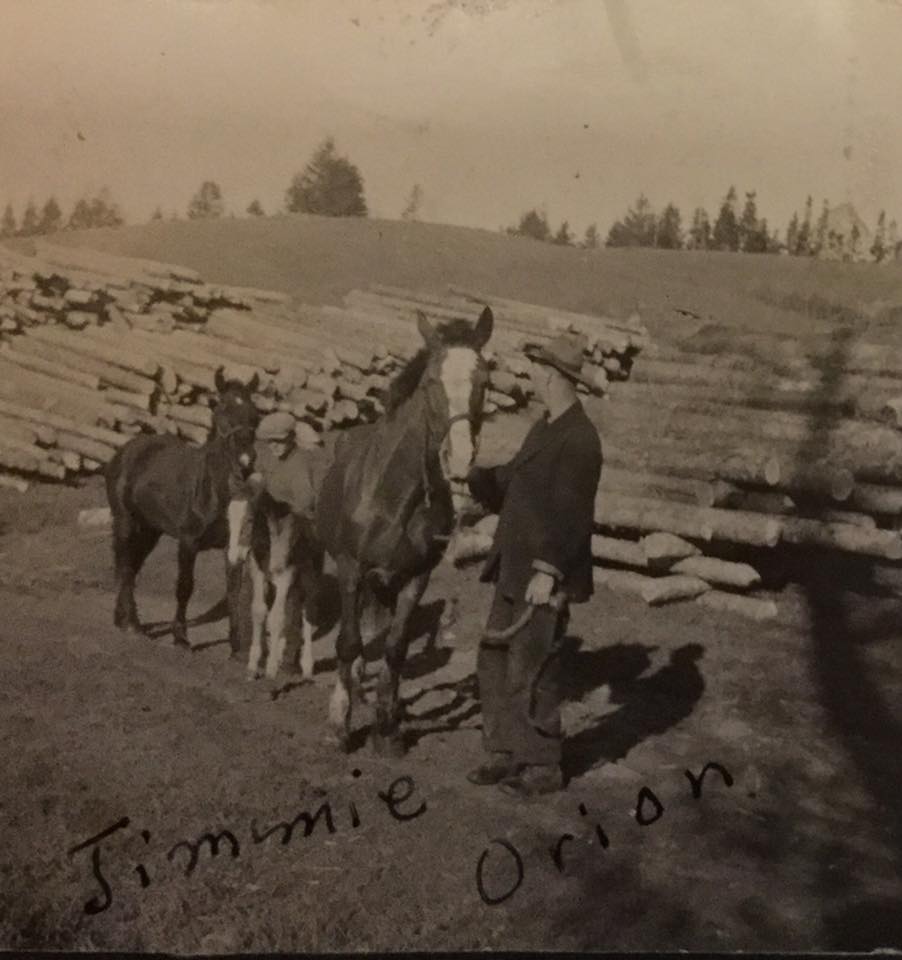
Orion Lackie and his son Jimmie with their horses. Photo courtesy of Ancestry.ca/com member and contributor Love-Darlene.
The truth is the benefit Mrs Bowers and her cookies (often meals) brought to a small boy, from large family with too few resources, were immeasurable. Mrs Bowers’ kindness, along with her son Murdock, thru his small store on School street made a substantial difference in the lives of the entire family, a debt of kindness which will never be entirely repaid.
Orion Lackie was born on the family farm in Upham Parish in 1896. The Lackie family arrived in New Brunswick about 1825 from County Tyrone Ireland. Orion and his wife Mabel married in 1920, and went on to raise their five children in the tiny farming and lumbering community in rural Kings county. After more than 40 years of marriage, having raised their family together, it is likely Orion found his home empty and silent after Mabel’s death in 1961.
We will never know for sure what inspired Orion and Willie to make use of cookie power. What we can say is that both men knew how best to employ it…maybe they had experienced it first hand? They knew that the key to unleashing cookie power is simple, it does not require a complicated process, it just takes a child, a cookie and a kind adult.
As the family cook, I know I will never be able to truly make Mrs Bowers Molasses Biscuits… I have no illusion it could be possible. I am however interested in creating a reasonable facsimiIe. Here is what I have discovered about Mrs Bowers biscuits, firstly they are thick cut, Ray remembers them being split in half and buttered. They were also slightly less sweet than a rolled out molasses cookie, and were sometimes served with a piece of cheese or meat. I suspect that Mrs Bowers might well have been drawing on her MacLeod family Scottish ancestry. In Scotland there is tradition of individual hand held ‘buns’. Sweet buns are similar to a cookie but usually eaten in company with soups and other savory foods. In Newfoundland there is a well known tradition of ‘Lassy Buns’, a sweet bun made with molasses. Since the ties between Newfoundland and Cape Breton are deep I can not say for certain the source of Mrs Bowers Molasses Biscuit recipe, since Lassy buns appear to be very similar.
It seems to me a little cookie power in our world, never goes a miss. At this crisis point in our history it is easy to loose site of the importance of small actions. The simple act of making and sharing cookies can be and often is transformative. I think it is time to encourage everyone to exercise cookie power, maybe it will provide an example to those who see violence as the solution… Russia and Ukraine time for some cookie power!
This recipe is inspired by Mrs Bowers biscuits and traditional style Newfoundland Lassy buns.
My Mother’s Cookbooks Mrs Bowers Molasses Biscuits:
Ingredients: 1 cup molasses 1 cup melted butter 1/2 cup milk 4 1/2 cups all purpose flour 3/4 cup sugar 1 egg 1/8 tsp salt 1/2 tsp ginger 1 tsp cinnamon 1/2 tsp ground clove 2 tsp baking soda
Method: 1. Preheat oven 350oF; 2. Combine molasses, melted butter, milk and egg; 3. In a separate bowl combine flour, sugar, salt, spices, baking soda; 4. Add dry ingredients to molasses mixture; 5. Roll the dough out on a floured surface to 3/4 in thick, cut in to rounds/squares; 6. Bake for 15 to 22 minutes. Removed from the pan and place on a wire rack until cool.
Acknowledgements and Links: 1. Kookie Kutter – https://kookiekutter.ca/ 2. I want to thank two people very familiar with cookie power, Stewart Totten and Ray Morrison. Stewart was generous enough to not only share his Grampie’s molasses cookie recipe but his experience about being drawn to his Grandfather Orion’s house by those Molasses cookies. Of course I also thank Ray for sharing his memories of Mrs Bowers and her Molasses biscuits. I think he enjoyed the process, and revisiting Mrs Bowers and her molasses biscuits.
Land Acknowledgement:I acknowledge that the land on which I live and write about is the traditional unceded territory of the Wolastoqiyik (Maliseet) and Mi’kmaq Peoples. This territory is covered by the “Treaties of Peace and Friendship” which Wolastoqiyik (Maliseet) and Mi’kmaq Peoples first signed with the British Crown in 1725. The treaties did not deal with surrender of lands and resources but in fact recognized Mi’kmaq and Wolastoqiyik (Maliseet) title and established the rules for what was to be an ongoing relationship between nations.
Happy to share this link, of my conversation with Brian Nash from How We Got Here Genealogy for Atlantic Canadians in The food that made our Ancestors great, webcast on Youtube. Brian and I discuss how I became involved in genealogy and in blogging about My Mother’s Cookbooks. We chat food, its role in family history and my current research projects… I want to thank Brian for a great conversation, I hope you enjoy it!
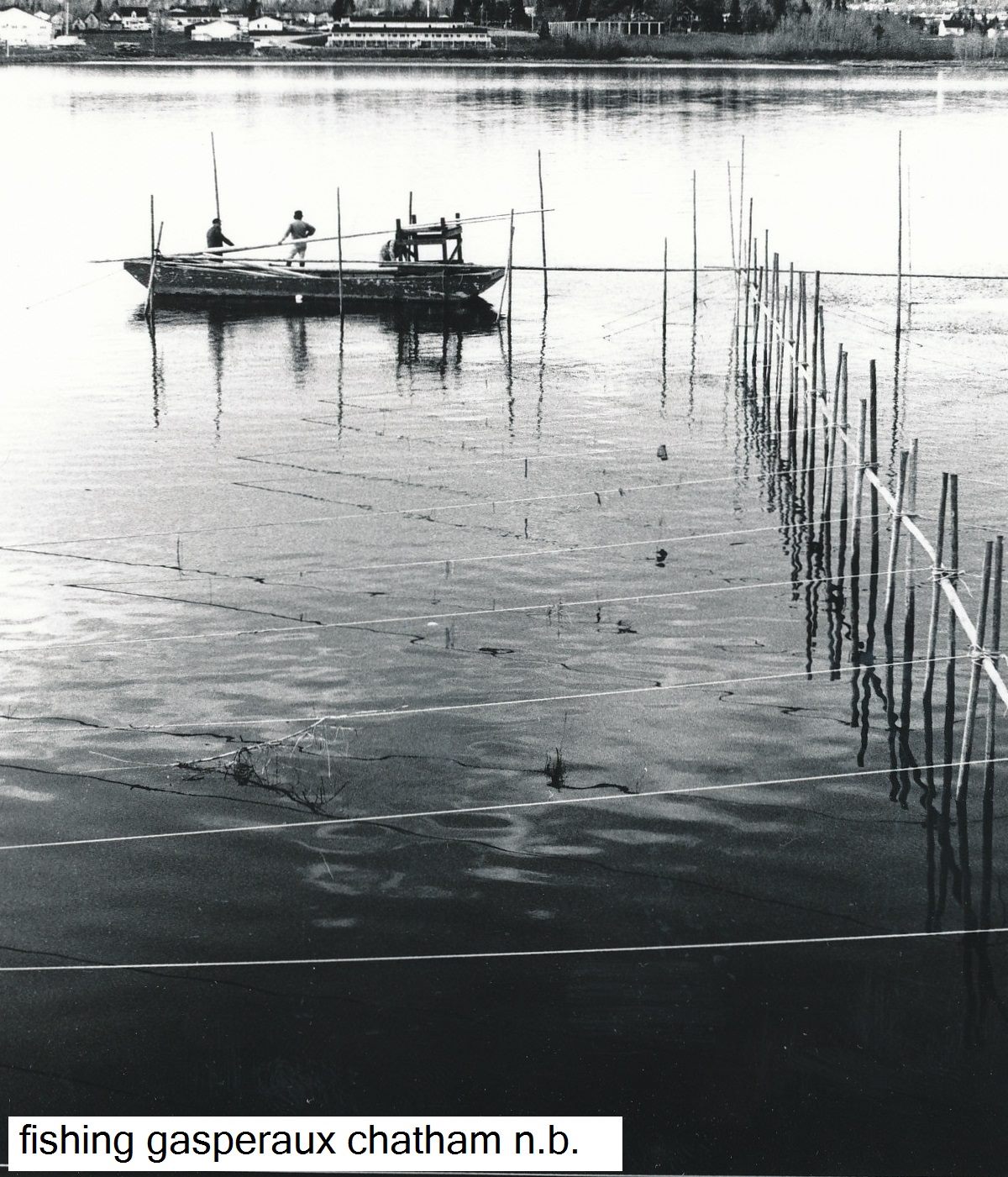
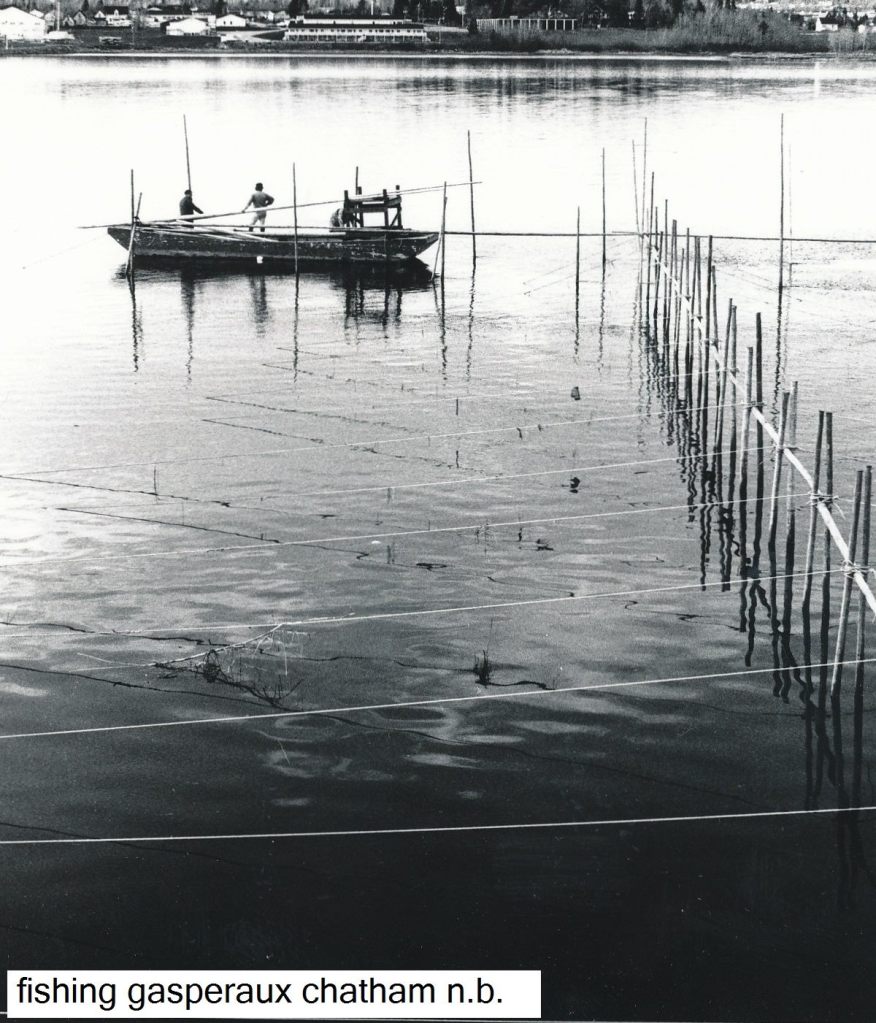
Fishing Gasperaux at Chatham, Northumberland County, New Brunswick c.1920 Image courtesy of Our Miramichi Heritage Family FB site – Charles Asoyuf’s Collection.
“Do you want a feed of Smelts?” is still commonly heard in many areas of Atlantic Canada and it is usually closely followed by the question “are they cleaned”? Mum did not enjoy cleaning fish and wild game. Knowing the cooking would fall to her, she was quick to quashed the idea that she would be cleaning it too. Most of what needed cleaning, gutting and trimming was fish. In summer salmon and trout, during winter and early spring smelts1, followed by shad and other migratory fish.
The rhythm of life in rural communities of the North east is dictated in part by weather, and by the seasons, although not as much as in the past… For Early European settlers, the line between success and failure was narrow and the stakes high. Access to food, year round access was a primary driver of where people settled, timber played its part, ship building too, but fish, access to it, represented both food and income.
Britain’s settlement of Canada came after a protracted period of conflict and war, which in its own way proved beneficial to early Scottish settlers. Military service with the British was a practical reality for many poor young men from across the United Kingdom including from Ireland and Scotland during the 18th and early 19th century. Despite the apparent contradiction of loyalty, economic and social reality saw large numbers of Lowland and Highland Scots serving with British units overseas including in North America. Many of those who settled in the colonies after their service remained loyal during the American Revolutionary war, eventually taking land grants in Atlantic Canada and elsewhere.
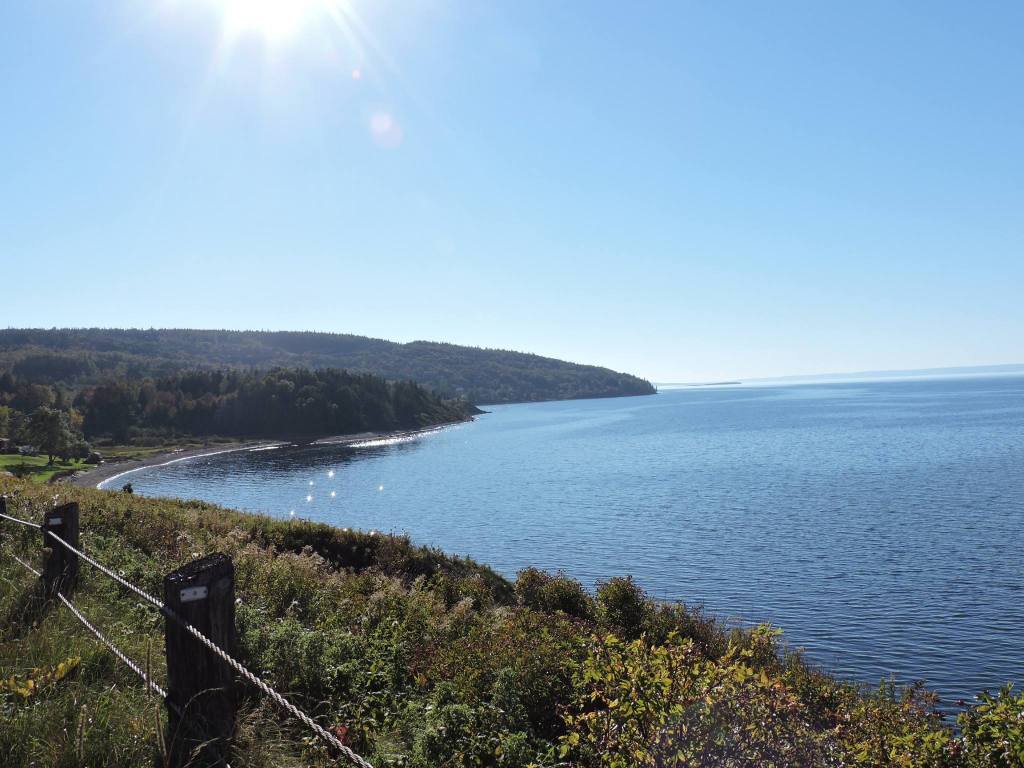
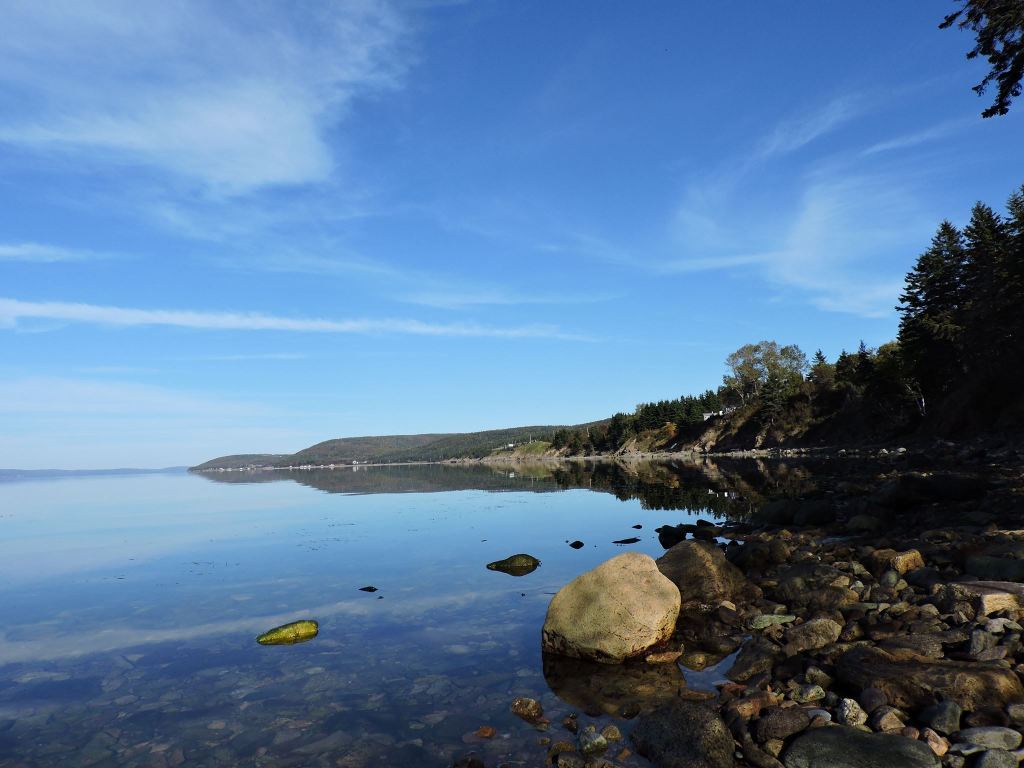
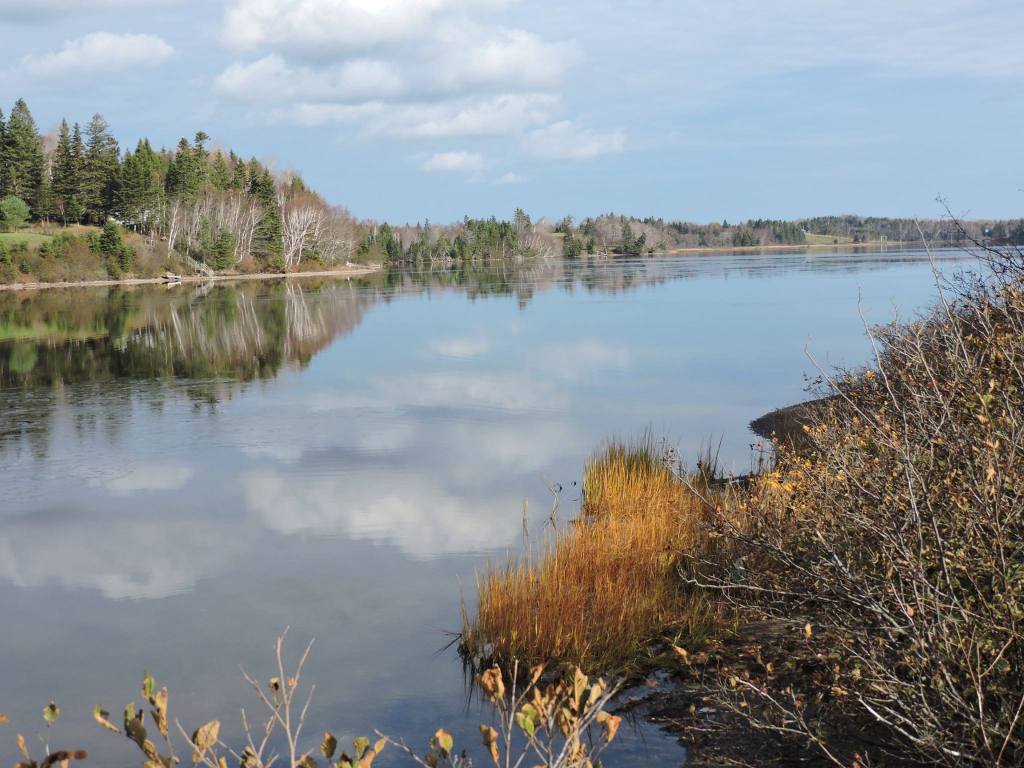
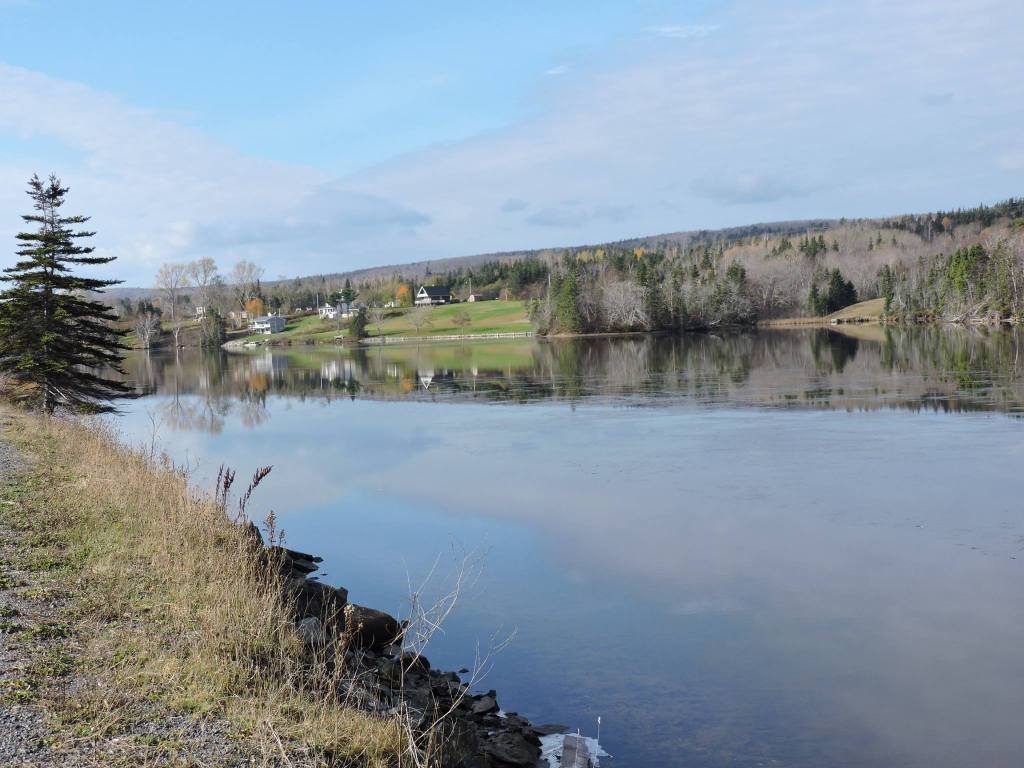
Grand Bra D’Or at Irish Cove, Cape Breton. c. 2016 Photo F. Eliza Morrison Collection
It is hardly surprising that young men, motivated by the real possibility they would be granted land for their service, were thrilled to find terrain and waterways strikingly similar to home. The timber covered hillsides, lush river valley’s, sheltered bays and inlets, lakes and sea lochs with plenty of fish and game of Atlantic Canada inspired many. What is surprising, is not that information was gathered, but that it was sufficiently detailed, despite the absence of written descriptions or maps to direct the movement and settlement of early settlers.
Grand Bra D’Or Cape Breton July 2016
Margaret McDougall Currie was born in Isle St Jean (Prince Edward Island) about 1778. Margaret’s husband Duncan Currie’s family, originally of South Uist, Scotland, like the McDougalls were among the passengers of the Brig Alexander who landed on John MacDonald’s property Lot 36, Isle St. Jean in July of 1772.
When the entire Currie family, including Margaret and Duncan relocated to Isle Royale (Cape Breton) about 1812, it is entirely likely they had some prior knowledge of where they were heading. The sheltered, fertile and accessible land they choose to settle might well have been ‘picked out’ years earlier as a good place to live by someone connected to the family. It is possible one of the Currie family might themselves, have visited the island while in service of the crown.
East Bay, Cape Breton facing east toward Portage, NS Nov 2016 Photo F. Eliza Morrison CollectionEast Bay, Cape Breton County, Nova Scotia November 2016. Photo F. Eliza Morrison Collection
The property, located at the Eastern end of Grand Bra D’or, had everything a good Scottish family could need, arable land for crops and livestock, access to fish and game, and waterways for transportation and access to family and friends. Most importantly, the land was freehold, and they would own it. Soon they would be joined by friends and family from Isle St John, and Pictou but also from Scotland.
Dumping Day – Setting Lobster Pots on Grand Bra D’Or, May 2017 Photo F. Eliza Morrison Collection
Anna Annie Brown McDonald was born about 1777, after her parents William Brown and Agnes Taylor Brown moved to New Brunswick from Scotland via Dorset. The Brown’s, along with most of Agnes’ siblings, the Taylor family were among the settlers to the lands of William Davidson on Miramichi bay and the Miramichi river system. Annie grew up near what would become the shipbuilding center of Chatham, NB, at the mouth of the Miramichi River. When she married Alexander McDonald she moved to Point Aux Carr further down on Miramichi Bay, where Alexander had been granted land.
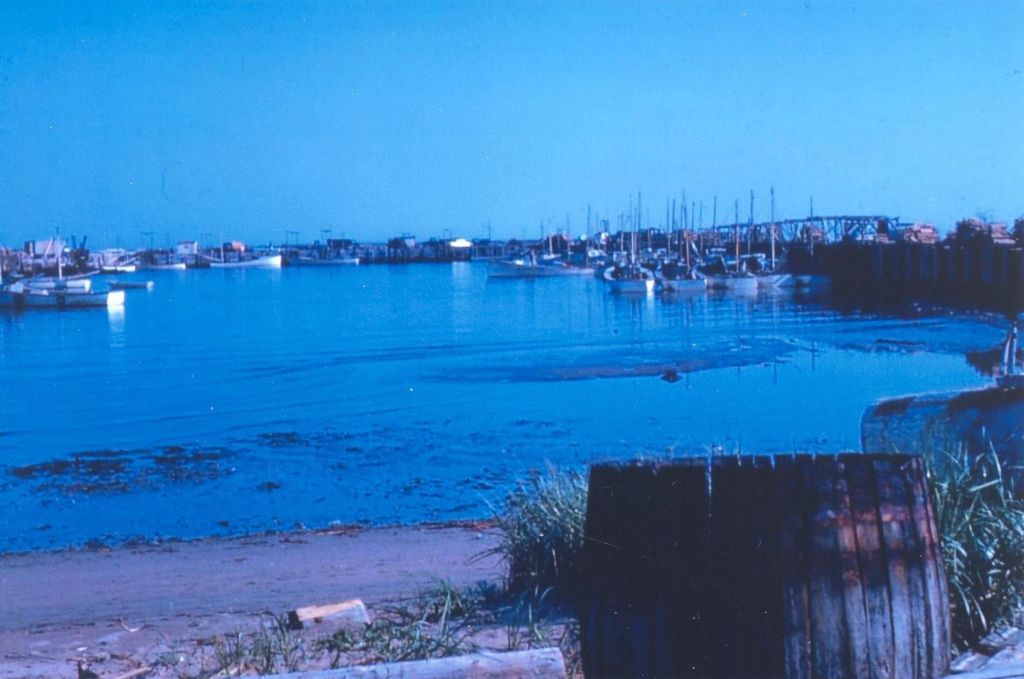
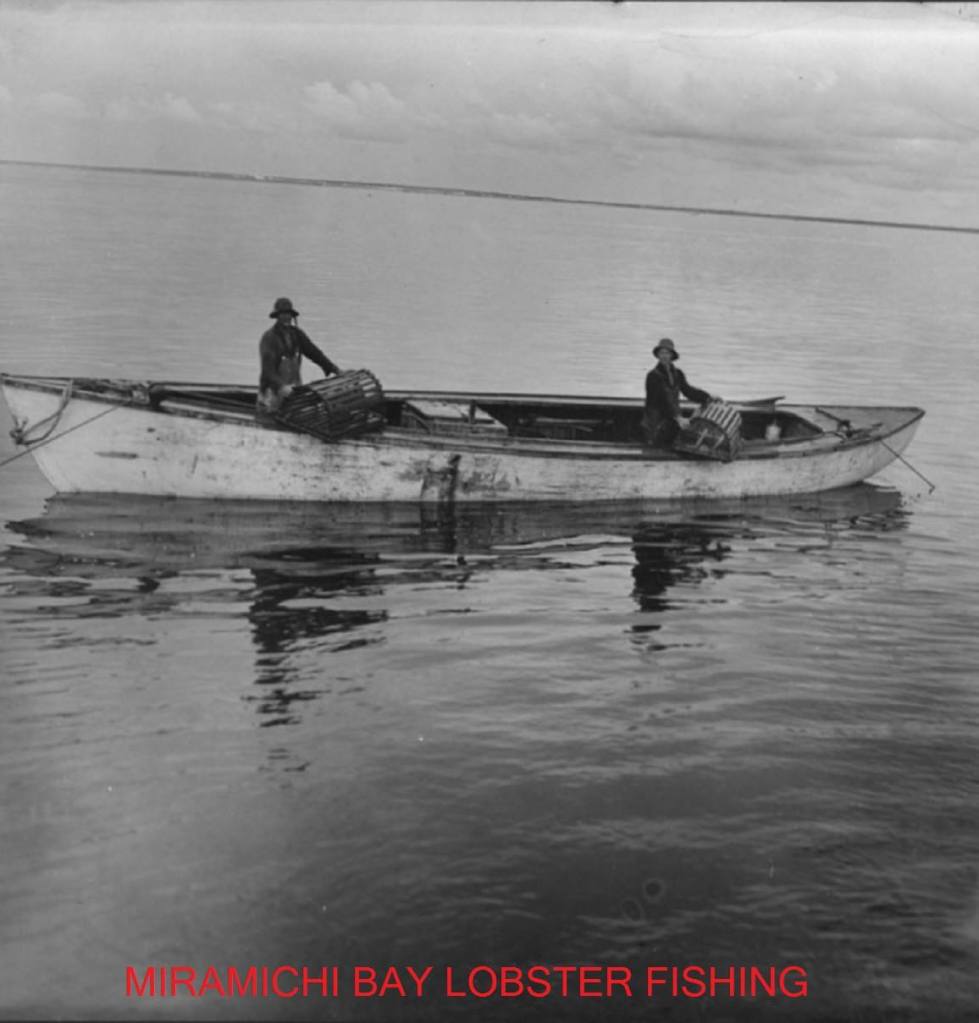
Miramichi Bay Fishing Fleet safe in Harbour. Photo Courtesy of the Our Miramichi Heritage Family FB site – Charles Asoyuf Collection.
The 42nd Highland Regiment of Foot (The Blackwatch), one of three British Highland regiments2 which served during the Revolutionary war, was first deployed to North America during the French Indian Wars. The Blackwatch saw service in many of the major battles of French Indian War, Seven years War and the American Revolutionary War including in Atlantic Canada.
Anne’s husband Alexander McDonald Jr. was born in Staten Island, NY while his father Alexander Sr. (wife and family) served with the 42nd. At the end of the Revolutionary War Alexander Sr. along with other members of his unit were granted land in the Nashwaak river valley in New Brunswick. The decision by many of the 42nd Highlander veterans to relocate to land grants elsewhere was driven by several factors, better lots with water access and a desire to locate near kin included. Many of the 42nd highlanders relocated to new grants on the Miramichi, some immediately, other families made the move later.
Ice boats on the Miramichi River at Newcastle, NB c.1900 Image courtesy of Our Miramichi Heritage Family FB site – William Brennan Image in Charles Asoyuf’s Collection.Winter in the Bra D’Or region of Cape Breton c.2017 Photo F. Eliza Morrison Collection
For early settlers, a community of others could mean the difference between life and death. The struggle and hardship of clearing land, building shelter and cultivating crops from dense forest, stretching from beach to hill top was made easier and possible by sharing resources and working together.
Fishing on Miramichi Bay c.1890 Photo courtesy of the Our Miramichi Heritage Family FB site.
When Margaret and Duncan moved their family to East Bay, Cape Breton it is likely the move was made over time. During summer the hard work of clearing land, building shelter, cultivating the first crop of potatoes and laying the ground work for other crops was carried out. Being able to retreat to established communities with kin for the winter months made settlements of new areas possible.
It is possible Margaret and Duncan enjoyed the benefit of much shorter trip to over winter with Margaret’s sister Mary and Hugh McEachern in Inverness. It is certainly true that settlement of areas of Cape Breton more distant from the established communities in Isle St Jean and Pictou took longer to be settled. The first wave beginning as early as the mid 1770, settlers to East Bay on the Bra D’Or lakes arriving 30 or so years later.
Atlantic Salmon South West Miramichi, Northumberland Country, New Brunswick c.1930 Image courtesy of Our Miramichi Heritage Family FB site – Charles Asoyuf’s Collection.
Despite the bounty of food Miramichi Bay and the Bra D’Or Lakes provided in summer, despite settlers efforts to preserve their summers harvest, and with a supportive community, winter was difficult for early settlers. Ice and snow effectively shuts down harvest of wild fish and game for much of the winter season. In late winter and early spring Miramichi bay and areas of the Bra D’Or lakes begin to team with schools of fish preparing for a run up their fresh water spawning grounds. One species in particular could be depended upon to congregate and run… the earliest fish to arrive, is a family of small fish which are familiar to most in North Atlantic region, Smelt. During spawning season they make their way from the ocean into most fresh water systems, lakes and rivers in both Europe and North America… and are welcomed by the winter weary.
McCullum Brigde Glengelg Parish, Northumberland County, New Brunswick Image courtesy of Our Miramichi Heritage Family FB site – Charles Asoyuf’s Collection.
The My Mother’s Cookbooks recipe for a Feed of Smelts…
Ingredients: Whole smelts, cleaned with head removed. Flour Salt and Pepper Butter and oil Method: 1. Combine flour, and seasonings together in a wide shallow bowl; 2. Dust each smelt in flour, shake well to remove excess flour; 3. Heat butter and oil in a large frying pan, over medium high heat until butter and oil shimmers in the pan; 4. Place smelts in pan and fry until light brown and crispy, turning half way thru; until flesh is no longer translucent (internal temperature of 140-145 F). 5. Serve with boiled potatoes and other root vegetables. Garnished with a bit of Green Tomato Chow chow and enjoy.
Explanations:
1. Smelts – Are a family of small fish which are native to both the North Atlantic and North Pacific Oceans and in fresh water rivers and lakes in North America, Northern Asia and Europe. The specific species common to the waters of North America is Rainbow smelt. 2. Highland Regiments serving during the American Revolutionary War: The 42nd Royal Highland Regiment; 71st Regiment of Foot (Frasers Highlanders); 76th Reginment of Foot (MacDonalds Highlanders) were the 3 Highland units to serve in North America during the Revolutionary war, they were joined by Highland units raised in America including the North Carolina Highlanders and the Royal Highland Emigrants (the 84th Highland) Regiment. There were Scottish Regiments comprised primarily of Lowland Scots, which served during the war as well. 3. Green Tomato Chow chow is a pickled relish made of green tomatoes, onions and spices. It is not entirely clear how Chow Chow came to be, one of the first printed recipes appeared in the Harriet Pinckney Horry cookbook of 1770 in South Carolina. Tomatoes were largely unknown to Scottish, Irish and English settlers who were at suspicious of unfamiliar fruit and its rumoured poisonious nature. It would take time for it to become popular with folks in Atlantic Canada, probably encouraged by the region’s trade with the West Indies.
Acknowledgement: I acknowledge that the land on which I live and write about is the traditional unceded territory of the Wolastoqiyik (Maliseet) and Mi’kmaq Peoples. This territory is covered by the “Treaties of Peace and Friendship” which Wolastoqiyik (Maliseet) and Mi’kmaq Peoples first signed with the British Crown in 1725. The treaties did not deal with surrender of lands and resources but in fact recognized Mi’kmaq and Wolastoqiyik (Maliseet) title and established the rules for what was to be an ongoing relationship between nations.
Sunset on Grand Bra D’Or July 2016 Photo F. Eliza Morrison Collection.
Just because a food is traditional to a community or group does not mean it was eaten by everyone in it. It is interesting how individual and varied food choices are, despite major underlying similarities…A few years ago, Ray and I were attending a conference out of province, a good friend offered to ‘stay in’ to care for our dog Meesha in our absence. The evening before our departure, I prepared a meal with intended leftovers and I left a note telling my friend to enjoy the roast pork, salad, carrots, couscous, gravy, and My Mother’s Cookbooks bread pudding for her after work meal.
Mrs Dugas making bread as her daughter Joyce looks on c.1951 Alex H. Leighton NS Archives collection 1988-413
Later that next evening I received a text from my friend thanking me for dinner. When she said she’d never eaten ‘it’ before, I assumed we were talking about the Morrocan couscous. But her confession she eaten two servings, one with the pork meal and the other as dessert had the penny dropping…my friend had never eaten or encountered bread pudding before.
Acadian Camp cook, Saulnierville Station baking bread c.1958 Alex H. Leighton NS Archives collection 1988-413
Foods which were in regular rotation in our home growing up tend to engender one of two responses in us as adults…intense enjoyment or complete avoidance. Of course which category a food fits into is dependent on many things, individual preference, the skill of the cook, even the associations foods carry with life events contribute to whether a food becomes a personal tradition. The variety of traditions of individuals and families, is vast even dietary staples like bread have their limits, bread pudding is a case in point.
1st Prize in the category under 16 girls cooking champion Guyborough county Exhibition c.1915. Buckley Family Nova Scotia Archives Collection 1985-386 no. 429
Given the variety of yeast raised breads available to us, it would be easy to assume that some form of wheat bread has always been available. Despite being used over thousands of years, despite a variety of methods for ‘baking’ it, the supply and consumption of yeast raised wheat bread varied upon location. Wheat is not indigenous to North America in Eastern North America the climate, and soil conditions are highly variable, settlers found they could grow wheat in some areas others not at all. The desire for wheat1, because of it’s nutrition and usability made it a valuable commodity. So farmers grew it where the yield was sufficient to justify it, but always accompanied by staples like squash, beans and corn2.
Salt Water Logging Crew enjoy their lunch by the shores of the Bay of Fundy. c. 1950 Alex H. Leighton NS Archives collection 1988-413
For young women like Mary MacKenzie Munroe and Dorothy Price Hovey, wheat flour and wheat bread came in and out of their lives, depending upon their movement, their ability to grow wheat or the funds or product available to exchange for wheat flour. Mary, who grew up in Stoney Beach on the shores of the Annapolis River in Nova Scotia, knew wheat as a child, her parents Alexander and Ann likely grew it on their farm. The Annapolis valley, one of the earliest European settlement in Canada, was home to the first wheat exported from Canadian soil. Acadian settlers brought wheat with them from France, by the mid 17th century the yield was sufficient to warrant export3.
Two women cooking by an open fire c. 1900. Dunlap collection Nova Scotia Archives 1992-398 no. 15.
The Annapolis Valley of Nova Scotia, ‘Acadia’, benefits from rich fertile soil deposited by the glacial movements of the distant past but it is the microclimate created by the valley’s location between two mountains which is truly unique. The North Mountain protects the valley from the winds off the Bay of Fundy, the South mountain sheltering it from the Atlantic Coastal winds, creating environment and soil conditions conducive to vegetable and fruit cultivation.
Like Mary, Dolly might well have preferred to eat yeast raised wheat bread but it would not have appeared regularly on her table. European settler families to areas like the Massachusetts and New Jersey colonies cultivated corn, squash and beans, with far less effort focused on wheat and Rye. It is entirely likely for Dolly daily bread was unleavened cornbread.
c. 1938 Cook and stove, prepared to follow the log drive. Photo courtesy of the Our Miramichi Heritage Family Facebook site.
The desire for new opportunities, fewer restrictions on religion practice and the offer of ‘free’ land saw Dolly’s parents Edmund and Jane relocating to the Nova Scotia colony as “New England Planters”4. The St John River valley of New Brunswick was a comparatively wild place in the mid 18th century. It did offer fertile land, some of the most fertile land in New Brunswick can be found in the St John River valley. The river with head waters in both Quebec and Maine, at Maugerville and Gagetown, is wide and slow moving as it meanders through a floodplain and delta created by the confluence of tributaries and wetlands. The narrow gorge at the Reversing falls some 60 miles down river creates a natural damming effect which during the spring melt causes regular flooding of the river plain.
Within 10 years of Mary marriage to Evan Munro and her move to Maugerville, New Brunswick, the influx of refugees from the Revolutionary war began placing strain on food, land and other resources. The challenge of feeding and supporting a suddenly burgeoning population saw farmers growing wheat where they could, primarily as a cash crop. Less fertile fields were cultivated with buckwheat, oats, barley, potatoes and used for personal use with any surplus traded.
It is possible during her childhood in the Nova Scotia colony that Dolly ate yeast raised wheat bread, courtesy of her family’s effort to grow wheat. When Dolly married Aaron Hovey and moved to the Miramichi River Valley, eating wheat became far less frequent. If it appeared at all, Dolly would have probably purchased it. The Miramichi region is long associated with the timber industry, and with the consumption of buckwheat which will grow in the very poorest soils. Provided one could afford the price, wheat was also available. It seems it was just available enough to assure folks maintained a taste for it. Although Selkirk settlers to the prairies began cultivating wheat in 1814 it would take until the development of cold hardy varieties for wheat to become reliably available.
c. 1910 Preparing lunch, Miramichi River, Northumberland county, New Brunswick. Photo courtesy of the Our Miramichi Heritage Family Facebook site.
Cooks in Atlantic Canada during the period from 1890 to 1950 made bread and plenty of it. It was common for a woman with a large family to make bread several times per week, most of which quickly disappeared. What did not get eaten immediately was not allowed to spoil, instead odd sized pieces and ends were repurposed in to dressings, added as thickening and transformed in to desserts.
Some dessert recipes call for the bread to be crumbed or grated and added as a sort of flour replacement. In bread pudding the high ratio of bread to other ingredients makes bread the obvious star of the show, even as it lends it self to a variety of flavour combinations. I suspect this in part explains why bread pudding rarely appears on offer at high end bakeries or restaurants. Even dressed with the freshest eggs, and cream, sweetened with cinnamon and sugar, or with some chopped fruit tossed in, ‘bread’ pudding remains a humble dessert in the minds of some, just leftover bread… but to others it is delicious comfort food.
My Mother’s Cookbook’s Bread Pudding
Ingredients: 3 beaten eggs, at room temperature 1 1/2 cups white sugar 2 Tbsp brown sugar 1 tsp cinnamon 5 Tbsp melted butter 3 cups whole milk 1/4 tsp pure vanilla extract 10 slices of whole grain bread cut into 1 inch pieces 1 cup of raisins (optional)
Method: 1. Preheat oven to 375 degrees F; 2. Melt butter and set aside to cool; 3. In a medium sized bowl beat eggs; 4. Add white and brown sugar and cinnamon; 5. Add cooled butter, vanilla and milk, mix well; 6. Place bread pieces in to a butter baking dish, pour the custard over it, set aside 30 minutes to permit the bread to hydrate; 7. Bake 30 minutes or until a knife inserted in the center comes out clean; 8. Allow to cool for at least an hour before serving, can be served warm or chilled.
References and Explanations: 1) Wheat is indigenous to Asia, during the course of thousands of years, wheat became a preferred grain in the diets of Western nations. The introduction of wheat to North America and the impact ‘our determined cultivation’ has had on First Nations People, their culture and way of life, is undeniable. Wheat and our fascination with it has often been with out consideration of the negative impact on First Nations Peoples, and on our environment. The “Wheat belly” controversy made a dent in some of our fascination with wheat and wheat bread, yet it remains an issue we have yet to resolve.
2) Squash, Beans and corn – are true North America foods, introduced to European settlers by First Nations peoples. Some describe these staples as the Three Sisters, others acknowledge even this nod to the importance First Nations People and their food played in the lives of European settlers is a distortion and over simplification, even a settler appropriation of First Nations culture. It is with out doubt European settlement and our fascination with wheat flour in particular has played a role in displacing, and destroying the way of life of First Nations People.
4) After the expulsion of Acadians from their lands beginning in 1755, British authorities began recruiting settlers to assume the properties forcibly vacated by Acadians. Recruitment occurred in both Britain and the Colonies, the largest group of settlers during this period were New Englanders who ‘planted’ in Nova Scotia. Governor Lawrence preferred to encourage settlers with farming experience, which actively discouraged ex military settlers since they were not ‘farmers’.
Acknowledgement: I acknowledge that the land on which I live and write about is the traditional unceded territory of the Wolastoqiyik (Maliseet) and Mi’kmaq Peoples. This territory is covered by the “Treaties of Peace and Friendship” which Wolastoqiyik (Maliseet) and Mi’kmaq Peoples first signed with the British Crown in 1725. The treaties did not deal with surrender of lands and resources but in fact recognized Mi’kmaq and Wolastoqiyik (Maliseet) title and established the rules for what was to be an ongoing relationship between nations.