The Holiday Favourites list…

Frying pan cookies and canned peas?
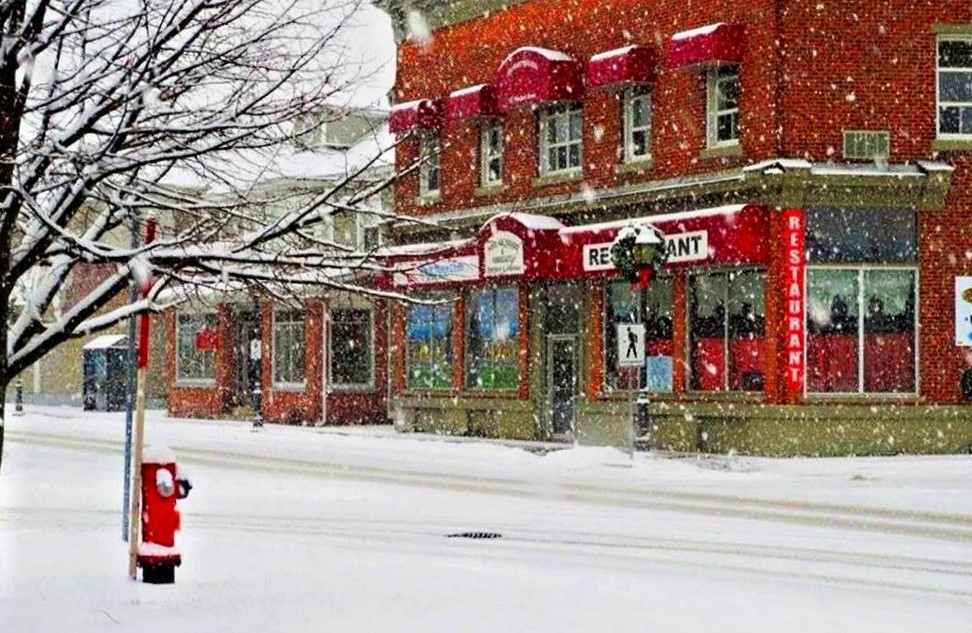
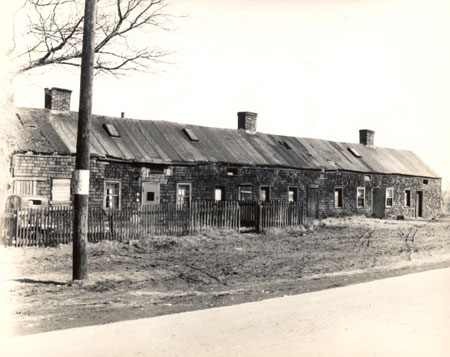
Christmas on the Miramichi, Miramichi, New Brunswick Photo courtesy of the Our Miramichi Heritage Family FBsite.

Recently, while browsing through some of the recipes in the My Mother’s Cookbooks collection I came across one of Mum’s handwritten holiday menus. A list of all of the special foods she planned to prepare, share and serve during the season. It contained all of the usual suspects, Squash Puff, Cornish Pasties, Whipped Shortbreads, Buttertarts, Doughnuts, Fruit bread, Sausage rolls, etc. including Frying Pan Cookies.

I remember frying pan cookies, they appeared perrennially each Holiday season, but I don’t recall them being anyone’s favourite. Mum spent weeks cooking and baking from her lovingly maintained list of each family member’s favourite foods. Come the Holidays some of each of the prepared favourites would be retained for everyone to share, the remainder packaged for the favoured family member to ‘take home’. Which of course helps explain the size and complexity of Mum’s Holiday menu.
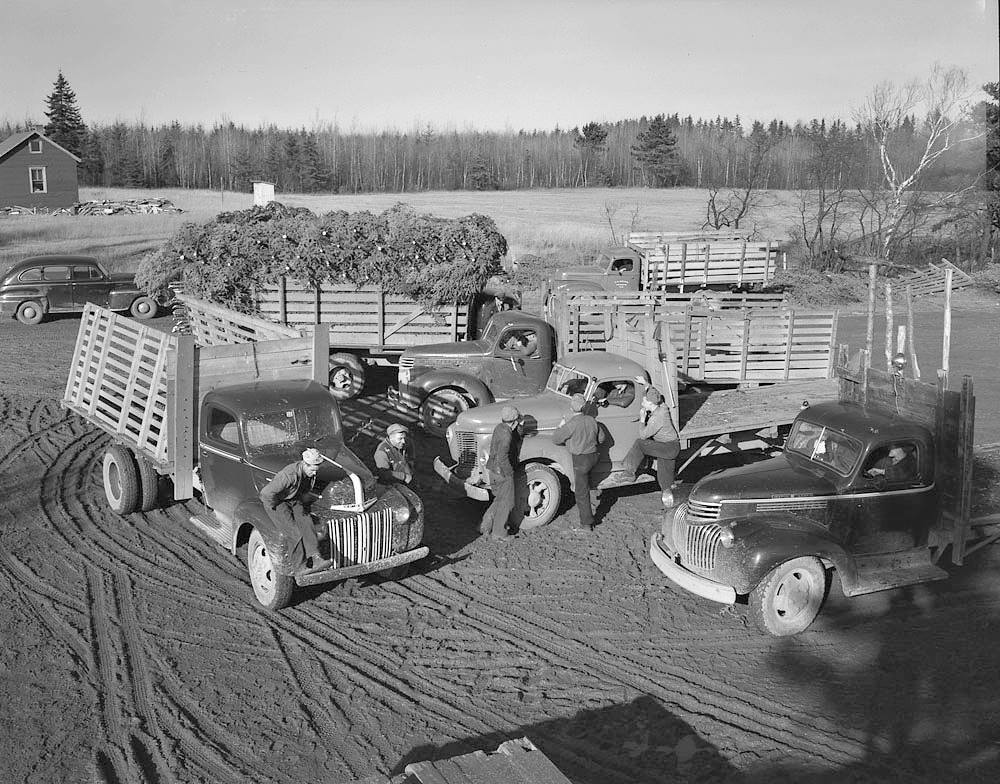
Holiday preparations, Christmas tree harvesters, Miramichi, NB c.1945 Photo courtesy of the Our Miramichi Heritage Family FB site.

Mum loved to discover new foods and managed to embrace the small bits of diverse culture and tradition she encountered, honouring and respecting those whose life and times intersected with hers, using food. At Holiday time that meant providing the best traditional experience for each and everyone at her table through their favourite holiday foods.
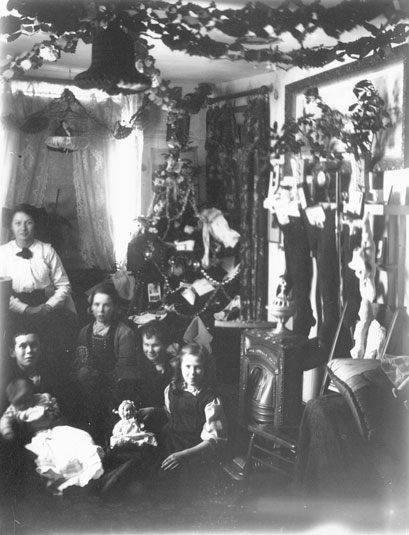
The Buckley Family Christmas c. 1915, Guysborough, NS Photo courtesy of the Nova Scotia Archives Buckely Family collection, William H. Buckley Photo # 1985-386 #22

When my then boyfriend, now husband Ray, found himself with a last minute change of his holiday plans, of course he was invited to spend the Holiday at my parent’s home. The haste of invitation restricted Mum from learning about Ray’s favourite foods and her limited knowledge of his background precluded her from preparing something specifically for him.

Ray’s first Christmas with our family was already heading for the record books. Christmas dinner was being hosted by Eleanor, My sister in law Darlene’s Mother, aided by her son a professional chief. The meal was outstanding, variety of roasted meats, vegetables, salads, and desserts, oh the desserts. After a lovely meal and time spent catching up on the year’s events in our lives, Ray and I along with my parents began the hour long drive back to my parent’s home.
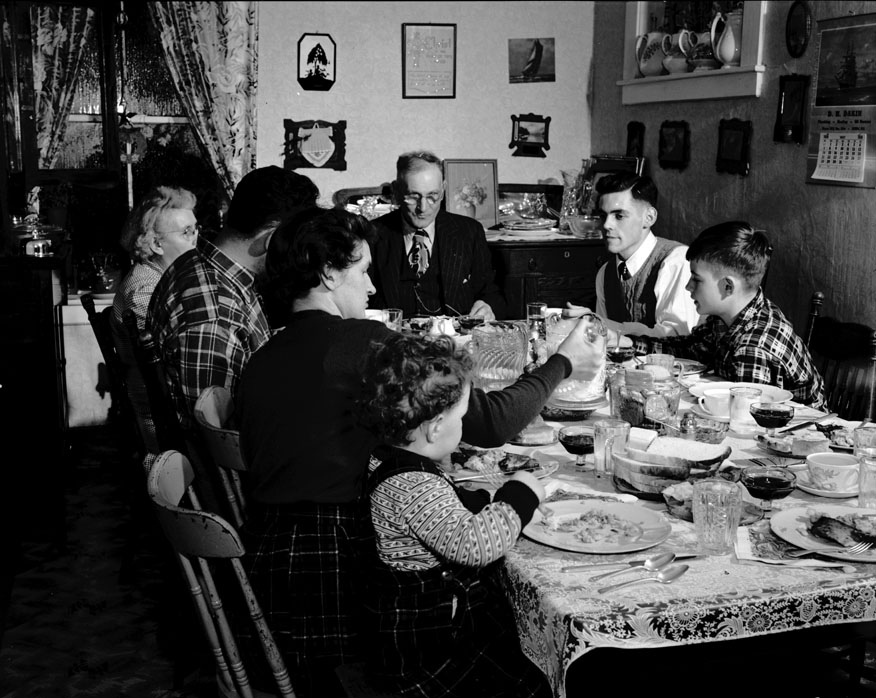
Christmas Dinner at Vian Aandrews’ c. 1950 A John Collier jr photo courtesy of the Alexander H. Leighton Collection at the NS Archives Image # 1988-413 negative 1895-d.

During the drive, the meal we had just consumed was lauded and appreciated by everyone. It was Dad, who’d pointed out delicious tho it had been, it had not been a ‘true’ Christmas dinner. He’d missed the turnip, and jellied salad had not replaced his favourite squash puff. Ray empathizing with Dad chimed in that yes, he’d missed the canned peas, with the turkey. Mum turned to meet his eyes in the darken car. “Now that is interesting Ray. Canned peas, to go with your turkey dinner. It is a good thing I have the turkey thawed, we will just have our true Christmas feast tomorrow”.
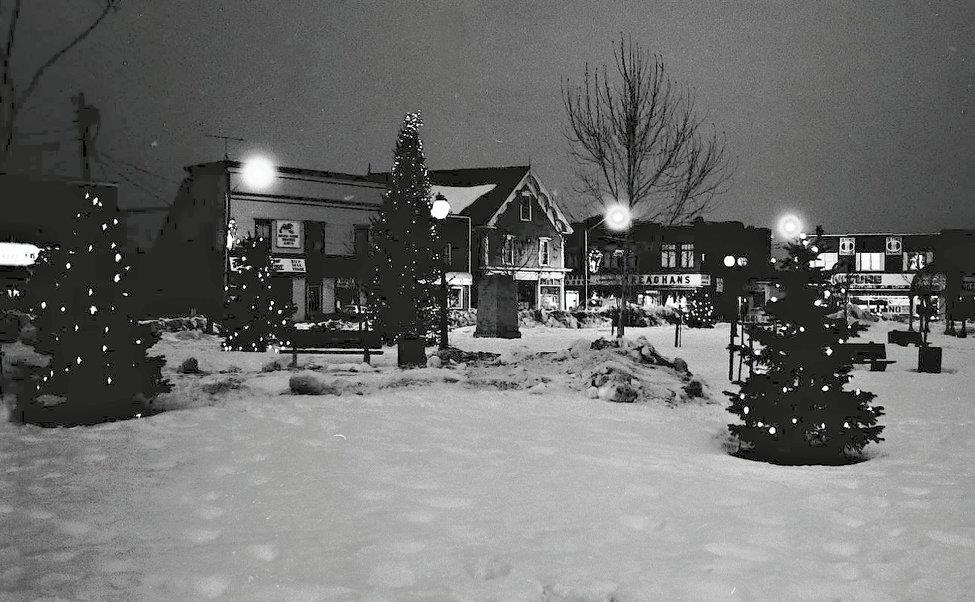
Christmas in the Miramichi, Miramichi, NS Photo courtesy of the Our Miramichi Heritage Family FB site.

The next morning Boxing Day, Mum was up early with the turkey stuffed and in the oven before most of the family were roused for the day. My parents retirement home in the central New Brunswick community of Ludlow did not offer much in the way of retail experience, especially on Boxing Day. So I was surprised, as I wiped sleep from my eyes, to find Dad donning his jacket and boots, heading out to find an open convenience store. You see Mum did not have canned peas on hand.

Oh sure, there had been a time when canned peas had appeared on our family table but they had long since been replaced with the frozen variety. For Mum that did not mean they could be used in a pinch, not for Christmas dinner. Ray had said canned peas, canned peas he would have. Dad always Mum’s accomplice when it came to ‘doing’ for family, happily made the slog to the local Irving and snagged a can of peas.
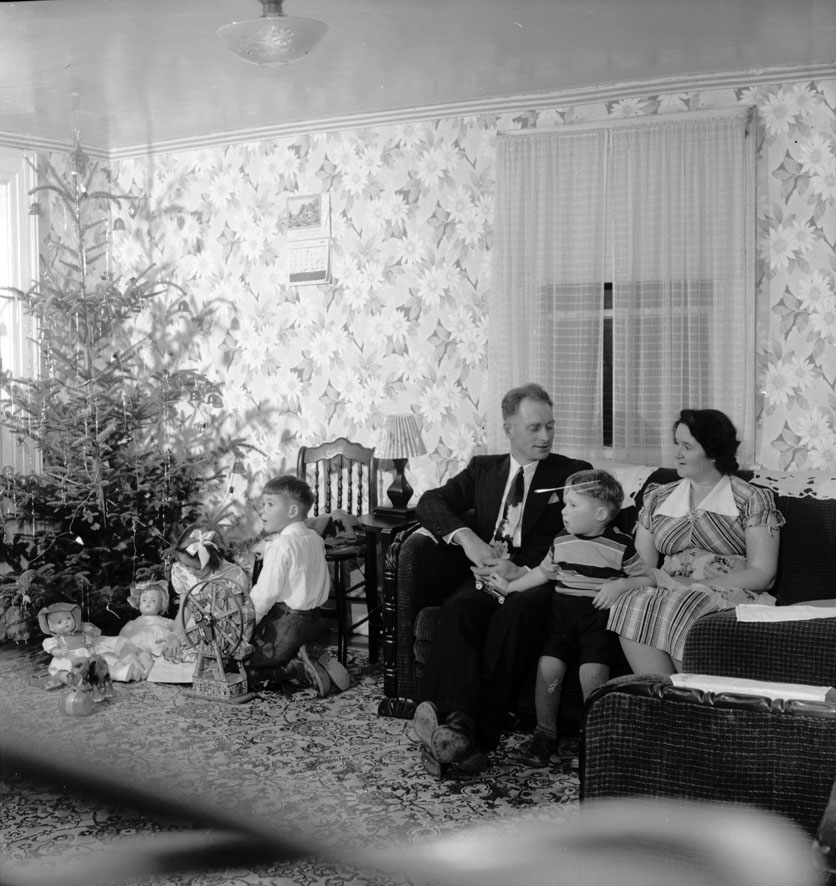
The Height Family c. January 1951 Photo courtesy of the Nova Scotia Archives. Photograph appears courtesy of the Alexander H. Leighton Collection at the Nova Scotia Archives – John Collier Jr. image 1988-413-4003-d

Ironically, I was the one who nearly ruined her plan to assure Ray had his peas just the way he liked. Fortunately, I was saved from an agregious mistake, by Ray’s observation ‘Oh you are heating the peas?’ You see Christmas dinner canned peas are not a ‘vegetable’ or at least not served as a one, they are served cold as a condiment, similar to cranberry sauce.

As was her habit canned peas along with a considerable number of Ray’s other favourite foods were added to her list of Holiday favourites. When I began writing this piece, I was stumped about whose list of favourites included Frying pan cookies. As I considered the recipe it became clear…dates, cherries, coconut; simple, quick, one dish…Frying pan cookies were Mum’s favourite.

My folks are both gone now but they live on in the hearts and minds of those who shared their table and spent time on Mum’s list of Holiday Favourites. A little last minute Holiday baking is in my future, Frying Pan cookies will make an appearance this year. Wishing you and your family the very best of the Holidays and a healthy and prosperous New Year!

My Mother’s Cookbooks Frying Pan Cookies

Ingredients:
1cup white sugar
1 cup dates chopped
2 Tbsp butter
1 egg
1/2 tsp vanilla extract
1/4 tsp salt
1/4 cup candied cherries chopped
2 cups rice crisps
1/2 cup (or so) of shredded coconut

Method:
1. Place the sugar, dates, butter, egg, vanilla and salt in an electric fry pan cook for one minute.
2. Add cherries and rice crisps, stirring to combine.
3. Portion in to small balls and roll in coconut.

Acknowledgement: I acknowledge that the land on which I live and write about is the traditional unceded territory of the Wolastoqiyik (Maliseet) and Mi’kmaq Peoples. This territory is covered by the “Treaties of Peace and Friendship” which Wolastoqiyik (Maliseet) and Mi’kmaq Peoples first signed with the British Crown in 1725. The treaties did not deal with surrender of lands and resources but in fact recognized Mi’kmaq and Wolastoqiyik (Maliseet) title and established the rules for what was to be an ongoing relationship between nations.

Friends, Fruit and Sultana Cake

For Mum, Christmas Holiday baking began in October. Fruit cakes, plum puddings, gum drop cakes, things which need curing were first, followed by the long list of sweets and savories which had become favourites in our family. Christmas baking for Mum meant focusing on special recipes those reserved for Christmas, including Elizabeth Moody’s Sultana1 Cake.

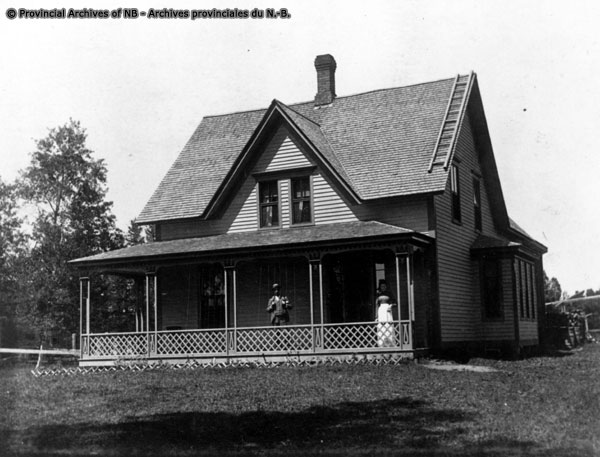
Vickers family home, Blackville, NB c.1900 Photo courtesy of our Miramichi Heritage Family FB site.

The telling of how this recipe became part of the My Mother’s Cookbooks collection is almost as much a Christmas tradition as the cake it’s self. Elizabeth Maud Walls Moody born 1895 Blackville, Northumberland County, New Brunswick was a woman known for her baking, her Sultana Cake in particular, but she was also known not to share this recipe.

Not all cooks share their recipes. It is a personal choice, and quite reasonable considering the risks to reputation sharing a recipe might mean. Elizabeth did not share this recipe, but she made the cake and shared it, generously. How else would she and her Sultana cake have gained reputation?

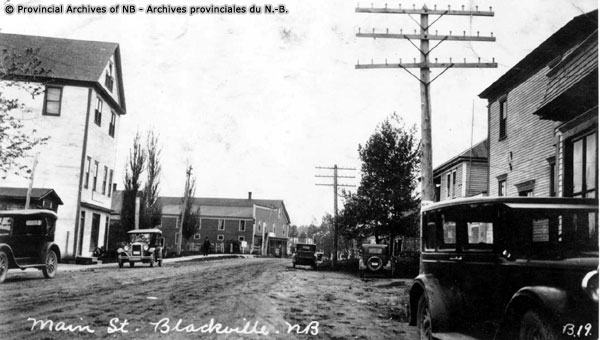
c. 1930, Main street Blackville, NB Photo courtesy of the Provincial Archives of New Brunswick Blackville Historical Family Collection Image number P143-18

Women’s Institutes; The Red Cross; Home and School Associations; Hospital Auxiliary’s; Church women’s groups; Legion Auxiliary’s etc. represent women actively serving their communities. Fundraising, the means to do the work of the group depends heavily on the generosity of women like Elizabeth and Greta Vickers Sturgeon. Scratch under the surface and you see hours of back breaking work, volunteer effort, by women. Cooking, baking, serving, washing dishes, etc. all done in aid of the group’s cause, suppers, bake sales and catered events.

For Elizabeth and Greta gaining a reputation as a good baker resulted from long hours of community and church group service. When fund raising was needed, women like Elizabeth and Greta went to work. Both wives and mothers, Elizabeth and Greta knew each other well as they did most in the small community.

Main street Doaktown, NB c. 1909 Photo courtesy of the Provincial Archives of New Brunswick Miscellaneous Post card collection Image # P46-54

Greta and Elizabeth share deep roots in the Miramichi region of New Brunswick, their settler families were primarily from Scotland, Ireland, and England. Settlers drawn by the promise of the areas natural resources, timber, and fish. Blackville, located on the Southwest Branch of the Miramichi River was settled first by Davidson settlers prior to the Revolutionary war and became a business center and mill town in the 1850’s.

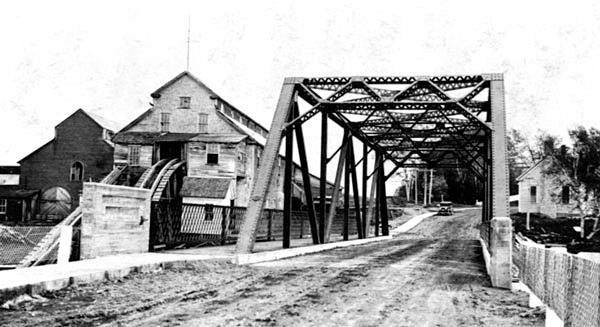
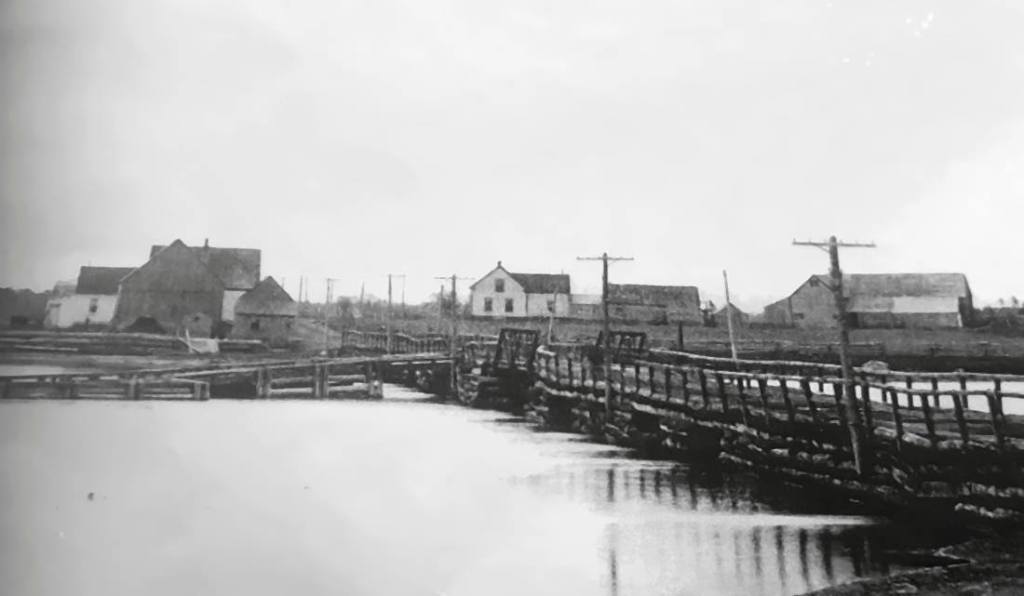
Bridge and Mill at Blackville, C. 1930s Photo courtesy of the Our Miramichi Heritage Family FB site.

It is common to see raisins in fruit cake recipes, along with the candied cherries and fruit peel. Fruit cake which has been in existence for hundreds if not thousands of years, was banned for a considerable period in Britain. Dried and preserved foods of all sorts were a practical reality during the Northern Appalachian Acadian winter when dried berries, meat, and fish comprised a large portion of the diet. So it is not surprising that during the Victorian period when Fruit Cakes began appearing as Christmas treats (encouraged by the festive green and red cherries) New Brunswickers were quick to assume it as Christmas tradition.

Elizabeth Moody’s Sultana cake is a ‘light’ fruit cake. Many fruit cake recipes are very fruit dense and the cake merely a vehicle to deliver the fruit. This cake is rich, moist and delicious on its own, with the fruit it is one of the best fruit cakes I have ever eaten.

So, how did it come that Elizabeth Moody’s recipe made its way in to the collection… Greta, despite being almost 20 years Mum’s senior, was a good friend and neighbour. Greta and her husband Freeman lived across the street from our family home, for the 17 years or so our family lived there. For many of those years, Greta and Mum met at least 3 times a week for a cuppa and chat. Usually, Mum would ‘just run over to Greta’s’ when she had a few minutes and there was an older sibling about to keep an eye on me, the youngest. Occasionally, I would accompany Mum to visit Greta, which I loved. I recall vividly those visits, and the cat clock which hung on Greta’s kitchen wall. The eyes tracking left and right, tale swinging right to left fascinating to my child mind and a great diversion as the two women chatted.

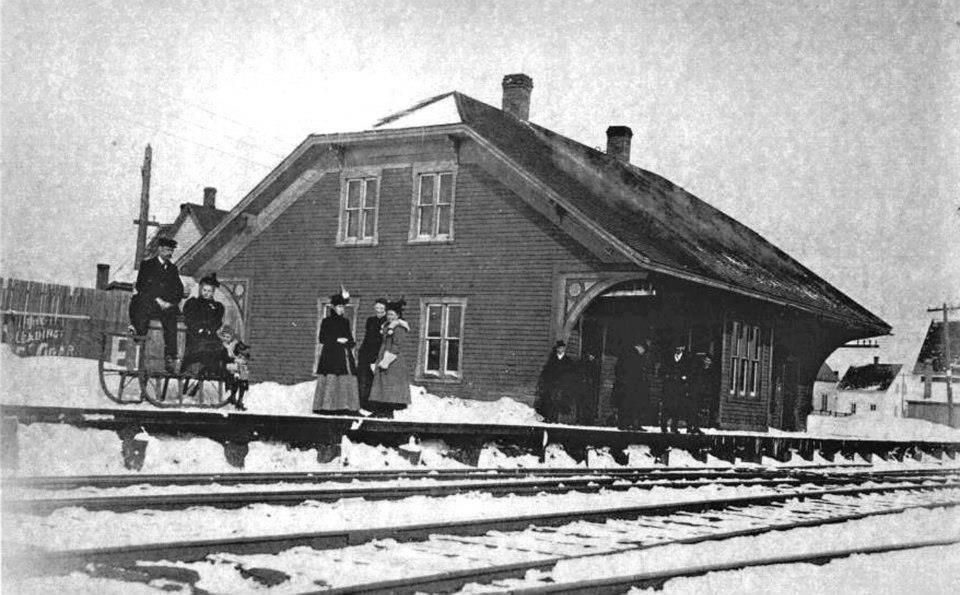
Blackville, NB train station c. 1890

One morning just before our family left Blackville in July of 1967, Greta invited Mum for a chat. Several times over the years of their friendship, the subject of Elizabeth’s Sultana Cake came up in their discussions, usually after one or the other had attended an event where the cake had appeared. Greta and Mum were avid bakers, and good friends. It surprised Mum to learn that Greta had the recipe, in fact had had it for some time. Greta who’d been sworn to secrecy by Elizabeth had spent considerable time agonizing whether to share the recipe with Mum. Now that Mum was leaving and knowing how much Mum enjoyed the cake she’d decided to break her promise to Elizabeth and share it with Mum. Mum kept to the strict promise she made to Greta. The cake remained ‘special’ it appeared only at Christmas, she never made it for any other purpose. Only after Elizabeth’s death in 1991 did I get my first copy of the recipe. I guess you can say friendship brought this recipe in to the My Mother’s Cookbooks Collection.

Elizabeth Moody’s Sultana Cake

Ingredients:
1 cup butter room temperature
1 1/2 cup white sugar
3 eggs at room temperature
1 1/2 tsp baking powder
1tsp lemon extract
1 tsp vanilla
1tsp almond extract
3 cups sifted flour, divided
1 cup warm milk
1 pkg white raisins (~ 11/2 cups)
1 pkg cherries (~1 cup)
1 pkg mixed peel and mixed fruit(~1 cup)

Method:
1. Preheat over to 250 degrees F. Grease and flour two 9 inch x 5 inch x 3 inch loaf pans and set aside;
2. Cream butter and sugar until light in colour, add well beaten eggs and mix to combine;
3. Add lemon, vanilla and almond stir to combine;
4. In a separate bowl sift 2 1/2 cups of the flour, baking powder together and set aside;
5. Alternate adding the flour mix and milk, being careful not to over beat;
6. Dust fruit with the remaining flour and add to the cake batter, mix to combine;
7. Divide the batter evenly between the pans and place in the oven for 2 hours or until tester inserted in to the center of the cake comes out clean.

Elizabeth Maud Walls Moody
Born 22 April 1895, was the oldest child of Justus Walls and Elizabeth Ann Astle Walls. In 1912 at age 17 years, Elizabeth married Wilmot Moody and settled in Blackville to raise their family. Elizabeth and Wilmot had two children before Wilmot’s untimely death in 1923. Elizabeth raised their two children on her own, never remarrying. She lived in Blackville until her death in 1991.

Greta Myrtle Vickers Sturgeon
was born 16 Aug 1911 to Thomas Vickers and Lucinda Maud Astle. On 14 December 1927, Greta married Freeman Ernest Sturgeon. Freeman and Greta raised their 9 children in Blackville. Greta died in 1994, Freeman a year later.

T.C. Millar house, Derby, Northumberland County New Brunswick, C. 1892 Photo courtesy of Miramichi Historical Society Collection Provincial Archives of New Brunswick Image # P204-261

Explanations and References:
1. Sultana raisins are a variety of raisin, dried from white grapes of particular varieties. The term ‘Sultana’ was once used to refer to ‘raisin’ generally.

Christmas Doughnuts and House Girls…

There were many baked treats on Mum’s Christmas preparation list, but only one item warrants two versions…Doughnuts. The most Canadian of doughnuts does not come from a coffee shop, it does not have maple icing or a fancy name…it is a cake doughnut made with molasses. Once fried, the doughnuts may be rolled in granulated white sugar, although the non sugared version is my personal favourite.

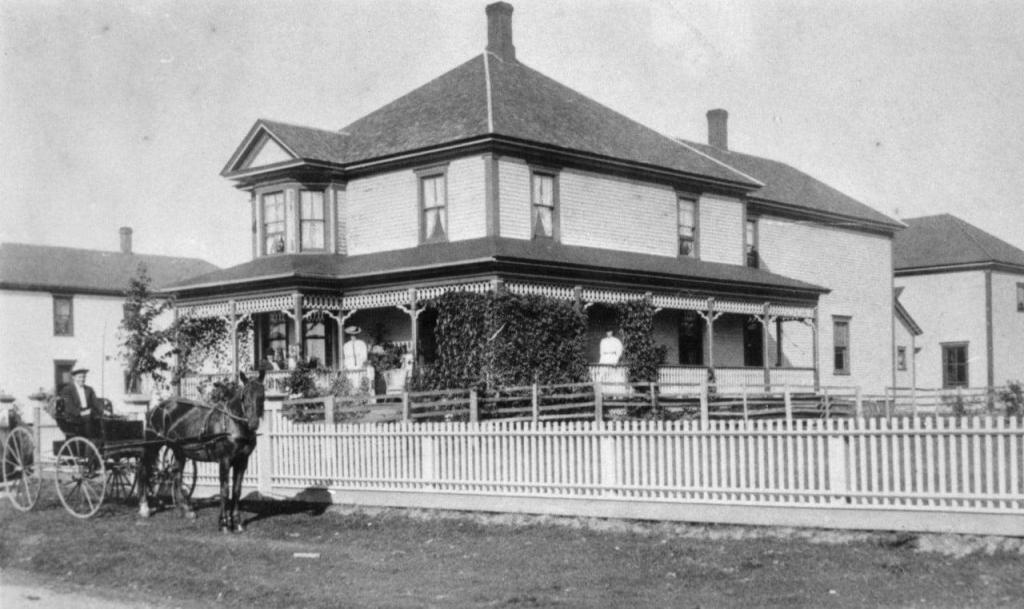
The home of Otto and Amelia (Wilson) Hildebrand, Main Street Doaktown, NB ca 1905-10. (P156-34, PANB)

It is impossible to know when doughnuts first came to Canada, since fried batter in one form or another has been around for thousands of years. What we can say is that doughnuts saw a major upswing in popularity after veterans returned from the First World War. Many Canadian Soldiers were introduced to the delicious fried treat by French families, who were doing their part to support the young soldiers fighting in nearby trenches. A good many of those young soldiers returned home with the taste for doughnuts.

The lives of our early ancestors were difficult, but none more so than those coming to age in the first quarter of the 20th century. Nearly 50 years of growth and development both technologically and socially had increased expectations. Expectations for a life different from their parents, an easier one, more advanced and modern were promised, development and modernization do not however follow a straight path. No one could know the challenges which would present in the first half of the 20th century and how much they would challenge and frustrate the expectations people had for their lives.

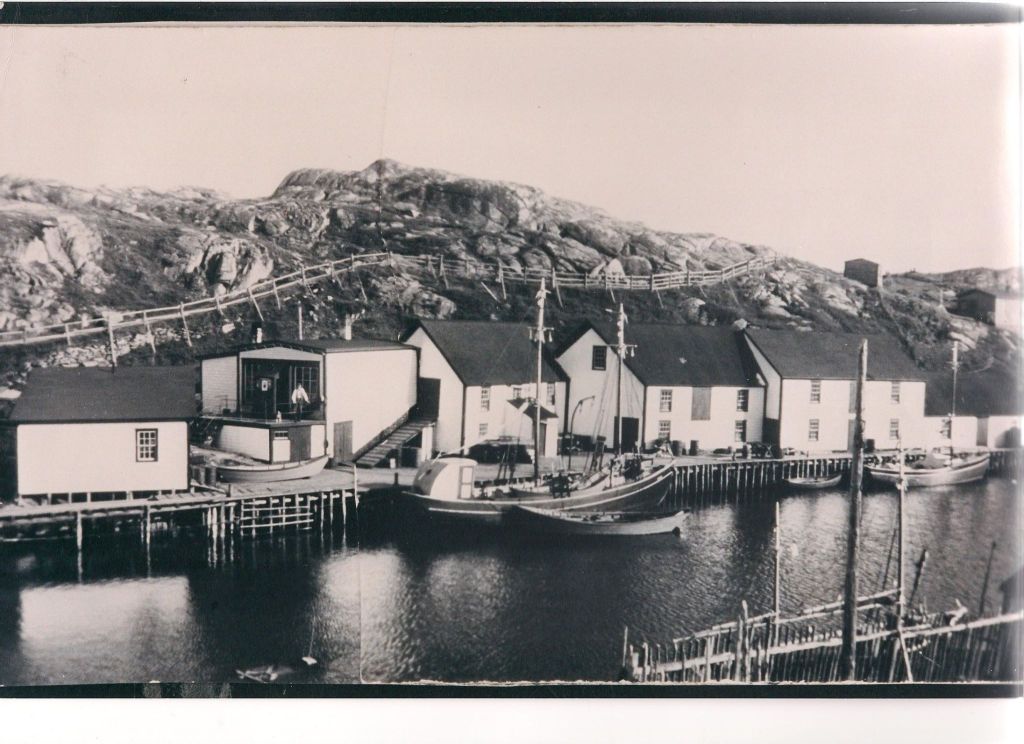
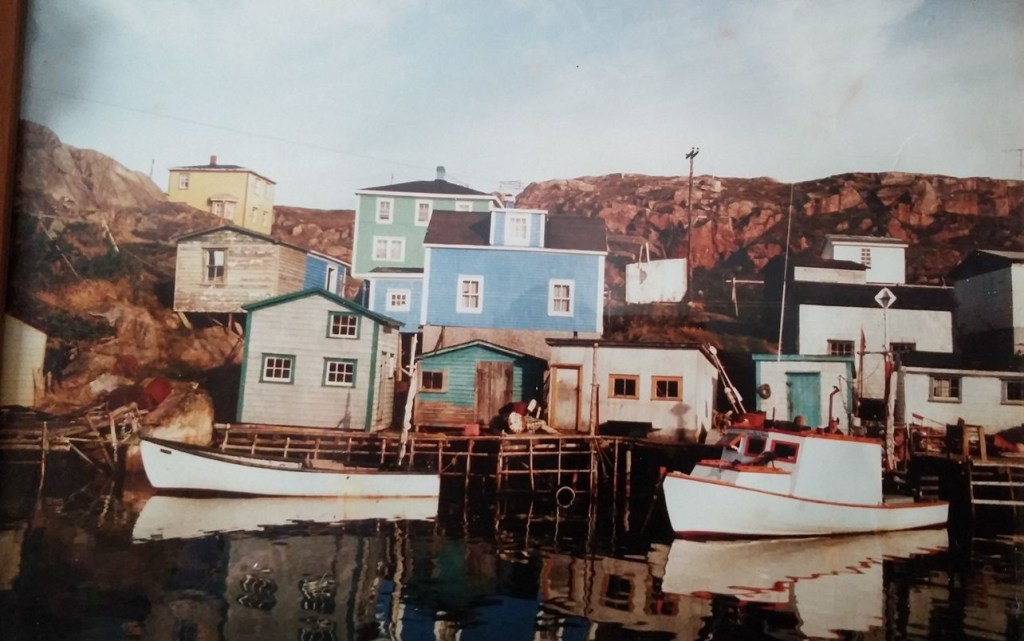
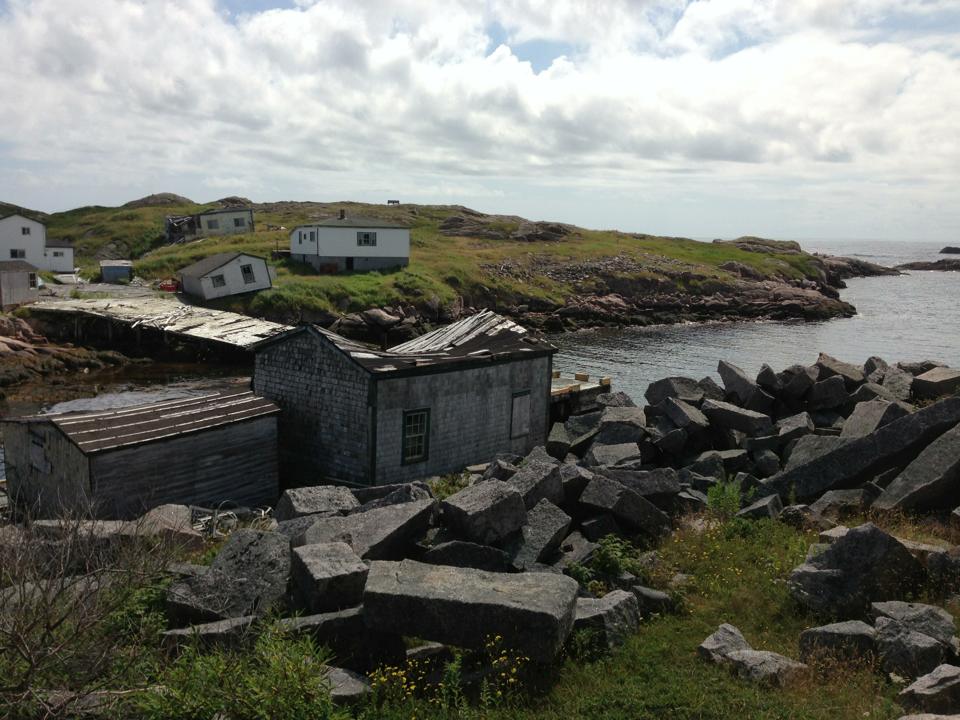
Petites, NL Harbour,and Merchants Row. Photograph Courtesy of the Petites Church Newfoundland: Restoration Project Facebook site.

Molasses, began falling out of favour as a baking ingredient as soon as a regular and affordable supply of sugar became available. Molasses has a unique flavour profile, one far different from that of sugar, and then there’s the colour issue. The strong dark colour of molasses and its characteristic flavour contributed to the perception Molasses is ‘old fashioned’ and ‘poor mans food’, especially as a baking ingredient. Yet most families in the Atlantic region continued to have molasses on their tables well in to the 1960s.

Growing up in the bustling out port fishing community of Petites, on the southwest coast of Newfoundland Maud Blanche Tufts knew molasses, it was cheap and available (thanks to fish and its trade with the West Indies). The fishing industry in Newfoundland, upon which out port communities had been built, depended heavily on molasses. For the fleet of vessels fishing the nearby Rose Blanche fishing grounds and on shore where the fish was processed, molasses was staple, providing a cheap and satisfying source of carbohydrates., and micro-nutrients.

Petites, Newfoundland c.1950 Photograph Courtesy of the Petites Church Newfoundland: Restoration Project Facebook site

Petites, despite not boasting more than 200 residents, was a community built on serving not only the fishing industry but also supplying the smaller out ports of the region. Strategically located near the rich fishing grounds, and graced with a source of fresh spring water, Petites boasted up to 6 stores, one of which was operated by Maud and her husband Isaac Mauger. It is without doubt a puncheon1 of molasses graced their storeroom, and that locals and fishers alike depended upon it for their supply.

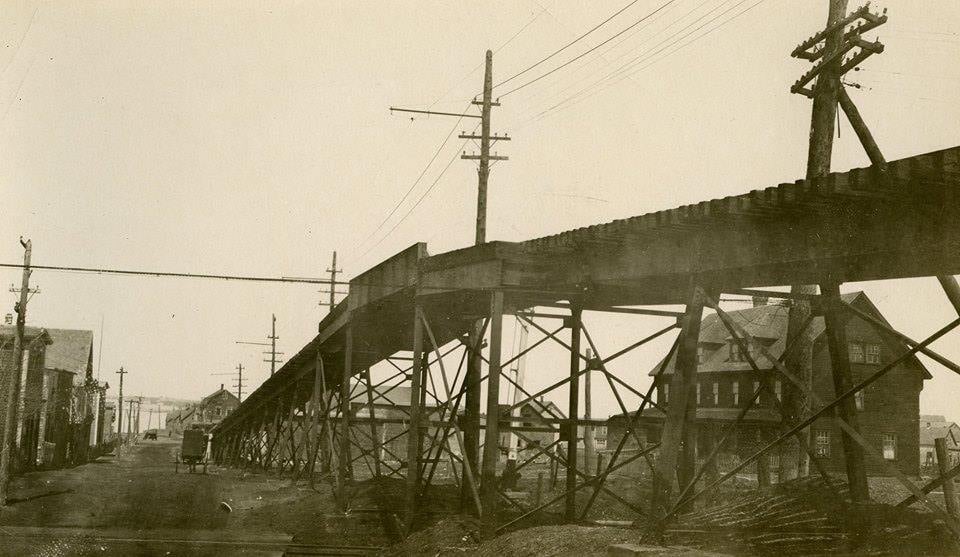
It would be easy to to think of Petites as isolated and insular during this time, but like Glace Bay, Nova Scotia, Petites was well connected to the outside world and surprisingly cosmopolitan. Trade vessels which supplied communities like Glace Bay and Petites linked them to far flung places, including European, American and West Indian ports of call.

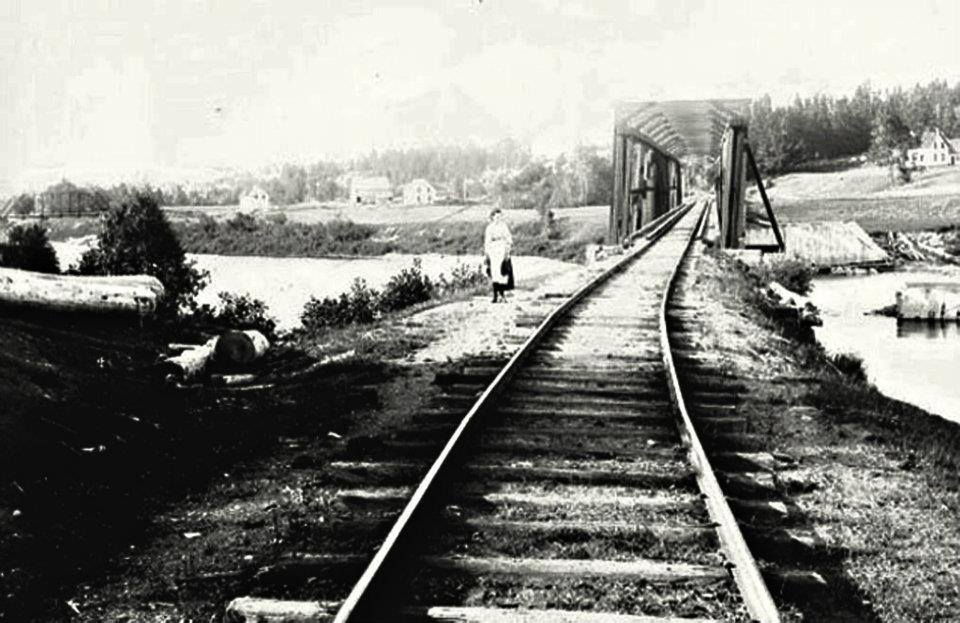
Train Trestle at Glace Bay, Nova Scotia c. 1900 Photo courtesy of the Cape Breton Island the other Scotland across the Atlantic FB site.

Sarah McDougall and her family relocated to Glace Bay, when her father Allan took full time work in the coal mining industry. For Sarah this move was transformational, her life transformed by new people, new foods and new opportunities not available in her rural Cape Breton Backland home.

Main Street, Glace Bay, Nova Scotia c. 1920 Photo courtesy of the Cape Breton Island the other Scotland across the Atlantic FB site.

For young women, respectable young women like Sarah, changing times, meant she could work outside of home, at least until her marriage. Some young women would seek training as nurses, and teachers, others moved to larger centers for work in factories or as store clerks but many women including Sarah found work as “house girls”2. Glace Bay at the turn of the century was a growing bustling industry town, with tram cars, stores, and people from all over the world seeking work in the mining and fishing industries. Merchants, businessmen, professionals and mine officials had the means to hire young women like Sarah to support their households, while the majority of citizens struggled to meet their basic needs. Until she married Sarah’s wages would have been added to her family’s resources with a bit reserved for Sarah to buy something for herself, a bit of pretty lace for her hat or a sugary treat from one of the local bakeries which served area workers. At home molasses remained a dietary staple.

It is not in the least surprising that at the end of the First War, once the Influenza Pandemic of 1918 -1919 had waned people wanted to celebrate. The lingering piety of the Victorian period was forced aside by enjoyment, indulgence and by a focus on the new, the modern and on luxury, doughnuts included.

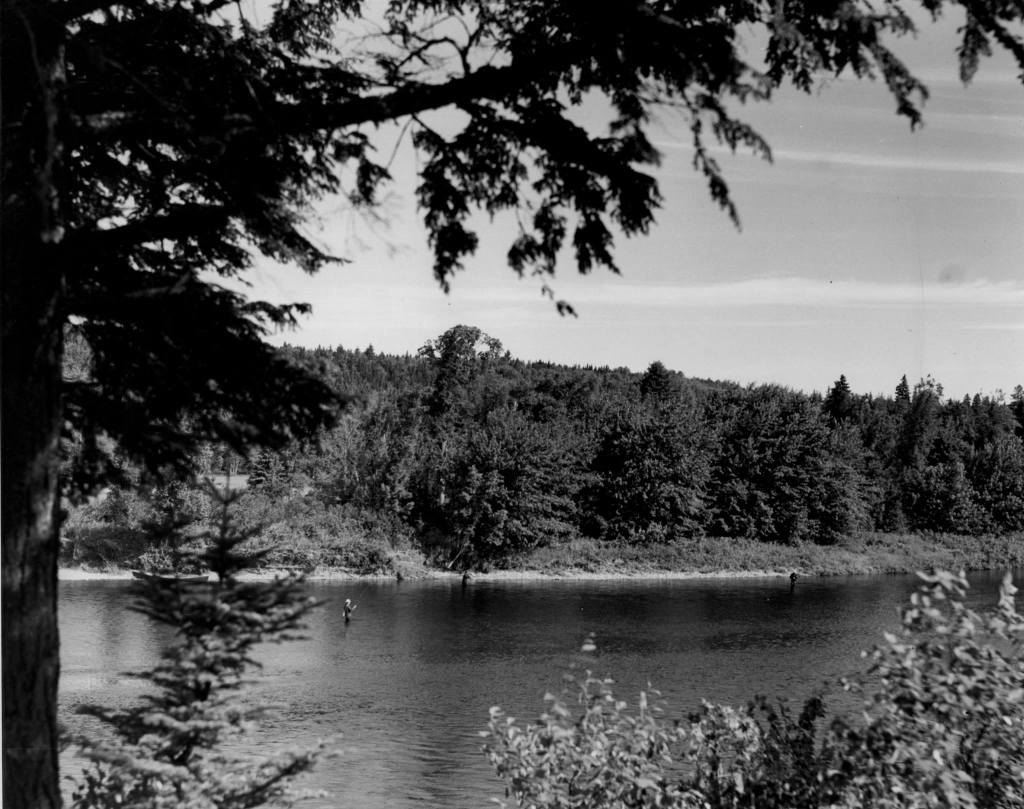
Nelson Hollow – near Doketown, N.B. – scenic – wading on gravel bar – in Miramichi River, 1950. Ingenium digital archives Archival Number X-32648

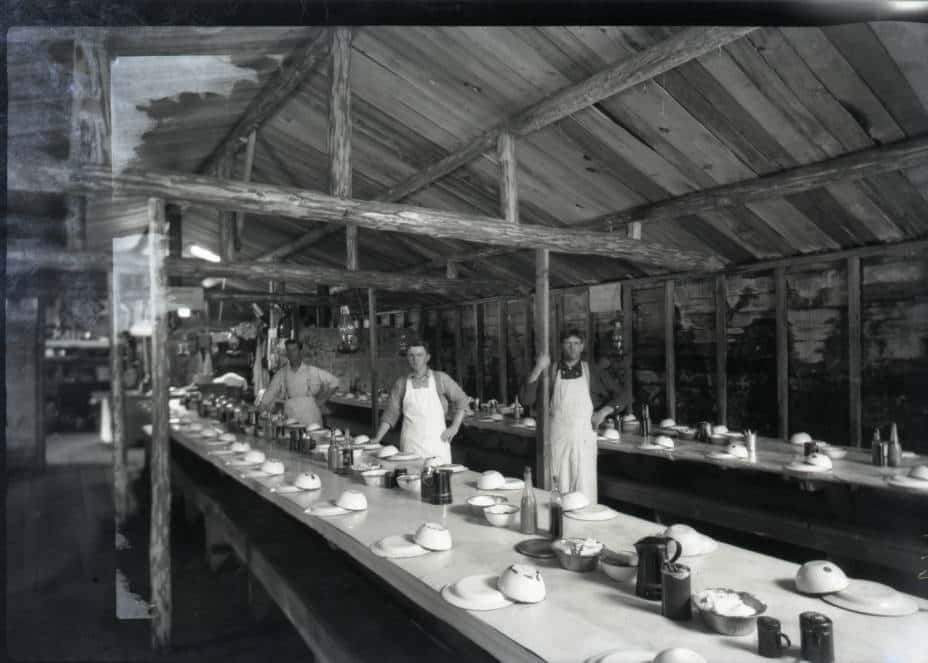
Ethel O’Donnell of Carrolls Crossing in central New Brunswick, married London born First World War veteran Wilfred Knight in 1919. Ethel might have found her first attempts at making doughnuts a challenge but the desire to ‘provide’ for her new husband’s tastes would have seen her working to get it right. Doughnuts quickly became a favourite, appearing in bakeries, home kitchens, and lumber camps. Lumber camp cooks, both men and women, were interested in keeping their crew happy and well fed. By the early 1900’s out migration served to improve conditions for lumber camp workers, by making it necessary for employers to compete for workers. For employers and owners of Lumber camps recruiting and keeping workers meant finding and keeping a good Camp cook, especially one able to provide for changing and modern tastes of workers.

New Brunswick farm – near Nelson Hollow – near Doaktown, 1950. Ingenium digital archives Archival Number X-32690

The Roaring Twenties, and the modernity which was taking hold in the region was short lived, ended by the dark days of October 1929 and the beginning of the great depression. The Depression would force old fashioned making do and old fashioned molasses back in to the lives of Sarah, Ethel and Maud, as they provided for their families. Did Maud, Sarah or Ethel develop molasses doughnuts? Probably not, but without doubt a home cook, a lumber camp cook, a cook somewhere in the region did. Someone who saved on expensive white sugar by replacing it with molasses, brown sugar and adding ‘molasses spices’.

Miramichi River Lumber Camp dining hall c. 1935 Photo courtesy of the Our Miramichi Heritage Family FB site.

That a recipe for Molasses Doughnuts is found in many family cookbooks across Atlantic Canada (and elsewhere), that they are prepared as Christmas treats and that they reflect the role molasses played in the lives of ordinary Canadians…makes it ‘Canada’s Doughnut’.

My Mother’s Cookbooks … Molasses Doughnuts

Ingredients:
1) 1 cup brown sugar
2) 1 cup molasses
3) 3 eggs at room temperature
4) 5 Tbsp melted butter
5) 1 tsp each nutmeg, ginger, ground clove, and cinnamon
9) 1 tsp salt
10) 1 tsp vanilla extract
11) 1 1/2 cup soured milk with 2 tsp baking soda dissolved
12) 2 tsp baking powder
13) 4 – 5 1/2 cups flour
Method:
1) Prepare your fryer and oil to a temperature of 350 degrees F. (Objective is to keep the oil between 350-360 degrees F while frying);
2) In a large bowel mix brown sugar, molasses, eggs (slightly beaten) butter and vanilla and mix well;
3) In a second bowl combine flour, salt, and spices, mix well;
4) In a liquid measure add baking soda to the soured milk and mix to dissolve;
5) Alternate adding milk and flour to the other ingredients until all of the milk and at least 4 cups of flour has been added. The batter should be thick and sticky, cover and set aside in the refrigerator for at least 30 minutes or up to 1 hour.
6) Place about 2 cups of batter on a generously floured surface, and roll out to about 1/4 inch thick, cut with a doughnut cutter. (additional flour may need to be added to make the batter workable.
7) Fry doughnuts until done, flipping once. Molasses doughnuts can be difficult to cook well, start by test frying for 3 minutes per side, remove and check.
8) If desired roll the hot doughnuts in white sugar before cooling, a paper bag containing the sugar can be used to sugar the batch at once.

A final word about modernity and disease… Pneumonia killed many people through out history, including during the Flu pandemic of 1918-1919, it would take until the development of antibiotics at the end of the first quarter of the 20th century for modernity to remove it as a regular and frequent cause of death. Sadly, Maud Blanche Tufts Mauger died in 1938 of pneumonia, leaving Isaac to raise their young family.

Explanations and Resources:

1. A Puncheon of Molasses – A wooden barrel of molasses which commonly weighted between 1,120 to 1,344 pounds.
2. House girl – a young woman employed as domestic help in the homes of wealthy citizens. By the 1900s the term ‘servant’ was replaced by the more genteel house girl, the work remained.
3. Petites, NL is a resettled community, but efforts continue to restore the Petites Methodist Church, reputed to be the Oldest Methodist Church in North America. https://www.facebook.com/search/top?q=petites%20church%20newfoundland%3A%20restoration

Christmas stockings, a potato and lemon nut loaf

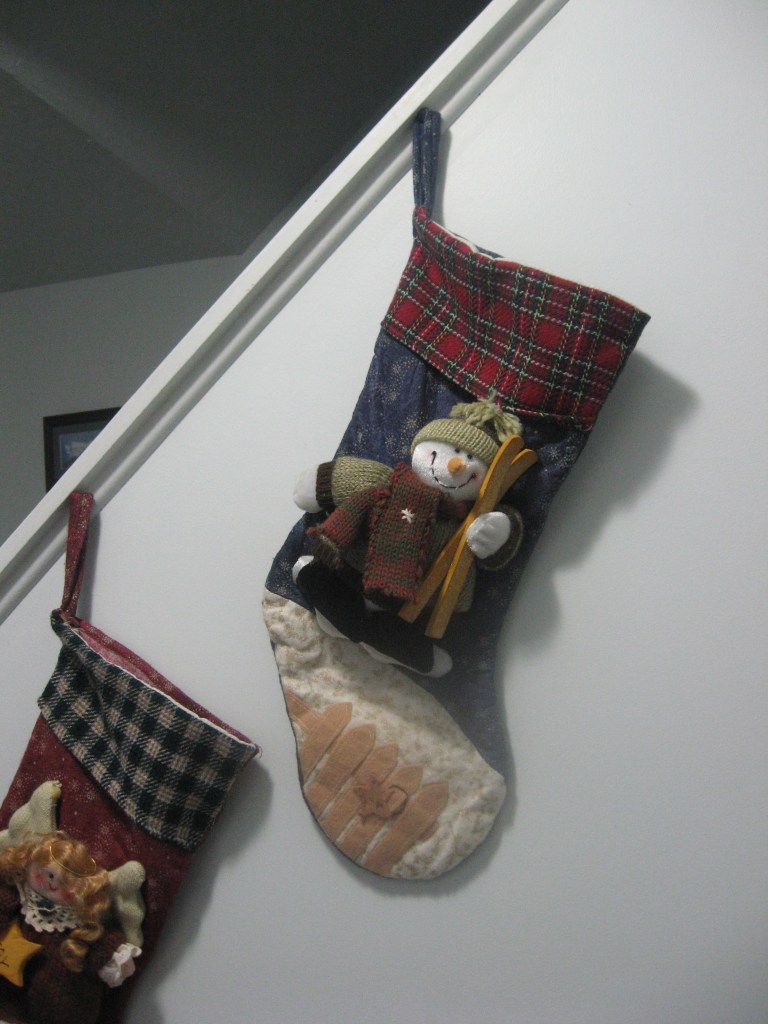
My first Christmas stockings were Dad’s socks repurposed for the night. Don’t get me wrong I was not disadvantaged nor was I unusual, it was the 1960’s, and my parents believed Santa was not really what Christmas was about. Despite that, in the weeks leading to Christmas eve, I heard reminders about Santa’s naughty list and the threat of getting a potato and stick instead of an orange in the toe my Christmas stocking.

Merry Christmas from our home to yours!

I am not sure how the potato and stick family tradition began, (our family’s version of a lump of coal), but I know it started with my Mum’s family since Dad had no tradition of Christmas stockings. The Walls family of Blackville, NB were a tight knit group who loved to laugh and enjoyed playful interaction even as adults, with potatoes playing their part.

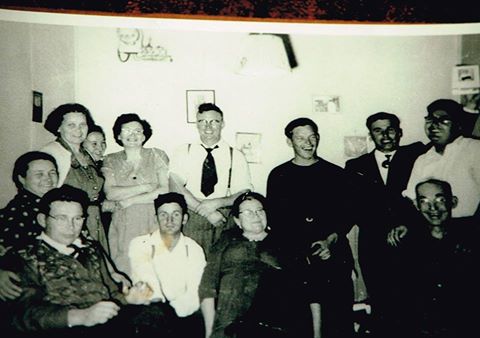
The William and Edith Walls family c. 1955 William (Billy) seated far right; Edith (Edie) seated front center, next to Edie, Ben, and Ted. Second row, left Dorothy, Elsie, Evelyn (peeking over Elsie shoulder) Louise, Royce, George, Steward and Ike.

Of course the potato was a logical choice as a booby prize at Christmas time. The humble and ordinary tuber compares poorly with the treat most often found in my Christmas stocking. Citrus fruits, lemons and oranges are not really ordinary or humble despite their being readily available to us.

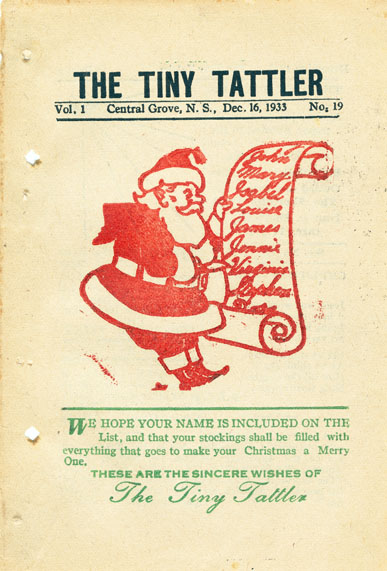
The Tiny Tattler – 13 December 1933 vol 1 issue 19 Photo courtesy of the NS Archives.

The origin story of citrus fruits is a difficult one, there are various theories on where the fruit trees grew naturally and when their spread began. Regardless of where and when we know the sour sweet fruits have been valued and pursued for thousands of years. Citrus trees were introduced to North America early, probably by the Spanish, by the mid 1800’s oranges and lemons were growing in Florida and other southern US states. It would take major developments in refrigeration and transportation for citrus to become the available fruits they are today.

And yet citrus fruits have had a long association with Christmas despite the challenges of transportation and storage. Citron or candied citrus peel appeared in recipes for Christmas cake as early as 16th century. Drying with sugar preserved the fruit but required careful attention to avoid quality issues from variances in temperature and moisture during storage. Available, known and pricy added to their exotic and special nature, helping solidify citrus as prized holiday fare for north eastern North Americans.

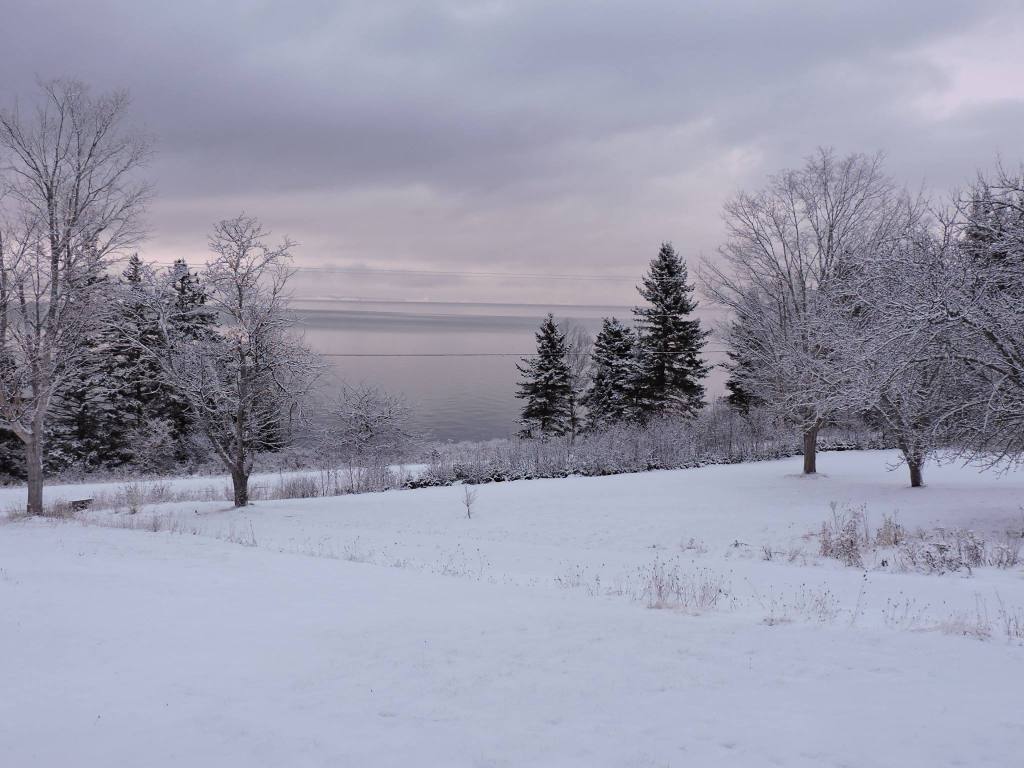
Christmas morning, Irish Cove,, Richmond County, NS c,2015 Elizabeth Lyons Morrison

Potatoes have a world wide prevalence, citrus will never have. Despite being introduced to the wider world much later than citrus, their ability to retain freshness through months of storage made them a logical choice for seafarers. The ease at which potatoes grow in acidic soil made them a logical choice for settlers too. It took time for potatoes to grown in popularity in Europe but in North America need saw potatoes playing a key role in preventing starvation and hunger.

Nicholas Doucette, farmer-fisherman, harvesting his potatoes. Near Mavillette; November, 1950 Photo courtesy of the NS Archives Alexander H. Leighton Nova Scotia Archives 1988-413 negative number 819-d

Growing conditions in Maritime Canada are extremely varied, from province to province, county to county, farm to farm, field to field the variability in soil and weather seriously limits variety and productivity. Microclimates do aid in growing some temperature sensitive crops in specific locations but not lemons and oranges. Potatoes on the other hand grow readily provided the soil is well drained and a bit of sunshine is available.

Of course potatoes do make an appearance at Christmas, even when you have been a good child. They play their role in the traditional turkey dinner, and they are important ingredients in traditional feast foods like Poutine Râpée, Latkes, etc. It is likely that potatoes work well as the consolation Christmas prize in part because of their ordinariness, but the potato’s much darker association with hunger and famine, the Irish potato famine in particular plays a role too.

Four of the six bothers and tricksters – sharing a laugh. Left to right – Royce, Isaac, Ted and Steward Walls

The appearance of oranges, fresh oranges in Christmas stockings had to wait for transportation and temperature controlled storage improvements. By the late 1890’s fresh lemons and oranges began to appear most every where ships and trains served, including central New Brunswick. When Grandmother Edie was preparing for her family Christmas fresh oranges and lemons were well established as Christmas fare. Special and exotic oranges got tucked in to the toes of Christmas Stockings, and fresh lemons got made in to Christmas baking like Lemon Nut Loaf.

Food, Drink and the Pleasures of Eating in Old-Time Nova Scotia
Catholic Church Picnic Photo courtesy of the NS Archives Alexander H. Leighton Nova Scotia Archives 1988-413

My Mother’s Cookbook’s

Grandmother Edie’s Lemon Nut Loaf

Ingredients:
5 tbsp melted butter
1 c. white granulated sugar
zest of one lemon
1 1/2 tsp baking powder
2 eggs at room temperature
1/2 c. milk
1 1/2 c. all purpose flour
1/2 tsp salt
1/2 c. finely chopped walnuts or pecans
1/4 c lemon juice
1/2 c. sugar
Method:
1. preheat oven to 350 degrees F or 177 degrees C.
2. in a medium sized bowl blend butter and sugar
3. add eggs and beat well;
4. in a second bowl sift flour, baking powder, salt;
5. alternate adding flour and milk, (ending with flour) to egg butter mixture, fold gently after each addition; toss nuts in with the last flour addition and mix until blended. Over mixing will cause the loaf to be tough;
6. place in a parchment lined 5 x 9 in loaf pan and bake, until nicely browned and the top springs back from a light touch, about 40 minutes;
7. remove from the oven and let cool only while you mix lemon juice and sugar together in a bowl;
8. using a tooth pick poke holes in the top of the cake and then poor the lemon sugar slowly over the loaf,
9. Let the loaf cool completely before removing the loaf from the pan.

Grandmother Edie’s Lemon Nut Loaf.

Merry Christmas


Miner’s Wives and Mothers…

There are a number of recipes in My Mother’s Cookbooks which are traditionally associated with mining and mining communities…Welsh cakes, Cornish pasties, Welsh pasties, hand pies, etc. Although mining of various minerals is very much a Northern Appalachian/ Acadian regional reality, in some areas coal was king.

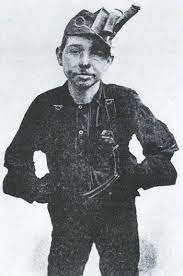
Child Miner c.1890 Photo courtesy of the Public Archives of Canada

Canadian mining communities which thrived during the early 1900’s and even during the depression, attracted skilled workers and labourers from Europe and beyond. A ready supply, miners from Wales/ Cornwall, tradesman from Italy, Lebanese merchants, labourers from Poland, the Ukraine, the Caribbean etc. filled the need in mining towns. The communities which became home to these diverse populations developed food traditions which combine all of the community’s offerings. Polish sausage, Italian cured meats and mid-eastern flatires combined with the more prevalent northern European traditions to create a diverse diet.

For country born women like Margaret McDougall McNeil Morrison in Glace Bay, NS and Jessie Blanche Vye Gaudine(i) in Minto, NB cooking on a coal fired stove required a new skill. Coal fired stoves were the norm in communities like Glace Bay, NS and Minto, NB unlike the surrounding rural farm communities where wood remained the primary fuel source.

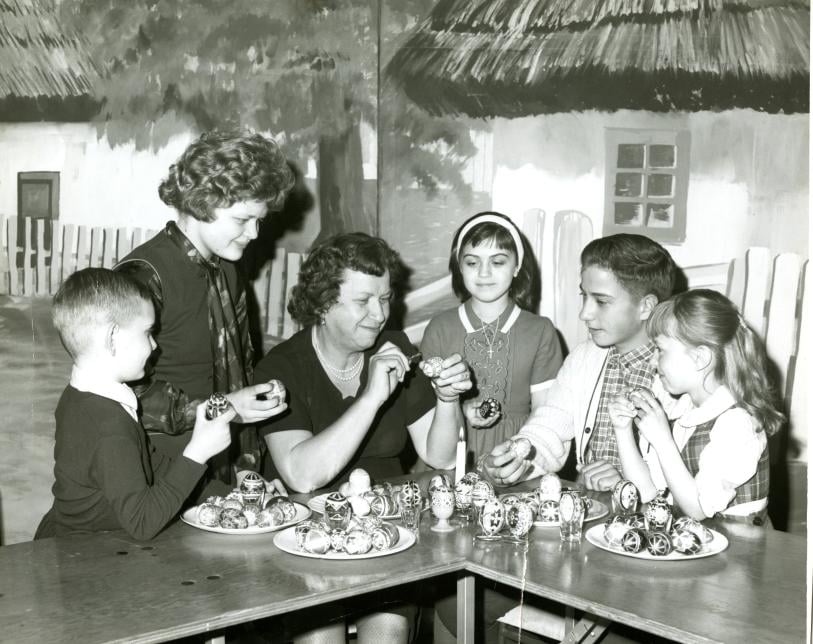
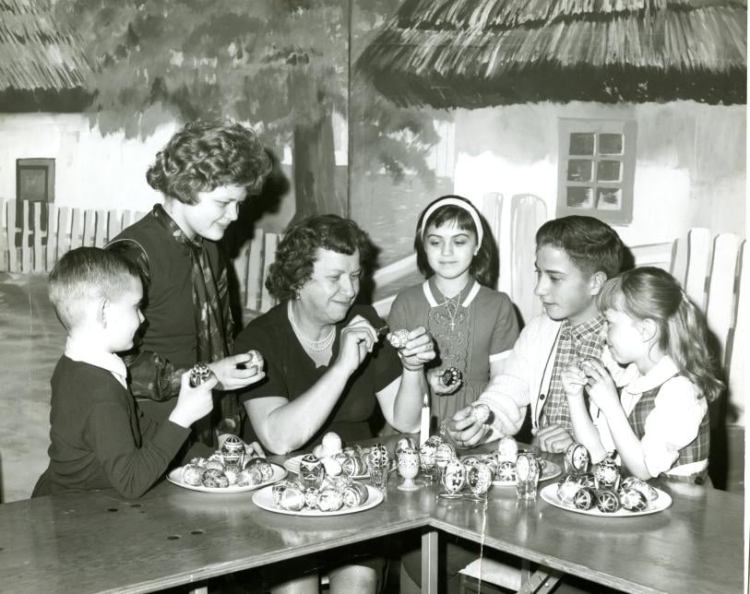
A group of Children learn the traditional craft of egg decoration Ukrainian style c. 1950

Wood stoves were more predictable, coal stoves notoriously difficult to control. So much so a tradition of “Roof Coal Bread”1 developed in some communities. The bread which is scorched and heavy crusted on top (sometimes all over) is still made at local bakeries in Cape Breton. Many mining town cooks have been heard to exclaim…”Oh No, the bread burned…Oh well good it’s enough for the pit.” Alluding to the coal dust which contaminates everything in the mine.

Miners, men and boys entering the pit for their shift in Cape Breton C. 1890 Photo courtesy of the Nova Scotia Archives

Jessie Blanche Vye Gaudine(i) was born on her family farm in South Nelson, Northumberland county, New Brunswick. Jessie’s husband Domenico Gaudini2, a machinist took work with the mine owned by Miramichi Lumber Company3 bringing the family to Minto.

Mining company towns were not easy places, although the coal seam at Minto, NB was considered a stable seam, risk of injury and death was ever present, this in addition to risks posed by poor housing, poor sanitation, and poverty. The Sydney coals fields were more gassy, and with greater overburden issues, the living conditions were similar although more crowded.

Company homes in the Sydney coal fields c1890 Photo courtesy of the Nova Scotia Archives

For Flossie Jane Williams Stackable, coal was a familiar fuel. She also understood better than some the risks inherent in coal mines and coal mining towns. In her home country of Wales coal was a major industry. Flossie would have prepared foods in her Welsh tradition pasties, and Welsh Cakes, possibly combining them with her husband John’s family’s Finnish traditions.

14 year old boy miner Photo courtesy of Public Archives of Canada C. 1900

For Maggie’s whose career as a miner’s wife would turn to miner’s widow and almost immediately to miner’s mother, what she baked would have been dictated by what she had. Flour, oats, lard, sugar were available from the company store and other stores provided of course one had the money.

Flossie’s choices would have been even more restricted after her husband John Stackable4 was killed in the mine in 1925. The challenge facing widows like Flossie and Maggie was daunting… they had little choice, take in laundry, open their modest home to borders and send boy children to the pit to work.

Pit pony, driver and miners in Cape Breton Coal mine c.1890 Photo courtesy of the Nova Scotia Archives

Young boys were valuable as trappers 5 and drivers6, jobs which did not ‘require’ adult strength could be done by boys whose families were desperate for their meager wages. Wages less than half that of adult miners. Bartholomew Stackable and Allan McDougall would enter coal mining early, their boyhoods cut short by the need to feed their family.

Young boys who spent 10 hours a day six days a week in the dark, wet, dusty, rat infested pit opening ‘traps’ and driving ponies instead of attending school and enjoying the sunshine… young boys sustained and comforted by the food lovingly prepared by their Mother’s despite meager means…oatcakes, hand pies, maybe even a slice of Bonnach sweetened with molasses or Welsh Cakes.

My Mother’s Cookbooks Welsh Cakes

Ingredients:
1/4 cup each butter and lard (or shortening)
2 cups Flour
1/3 cup Sugar
1 tsp baking powder
1/2 tsp of nutmeg or mace
pinch of cinnamon
1 egg at room temperature
1/2 cup currents
2 to 3 Tbsp milk
Method:
1) Combine dry ingredients in a bowl and add fat, working it into a fine crumb with your fingers;
2) Add currents;
3) Add slightly beaten egg and only enough milk to create a soft dough;
4) Wrap the dough in plastic and place in the refrigerator for at least 30 minutes;
5) Remove the plastic, roll out dough to about 1/4 inch thick, cut into 11/2 to 2 inch rounds;
6) Fry in a small amount of butter, until slightly browned on each side and cooked through about 3-4 minutes;
7) If desired the cakes can be cooled slightly and then rolled in sugar for added sweetness.

My Mother’s Cookbooks Bonnach

Ingredients:
6 cups of flour
6 level tsp baking powder
1 tsp salt
1 tsp soda
1/2 cup sugar
3/4 cup of melted lard/butter or oil
3 eggs at room temperature
2 cups buttermilk or soured milk
Method:
1) Preheat oven to 350 degrees F.
2) Mix together sugar, oil and eggs;
3) Assemble dry ingredients in another bowl
4) Add dry ingredients to the sugar / fat mix, alternating with the milk until incorporated.
6) Place in a greased 8 inch x 11 inch baking dish and bake 35 -45 minutes until done.

Minto, Sunbury County, NB – Miramichi Lumber Company Mine Shaft # 10 Tragedy

28 July 1932 – Three young boys ranging in age from 9 to 12, lay motionless at the pit bottom, some 35 feet from the surface. A forth child fled back up the wooden latter at the sight of his three friends passing out and falling. He raised the alarm and within minutes help began to arrive.

Sadly, there were no plans for such an event. Instead a haphazard rescue fueled by concern for family and close friends was mounted. Miner after miner attempted to enter the pit only to be over come, 11 in total, only 9 would be successfully retrieved.

Five died at the bottom of the #10 shaft on that warm July morning…

three curious children:
1) Allan Gaudine, s/o Domenic and Jessie Gaudine, 9 years old;
2) Vernon Stack (able) s/o John Stackable and Flossie Williams Stackable Gormley, 10 years old;
3) Cyril Stack(able) s/o John Stackable and Flossie Williams Stackable Gormley, 12 years old

and their attempted rescuers:
4) Thomas Gallant 43 year old miner originally from Summerside PEI
5) Vernon Betts 32 year old miner from Hardwood Ridge, Sunbury county, NB.

The events of 28 July 1932 in Minto would begin the transformation of safety in New Brunswick coal mines and lead to the establishment of long over due safety improvements. June 11th mining communities in Canada mark Miner’s Memorial Day…May they rest in peace.

Explanations and Resources:
1) Roof Coal Bread is available at Ropak’s bakery in New Waterford, NS.
2) Domenico Gaudini born Italy would change the spelling of his name to the more familiar sounding Gaudine after he and Jessie married.
3) Miramichi Lumber company owned by US based International paper operated a mine in Minto which served various pulp mills and factories in New Brunswick.
4) James Stackable was born in Hardwood Ridge, Sunbury county, NB of Finnish ancestry, after his death the family would shorten the name to Stack.
5) Traps are doors used to control the ventilation in the mine. Trappers were employed to open and close these doors as the mine operation required. It involved long hours in the cold, dark, wet and rodent infested pit
6) Older boys moved from trapper to pony driver, slightly better pay but even greater risk. Pit pony’s were key to removing coal from the mine to the surface and materials to the working face. Drivers were responsible for their pony, assuring it was fed and watered. Pit pony’s were more valuable than miners, and better fed. A hungry driver caught eating his pony’s oats was fired without investigation.

Baked Beans and …the Scots.

This blog is the first in a series which features early Scottish settlers to the region and the McDougald, MacEachern; McKinnon and McGraw families among others…

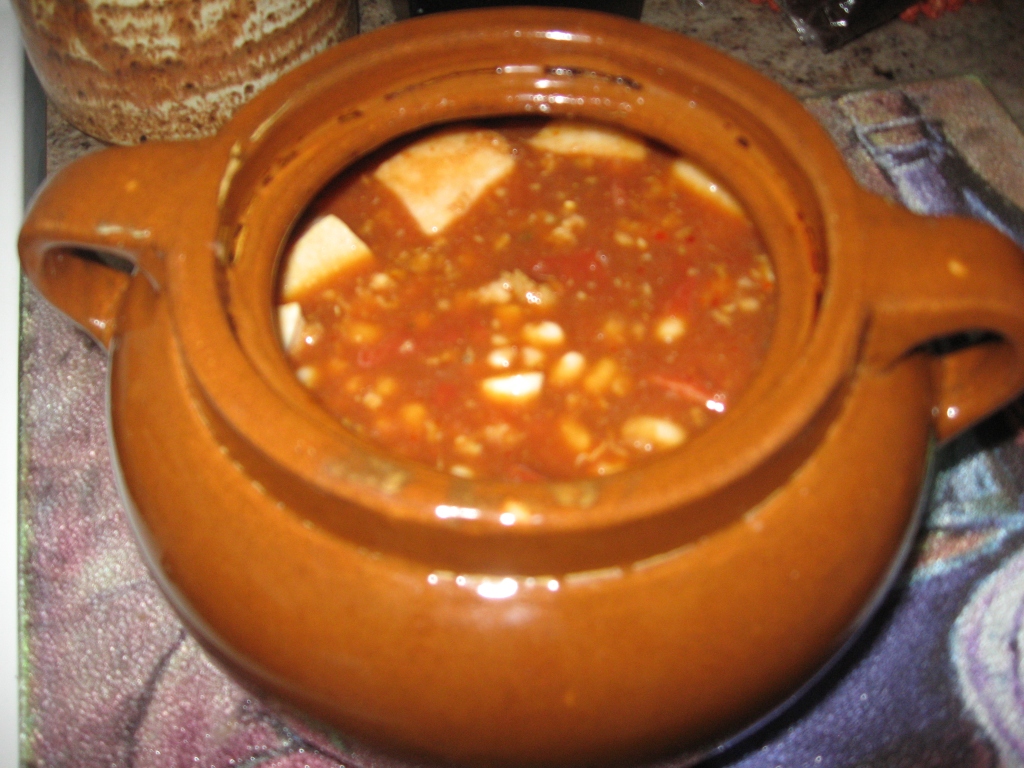
The tradition of enjoying a Saturday night supper of homemade baked beans is one familiar to families through out Atlantic Canada. Of course there are several versions of baked bean recipes in the My Mother’s Cookbook collection, most are Maritime style. Whether the recipe calls for fresh pork fat, or bacon, molasses and brown sugar or just molasses, the real question is not how these recipes differ, but what they were served with…

A Scottish Black house typical of the very early structures built by Scottish Settlers, located at the Highland Village, Iona, Cape Breton, Nova Scotia. c. 2014

There are plenty of choices for what to serve with baked beans, starch or protein, veggie or grain. Some areas of the region see starchy foods preferred, like Brown bread, or biscuits, some folks add protein in the form of ham, or sausage. Of course there are the wieners and bologna (baloney) group1.

Inverness county, Nova Scotia c.1920 Photo courtesy of the Nova Scotia Archives MacAskill photo # 1987-453 no.1202

First Nations Peoples were preparing a style of baked beans for generations prior to European settlement, using beans native to the Americas2. Introduced to European settlers by their First Nations neighbours, beans were originally cooked over an open fire. Like many recipes Maritime Baked Beans (aka Boston Style or New England Style) developed over time with the ingredients folks had available to them.

For Mary McDougald’s family the decision to leave their home in Morvern Scotland was the result of on going religious persecution and the fear of Religion of the Yellow Stick3. In 1772 Mary, a toddler and her family immigrated to St Jean’s Island4 with a group, sponsored by John McDonald 8th Laird of Glenaladale, which became known as the Glenaladale settlers.

Long boats on the Northumberland strait, winter 1900. Photo Courtesy of the Provincial Archives of New Brunswick

Jane Sharpe arrived in New Brunswick at the end of the Revolutionary War. Jane’s husband Gregor McKinnon, who was born in Isle of Skye, and served in India with the British Military had been a settler in North Carolina prior to the War. Jane’s family were early settlers to the Massachusettes and Connecticut, beginning in the mid 17th century. After the Revolutionary War, Gregor who was granted land in New Brunswick on the Madame Keswick chose instead to relocate to the Eastern coast of New Brunswick, on Miramichi Bay. It quite likely the McKinnon family chose the location because it offered a community of other Scots to live among.

The earliest sizable group of Scottish settlers to the Eastern region of New Brunswick were sponsored by William Davidson5. The first of the Davidson settlers, Protestant Scots, began arriving on the shores of Miramichi Bay in 1766. At the end of the Revolutionary war, a significant number of former British Military6, including the McKinnon family, many associated with North Carolina Volunteers and the 42nd Highlanders (Black Watch) joined the Davidson settlers in developing the region.

Bay Du Vin, NB on Miramichi Bay. Photo courtesy of the Our Miramichi Heritage Family FB site.

Although the Glenaladale settlers were grateful to the McDonald for sponsoring their move, many of the settlers saw it as an opportunity to leave the precarious life as tenant farmers behind and acquire freehold land. Mary’s family, appear to have been among the group motivated by both land ownership and adherence to their Roman Catholic faith.

Inverness county, Nova Scotia. Photo courtesy of the Nova Scotia Archives WA MacAskill Collection 1987-453 no.980

The Glenaladale settlers, like any group of Highland Gaels needed both a piper and a priest. Angus Bernard MacEachern, joined his family in Isle St Jean about 1790, eventually becoming the first Bishop of Charlottetown. Serving the Gaelic speaking Scots on Isle St Jean, Father MacEachern, also served the growing Gaelic speaking community in Pictou and Antigonish7 areas of Nova Scotia. When his brother Ewan MacEachern and his wife Mary McDougald relocated to what would eventually become Inverness County Cape Breton Island8, the tiny settlement depended on Father MacEachern for religious service.

Father MacEachern’s decision to guarantee those of the Highland Gaelic families who settled in the region of the Northumberland Strait9 access to Mass in Gaelic saw many families making that choice. Father MacEachern’s plan was a practical one, his flock would be accessible by water, the terrain in many areas was similar to that of their homeland, and sheltering and settling together brought opportunities for shared language, music, culture, kinship and food. As the large number of United Empire Loyalists flooded the region at the end of the Revolutionary War, many with Scottish heritage were drawn to where kin and culture could be found, including on the shores of the Northumberland strait and Miramichi Bay.

c. 1950, feeding the pig, Northumberland County, NB Photo courtesy of the Our Miramichi Heritage Family FB site.

Winters for Mary and Jane were difficult, their winter diet dependent upon what they had been able to grow, harvest, forage and preserve. Fishing provided not only a household source of food but also a source of income to purchase items like molasses, tea, etc. Salted and dried fish, dried beans, and potatoes, were staples.

Lands bordering the Northumberland strait are surprisingly varied, soil, topography and climate serving to make some areas sheltered and fertile, others exposed and barren, limiting food and crop choices.

Photo courtesy of the Our Miramichi Heritage Family FB site.

Mary and Ewan, living on the steep hillsides of Inverness county, would have grown both oats and wheat on their farm. Jane and Gregor would have grown some oats as well as buckwheat which is better suited to the northern end of the Northumberland Strait and Miramichi Bay area.

Picking potatoes in Black River Bridge, NB c.1950. Photo Courtesy of Our Miramichi Heritage Family FB site.

Baked Beans were familiar fare to Jane, Mary less so but she would have learned quickly the value of beans as a source of protein and carbohydrates in the cold climate. Their beans were made with what was available, sometimes maple syrup rather than molasses, maybe even bear fat instead of pork fat.

And what were their beans served with? Jane would probably prefer cornbread or Brown Bread (steamed), but corn and wheat were not always available as they had been in New England. Buckwheat pancakes are a more likely choice if Jane preferred a starch with her beans. It is possible she might have joined Mary in serving Fishcakes with her beans. After all both Mary and Jane lived on some of the most productive fishing areas in North America, the Northumberland Strait and Miramichi Bay region.

My Mother’s Cookbooks Maritime Baked Beans and Salt Cod Fishcakes

Baked Beans

Ingredients:
3 cups of Navy Beans, soaked and parboiled
1/4 cup + 3 Tbsp of Molasses
6 oz of Salt Pork or 6 slices of Bacon cut in to pieces
1 large onion chopped
1 tsp dry mustard
3 tsp white or apple cider vinegar
1 Tbsp Brown sugar
water
1/2 tsp pepper
2 tsp salt or to taste
Method:
1. Preheat oven to 325 degrees F.
2. Wash beans well and remove debris;
3. Place beans in a large bowl and cover with water, let soak overnight in the refrigerator;
4. Drain the beans, place in a large pot, cover with water, bring to a boil and simmer about 40 minutes or until the bean skins crack and split when blown on;
5. Drain the beans and place in a bean crock;
6. Add remaining ingredients except the salt, add enough water to just cover the beans;
7. Cover and bake until the beans are tender about 3 hours, adding water as necessary, during the last hour of cooking, add the salt to the beans.

Salt Cod Fishcakes

Ingredients:
1 Pound of Salt Cod soaked
2 1/2 Pounds of Potatoes, washed, and pared
1 Onion chopped fine
2 Eggs
1/4 Black pepper
Salt to taste
Cornmeal for dusting
Oil for frying
Method:
1. Drain the fish and add it to a pot with potatoes, bring to a boil and simmer until the potatoes are tender, drain;
2. Mash the potatoes and flake the fish into small pieces;
3. Add onion, egg and seasonings, mix well;
4. Using a 1/4 c measure portion and form the fishcakes;
5. Dust the fish cakes in cornmeal;
6. Heat oil and place fishcakes into a frying pan over medium heat, fry until the cakes are lightly browned and cooked to an internal temperature of 155 degrees F.

References:

  1. Bologna or Boloney as it is known in Atlantic Canada is reputed to have arrived in the region in the very early days of settlement courtesy of an Italian immigrant. Regardless, its origin boloney which is also known as Newfie steak, remains popular in the entire Atlantic region. Maple Leaf Canada (one of the most beloved bologna brands in Canada) report that 60% of bologna sold Canada-wide is bought in Atlantic Canada. Quite impressive for a region that only has about 7% of the country’s population. Of course, like wieners, its salty meatiness goes well with sweet Maritime Baked Beans.
  2. The varieties of beans commonly used in Maritime Baked Beans are “Navy” beans, which originated in the Americas, along with other varieties.
  3. Religion of the Yellow Stick – Creideamh a’ bhata-bhuidhe refers to the practice of some Scottish landowner’s attempt to force their tenants to convert to Protestantism.
  4. Canada’s smallest province, Prince Edward Island was known first as Epekwitk, meaning lying in the water, the first European settlers called the island, Isle St Jean. In November 1798, it was renamed Prince Edward Island.
  5. Davidson Settlers – William Davidson and his business partner John Cort were awarded a settlement grant of 100,000 acres of land on the Miramichi River in New Brunswick. In exchange for settling the area with Protestant immigrants, Davidson and Court would receive generous land and business grants. Many of those who settled the area were of Scottish heritage.
  6. The history of conflict between the Scottish and English is well understood, but the role of Scottish soldiers in British Military history aboard may be less so. After Culloden and the Jacobite rebellion of 1745, despite its contradiction large numbers of Scottish men joined the British Army. It appears poverty and a desire to serve and protect their local interests through militia units like the Black Watch is where it began. With in a short period of time, the Crown began using the Scottish militia units as regular army troops in their wars overseas, including in North America. By the 1770’s those considering a move from Scotland to the Colonies, had benefit of the knowledge and experience (theirs and others) gathered by Soldiers serving with English in the French /English Wars.
  7. The Hector Settlers to Nova Scotia – Just after the Glenaladale settlers arrived in Isle St Jean in 1773, the first major Scottish settlers to Nova Scotia arrived on the Ship Hector. https://www.scotland.org/features/the-hector-settlers-creating-a-new-scotland-in-canada
  8. The settlement of Inverness County, Nova Scotia began with Scots from Isle St Jean and Pictou area moving east. https://www.electricscotland.com/canada/inverness/chapter17.htm
  9. The Northumberland Strait – are waters between Prince Edward Island and coastal areas of New Brunswick and Nova Scotia. The northern boundary is between Escuminac NB and North Cape, PEI, while it’s eastern boundary is between West Point PEI and Inverness County, NS an area stretching some 225 km. https://www.thecanadianencyclopedia.ca/en/article/northumberland-strait


Buckwheat & River Rocks…

featuring My Mother’s Cookbooks Buckwheat cake, traditional Northern Appalachian / Acadian fare.
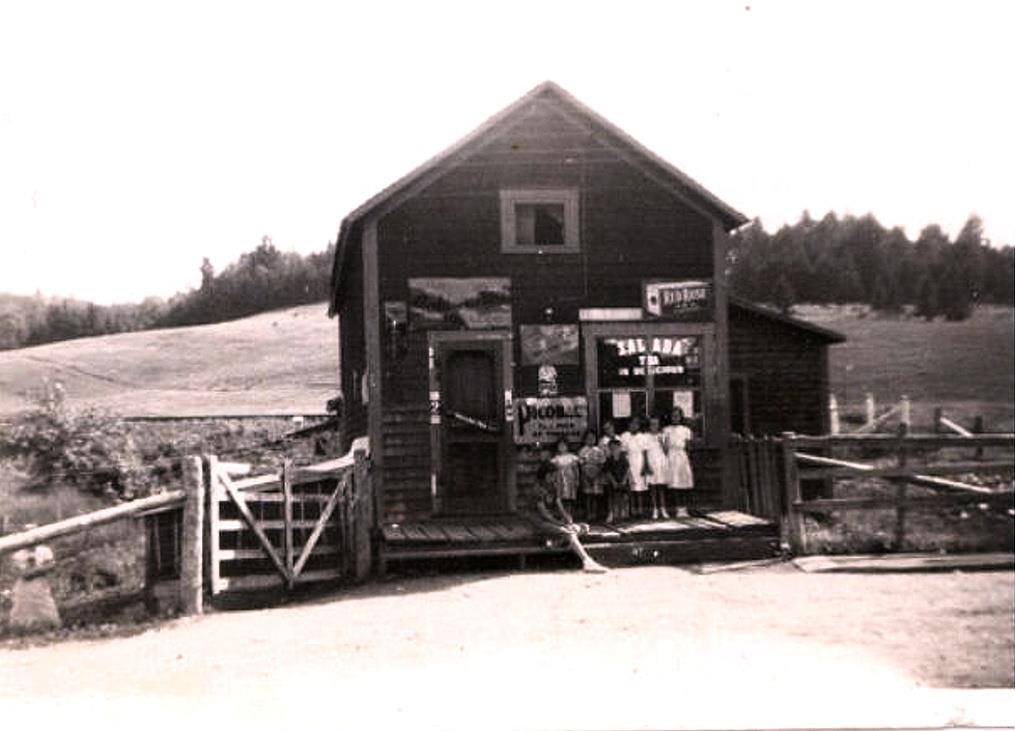
R.G.O’Donnell’s Store – Carroll’s Crossing, New Brunswick c.1950. (Robert O’Donnell was the youngest brother of Florence O’Donnell Lyons).

After thousands of years of having wheat in their diet, you might think early European settlers to North America expected that to continue in their new home, but they didn’t. Wheat, they knew requires weather and soil conditions not available everywhere, so they brought seeds for a variety of grains with them, including oats, barley and buckwheat. Native corn and corn cake figures large in the traditional menu of our Southern Appalachian kin, but in Northern Appalachia/ Acadia buckwheat was the grain (pseudo) of choice. Buckwheat in pancakes, cakes and ployes1 still feature large in the traditions of Northern Appalachians/ Acadians. My Mother’s Cookbook’s Buckwheat Cake is a great example.

My Dad had few memories of his mother and two of them involved food. The first was her sending him to the river to collect river rocks to place in the family’s barrel of buckwheat flour to keep it from spoiling. His second memory was the taste of her Buckwheat cake. I suspect my Dad’s memory was missing critical information. So I make no claim about the effectiveness of Grandmother’s method for keeping the warm spring days from spoiling her flour.

You see my Grandmother’s life was cut short by septicemia and flu. Blood poisoning from a splinter of wood in her finger, from scrubbing wooden floors left her with heart damage. A bout of flu complicated by the heart problems, 3 years later, her life ended. Florence Marjorie O’Donnell was born 13 April 1899 and died just a few months shy of her 36th birthday, when My Dad was just 10 years old. Florence was the forth child born to Alice Ann Lyons and Maurice Medley O’Donnell she lived, married and died all within the tiny central New Brunswick riverside community of Carroll’s Crossing. Florence’s family roots run deep in New Brunswick and like her New England Planter, Loyalist and Irish progenitors before her, she used Buckwheat to feed her growing family of 5 young boys.

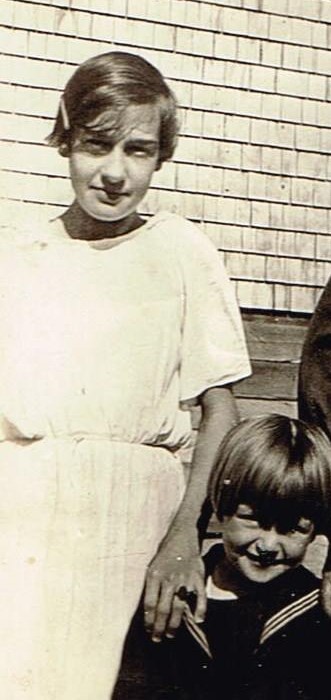
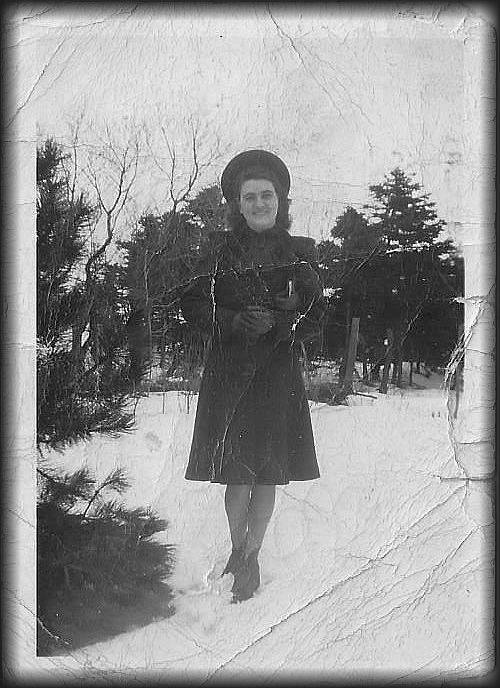
Is this Florence Marjorie O’Donnell Lyons? Sadly, we have no known photo of Florence…this is a photo cropped from one containing one of her sons and her husband, Tully.

Buckwheat, a commonly used ‘false grain’ (its seeds can be processed in to flour and Groats), came to the Americas in the 1600’s, possibly earlier. Buckwheat had major benefits to European settlers, it is nutritious, has a short growing season and likes nitrogen poor soil. In the early years of the province it could be said the three staples of the New Brunswick diet were buckwheat, molasses and butter. And that is small wonder, they do taste wonderful together…

Buckwheat was once so widespread that almost every farm in New Brunswick, grew a crop of buckwheat.2 Of course in those areas where the soil was poor and the growing season short it was a logical choice. That areas where wheat, oats, hay also grew well, buckwheat was grown for personal consumption proves the role buckwheat played in feeding families. From farmhouse tables to Lumber camps buckwheat was eaten, but it wasn’t sold as much as bartered. The market being limited to citizens of towns and lumber camps since most folks with any farming capacity grew their own. In the mid 1800’s New Brunswick farms produced enough buckwheat1 to provide the equivalent to 250 loaves of bread in pancakes for every man, woman and child in the province. Buckwheat pancakes were eaten several times each week. By the mid 1930’s far fewer were eating buckwheat but in communities where the combination of lumber work, a short growing season and nitrogen poor soil, buckwheat remained staple in many homes including those lining the Miramichi River. It would take until the mid 1950’s for buckwheat to lose its hold on most rural communities.

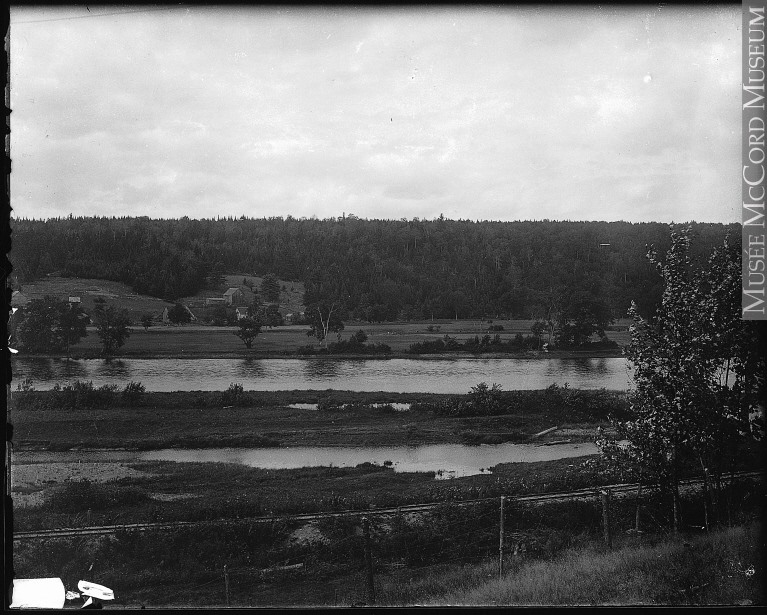
Southwest Miramichi River, at McNamee, NB c. 1920

When my parents married, my Dad did not have access to his mother’s recipes, he had only memories. My Mum’s family did not have a tradition of buckwheat cake, pancakes yes, but not cake. Over the years My Mother hunted up recipes for and made many versions of buckwheat cake. Of course none of her efforts could quite compare with his young boy memory of his mother and the love she put in to her buckwheat cake.

Buckwheat, like many pseudo grains, when milled results in a heavier and darker flour than wheat flour. Cooks quickly learned that using a mix of buckwheat and wheat flour (when it was available) produced lighter baked products. In short they began stretching the wheat flour (which had to be purchased) with the buckwheat which could be grown or acquired thru barter. I suspect this complicated my Mum’s hunt for a suitable buckwheat cake recipe. My Dad was sure his mother used only buckwheat. I suspect my Grandmother used what she had available to her, which during the 1930’s might have included some wheat flour. Eventually, Mum gave up trying to satisfy an impossible task and decided this recipe was the one she would serve her family, and yes it includes wheat flour.

One final point before we look at the recipe, despite her early death Florence managed to engender a strong love for food in her boys. Three of her sons would go on to careers as cooks.

My Mother’s Cookbook’s Buckwheat Cake:


Ingredients:
1 c all purpose flour
1 c Organic buckwheat flour
1/2 c white sugar
3 tsp baking powder
1/2 tsp salt
3/4 c whole milk
1 egg
3 Tbsp softened butter or margarine
Method:
1) Preheat oven to 350 degrees F. and grease a 9 ” x 9″ square baking pan.
2) Measure and sift the dry ingredients together into a bowl.
3) Cut in butter/margarine, add milk and egg. mix until incorporated. Do not over beat which will cause the cake to have a tough texture. Bake 30-40 minutes or until a tester inserted into the center comes out clean. Serve with butter and Molasses. Enjoy!

Carroll’s Crossing, Northumberland County, New Brunswick, Canada

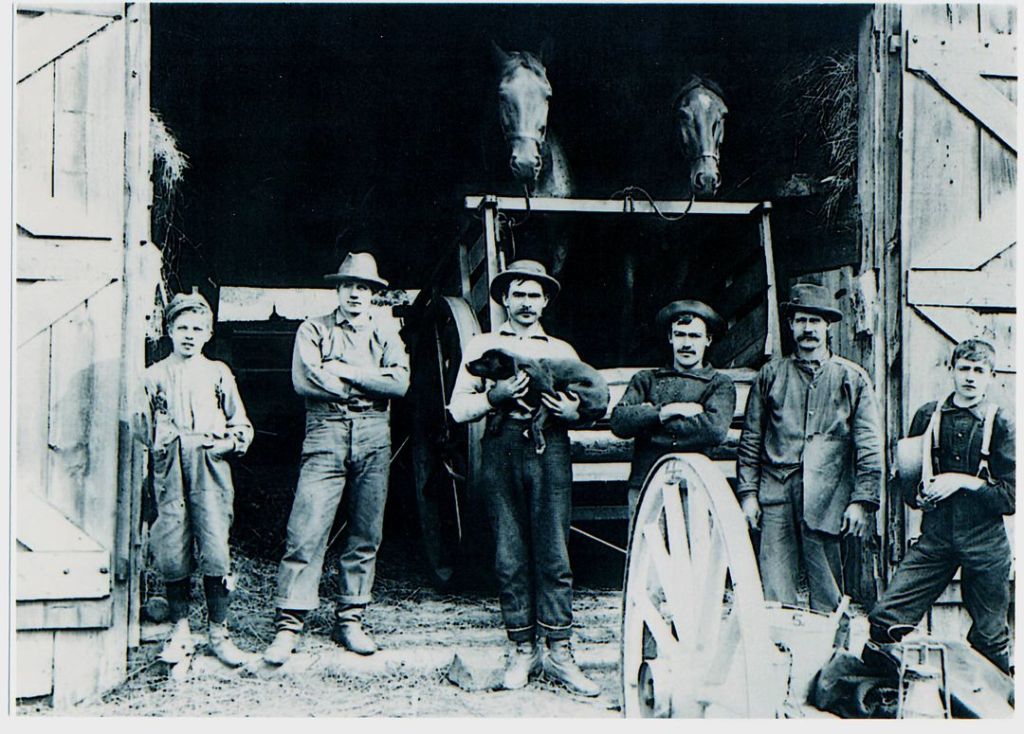
Myles Lyons wood cutter at Carroll’s Crossing c.1900, Left to Right – Gordon Finnie, Elias Lyons, John Stewart, Willard Wilson, Myles Lyons and Cecil Finnie.

The tiny hamlet of Carroll’s Crossing, nestled on the steep banks of the Southwest Miramichi river, was settled by Europeans beginning prior to the first land grant in1809. The grant in the heart of the Northern Appalachian / Acadian region was under the sponsor Ephraim Betts, which included some 60 parcels of land in the Upper Miramichi valley. The area which became Carroll’s Crossing is comprised of a handful of lots granted to Stephen Sutter, Francis Meuse, James Barcley, Widow Rose Smith, Jeremiah Lyons, William Betts and Azor Betts, lots numbered 58 to 64.

It is not as yet clear the extent to which some of these of Grantees engaged their property. Like many early Land grants, the practice of favouring influential and powerful individuals is demonstrated in the number of lots which were quickly sold, or transferred but not developed by the grantee. A case in point is the sale of lot 61, by Widow Rose Smith to Daniel Lyon, son of Jeremiah Lyons which occurred a mere 3 years after it was granted to her. It is important to remember the primary impetus for settlement of Northumberland county was the timber trade. In the period up to the Great Miramichi fire of 1825, the vast stands of virgin timber represented opportunity.

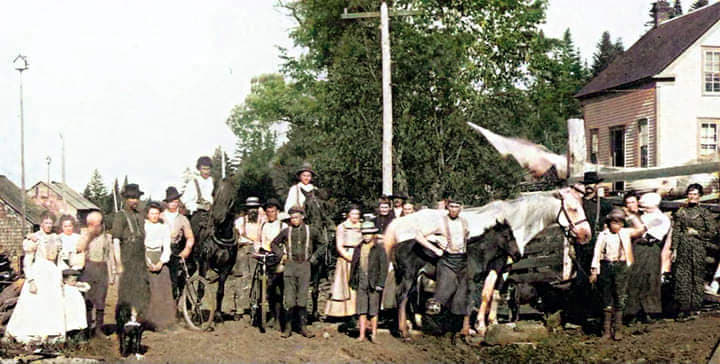
Carroll’s Crossing, New Brunswick c.1902 showing the home of Hazen Lyons on the right and his blacksmith shop on the left. All of the people in the photo have connections to the Lyons family. The young man on horse back wearing a hat is Hollingworth Tully Lyons, my Grandfather husband of featured woman Florence Marjorie O’Donnel Lyons.

What we can say is that the family of Jeremiah Lyon and later settlers, did remain in the area and were part of its growth into a community which once boasted a school, church and post office as well as stores, a quarry and a blacksmith. Most of the long term residents of Carroll’s Crossing engaged in the timber industry and subsistence farming. The steep side hill land soil is thin, and rocky but many grants had attached islands and river interval lands which although limited use for building structures because of spring flooding, provided rich soil for growing crops and for pasturing animals. Of course the water front lots were also favoured for their river access, for travel and for fishing. In addition to the Atlantic Salmon which was plentiful in the Miramichi River, the river provided a host of wild foods including the iconic Fiddleheads greens.

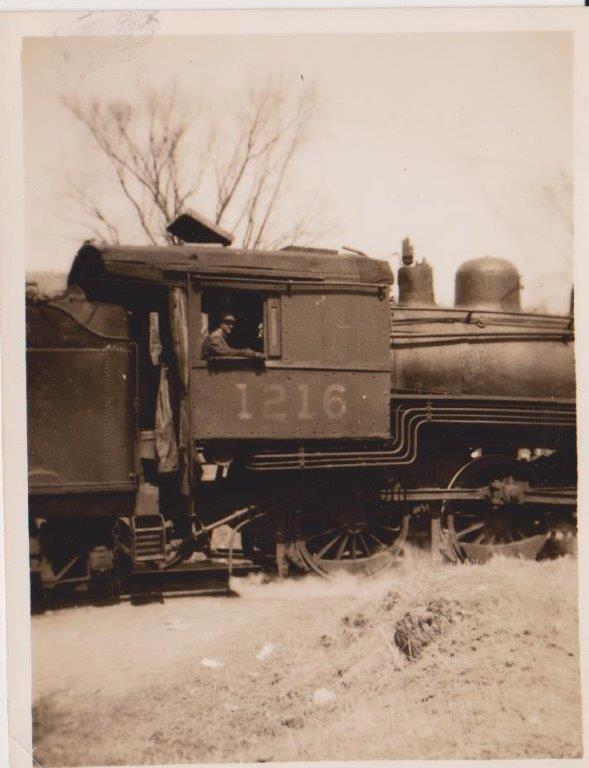
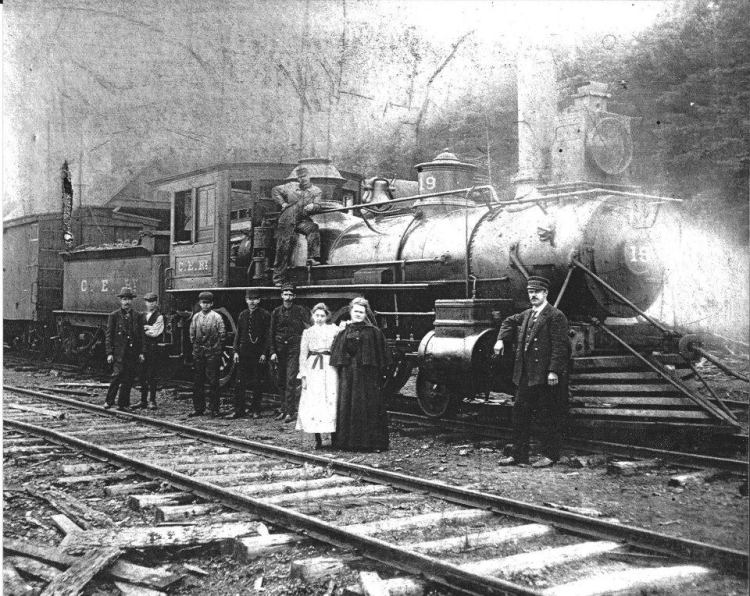
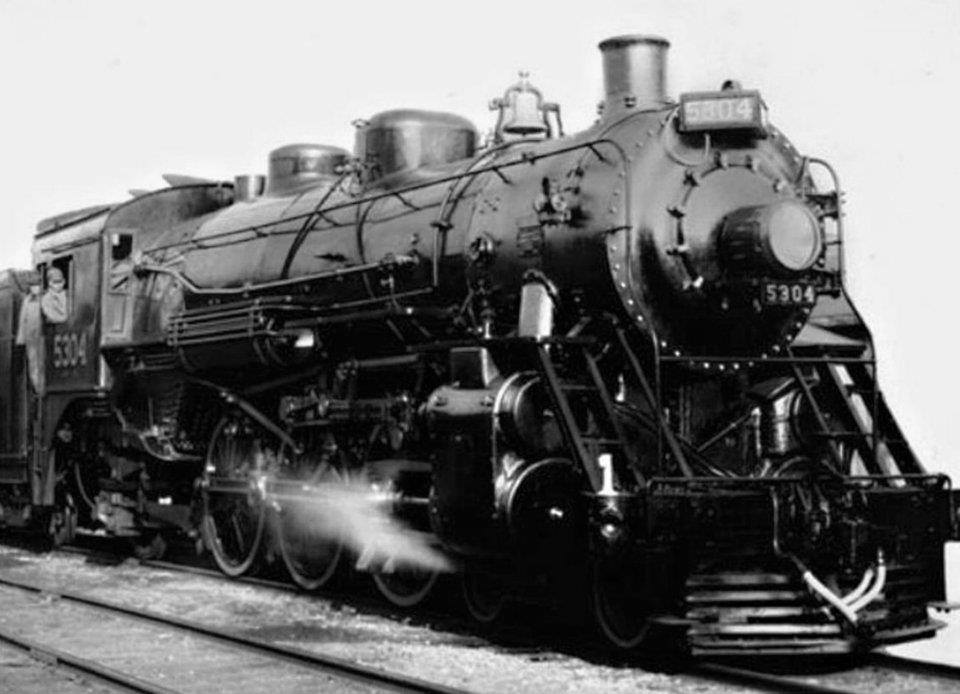
Engine 1214 at Carroll’s Crossing, NB.

The arrival of the railway in 1870’s saw the area gain its name, as the story goes Thomas Carroll who along with his wife Elizabeth McKinnon Carroll settled on the land granted to Francis Meuse, objected strongly to losing his land. Apparently, Mr Carroll was somewhat appeased by the authorities deciding to name the community after him. How exactly Thomas Carroll whose Carroll family had settled down river at Howards, NB, came to choose the area to live is unclear, he did have family connections to the area. Thomas Carroll was Great Grandson of Jeremiah Lyons through his Grandmother Dorothy Elizabeth Lyons Kearney, one of Jeremiah’s daughters. There also appears to be connection to some of the Irish settlers to the area in particular the McNamee family. Regardless, the Carroll family would settle, share their name with the community and grow into the prosperous family, farmers and business owners of today.

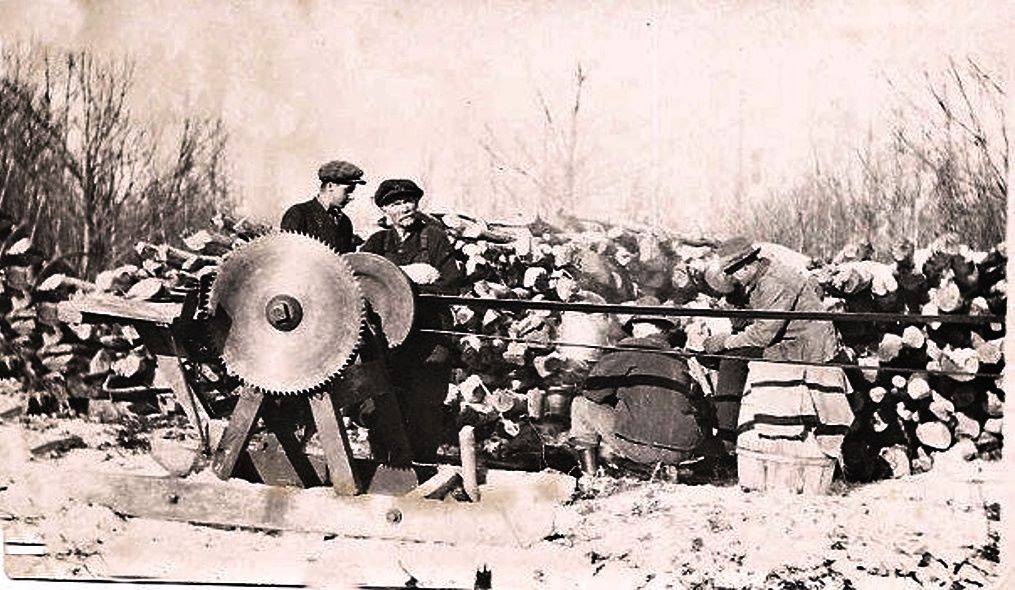
Portable saw at work sawing logs c.1930 Upper Miramichi River Valley.

Footnotes:

  1. Ployes – a crape like pancake that was eaten in Acadian homes on a daily basis, made with a special variety of buckwheat the small delicious accompaniment to almost any meal, has a lighter colour than the traditional buckwheat pancake. ↩︎
  2. T.W. Aceson (1993) “New Brunswick agriculture at the end of the colonial period: A Reassessment” Aadiensis XXII 2, page 11. ↩︎

Buckle up…its Blueberry picking time

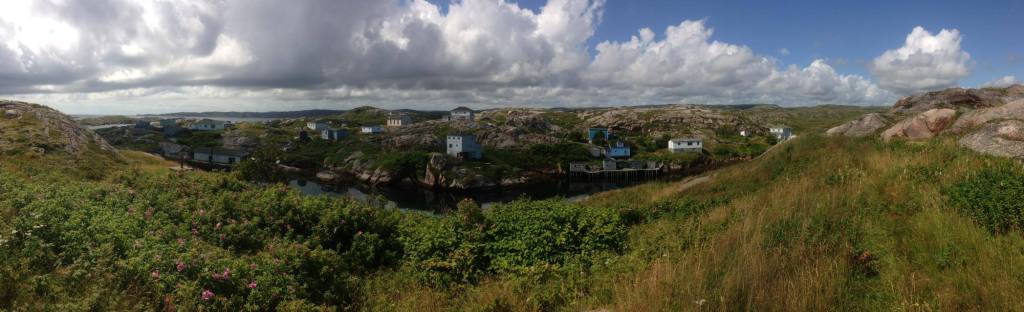
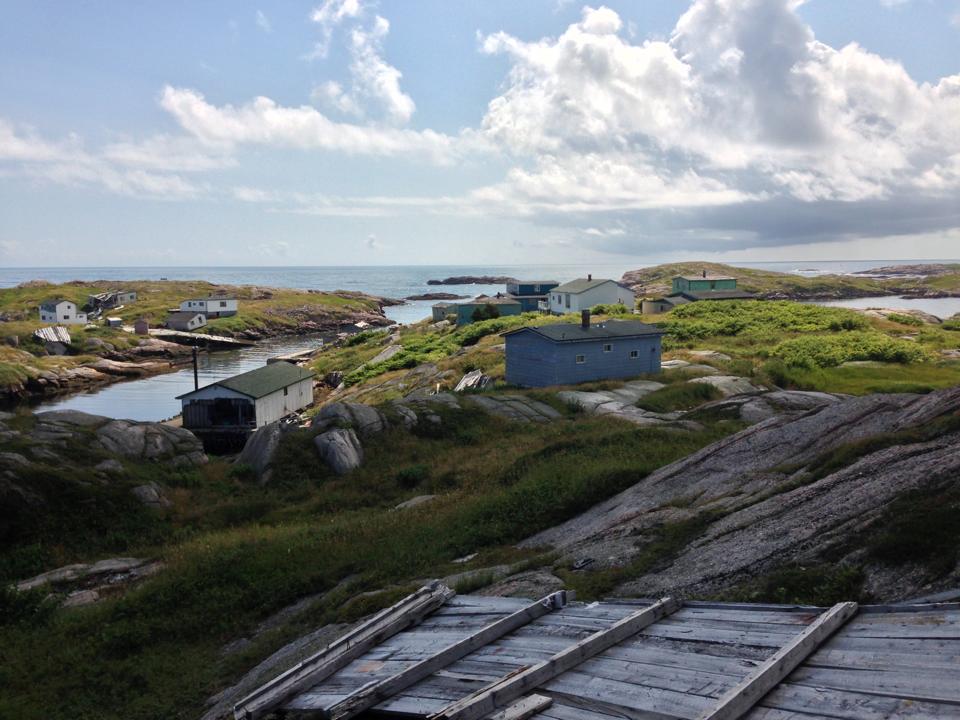
The resettled community of Petites, NL. Photo courtesy of Paul Graham 2013/

Blueberries feature large in the My Mother’s Cookbooks collection, muffins, pies, cakes, even blueberry vinegar. Some recipes have unusual names like Blueberry Grunt, Blueberry Bang Belly and Blueberry Buckle, a legacy of this delicious little berry’s reputation with those who came to live in Northern Appalachian/Acadian region’s coastal district.

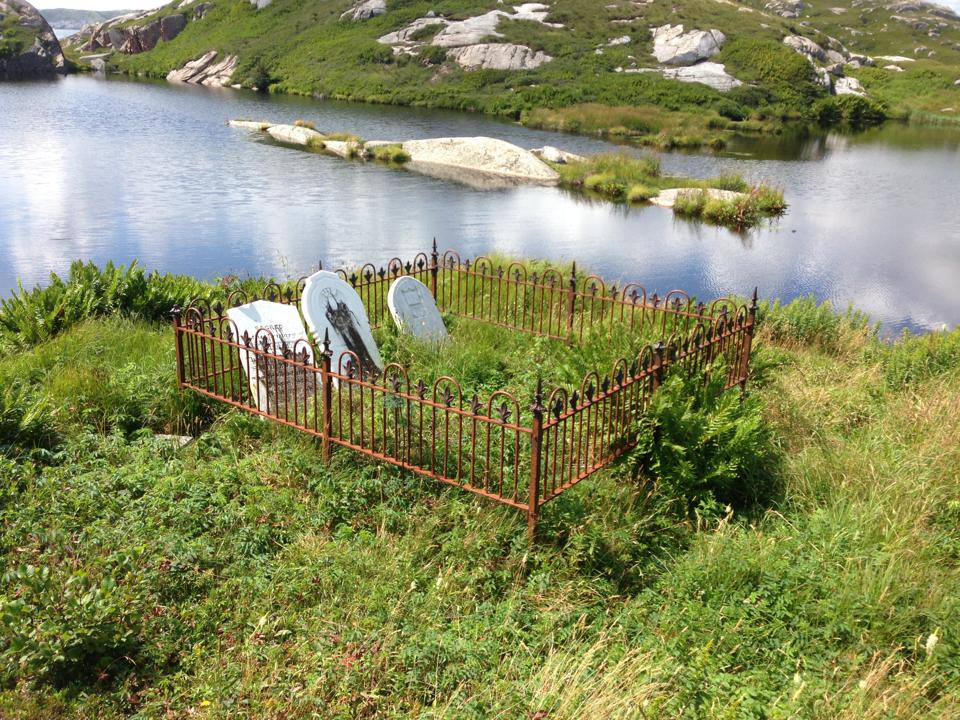
Today’s commercial harvest of wild blueberries takes advantage of the natural Blueberry barrens of largely coastal areas of Atlantic Canada. But blueberries grow in other areas too, near timber cuts, at the edges of farm fields, along rail lines and in village green spaces. I am told the some of the best blueberries grow near grave yards…

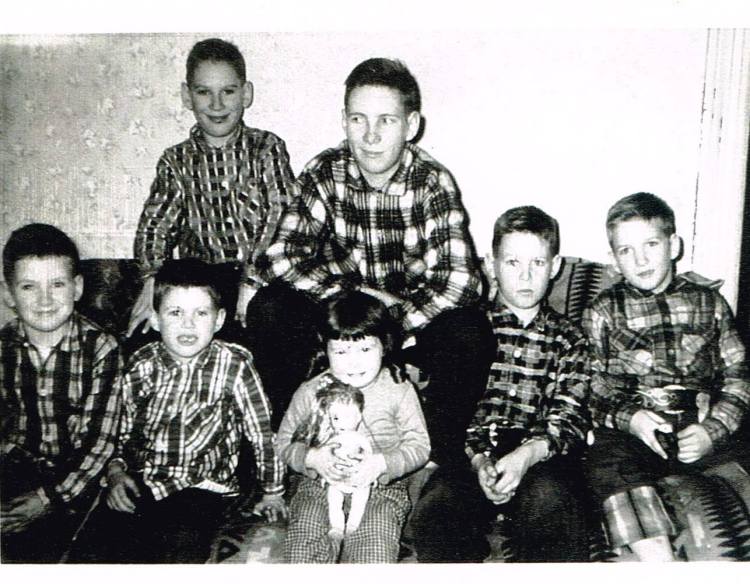
Evelyn Mauger c. 1942

Evelyn Louise Mauger Morrison, born in the small out port community of Petites, Newfoundland grew up picking the blueberries which grew on the scarce acidic soil of her home. It was only logical that she would teach her children to appreciate the bounty of this sweet fruit which grew near their home town of Glace Bay, Cape Breton.

Petites, located on the Southwest coast of the island of Newfoundland, existed because of fish. The long history of migrant Basque, Portuguese, French, English, and the Channel Islands fishers eventually lead to permanent settlement of coastal areas of the island of Newfoundland. Evelyn’s Mauger family arrived from the Channel Islands, prior to 1790 to engage in the fishery.

Growing up in Petites in the 1920’s the rhythm of Evelyn’s early life was set around the arrival of the fishing fleet to it’s small sheltered and well equipped harbour. Transportation in the region was by boat, no roads existed. The arrival of the summer fleet brought a temporary end to the community’s isolation. Boats arriving to off load their catch for processing by locals and to resupply before heading back to the fishing grounds. While others loaded the fish heading for Canadian and International markets. During summer, Petites was a bustling industrial community, but winters were remote and isolated. It is easy to imagine that the late summer blueberries which grew locally, would be a welcomed treat, but also a harbinger of the coming winter and its isolation.

Blueberry fields surrounding the resettled community of Petites, NL – Photo courtesy of Paul Graham. c 2013

That Evelyn would transform this traditional late summer activity of her home community to her family’s experience in the shadows of Cape Breton coal mines is not surprising. As long summer days began to shorten, and blueberries appeared Evelyn would gather together the children and the assortment of cans and containers which they would use to collect the precious fruit. The little band of children, some her own, others neighbour children, would wind their way through the pit yards, along the rail way spurs and on the side hills near the community’s grave yards in search of blueberries.

One of several small grave plots of Petites, surrounded by blueberries – Photo courtesy of Paul Graham

Once the fruit necessary for family consumption in treats like her blueberry buckle, was gathered, her children would sell their surplus fruit to neighbours, mostly seniors with no young children to do their berry picking.

Picking blueberries is no easy task… in addition to constant stooping, it takes a good deal of patience to stick with picking such small easily compressed fruit, it can seem to take for ever to cover the bottom of a container. Young enterprising boys learned quickly to gently invert the container of settling fruit just prior to offering it for sale. But the experienced older women, who were their customers were wise and on to the trick… taking the container out of the lads hands, “how much?” was the question. Hearing the price of 35 cents, the customer would tap the container, and reply, “how about 25”.

Evelyn’s berry picking crew

The annual task of berry picking served to raise additional monies for the upcoming school year, it also afforded Evelyn’s children an opportunity to share a little of her early life in Petites. She taught her children an appreciation of the natural world, the right places to look, the best picking styles, the patience necessary and the right recipe to use as reward for their hard work… a blueberry buckle.

Evelyn’s Newfoundland Blueberry Buckle

Ingredients:
1/4 cup Butter
1/2 cup Sugar
1 Egg at room temperature
1 cup All purpose flour
11/2 tsp Baking powder
1/4 tsp Salt
1/3 cup Milk
3 cups Fresh Blueberries
Crumb mixture:
1/3 cup Sugar
1/3 cup All purpose flour
1/4 cup Butter

Method:
1. Preheat oven to 350 degrees F.
2. Grease and flour an 8 inch x 8 inch square baking dish
3. Cream butter and sugar, add slightly beaten egg
4. Assemble dry ingredients in a separate bowl
5. Alternate adding milk and dry ingredients to the sugar / butter mix
6. Stir until incorporated, spread batter on to prepared baking pan
7. Layer blueberries on top of batter
8. Combine crumb mixture and layer on top of the berries
7. Bake about 40 minutes or until a cake is done.

Petites, Newfoundland:

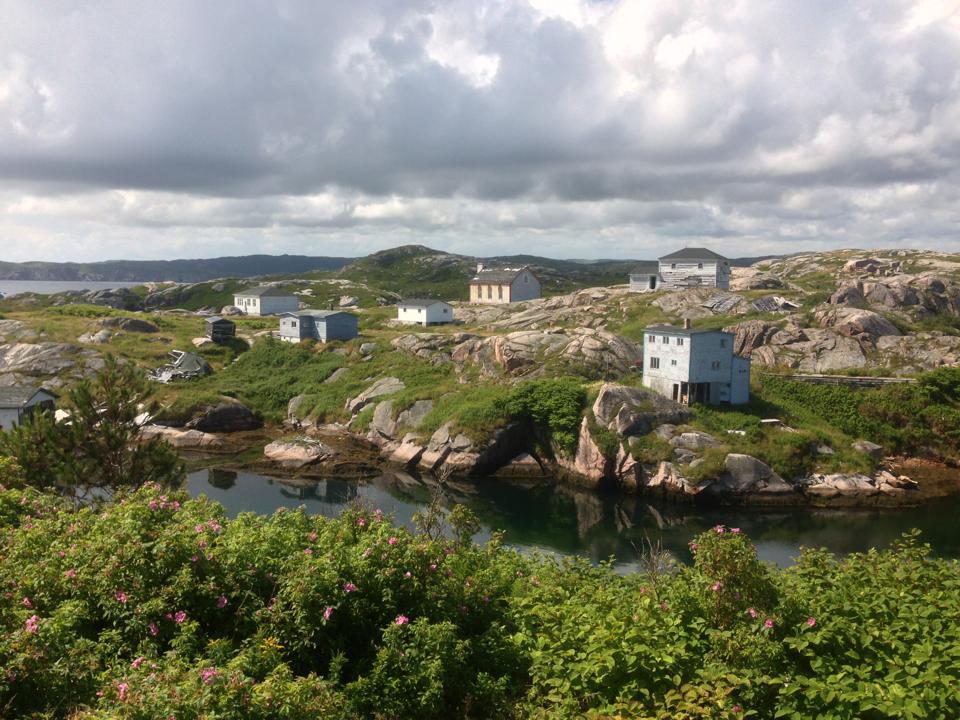
Petites, Newfoundland is located on the southwest coast of the Island, about 50 km from Channel Port Aux Basques. The community which was resettled 2003, is accessible only by water, a short boat ride from its neighbouring community with road access, Rose Blanche.

Petites c. 2013 – Photo courtesy of Paul Graham

Exactly when Petites was founded by Europeans is unknown, the rich fishing area of Rose Blanche banks was the location of the French migrant fishery from the early 1700s forward, with official year round settlements beginning in the early 19th century. The records are scarce but in the 1845 census, Petites boasted 10 permanent families with a total of 61 souls, 30 of whom were under 14 years of age. By 1921 the population had grown to 210 souls in 43 households. The census of this period lists the oldest Petites born resident Elias Mauger1 born 1845.

Petites was conveniently placed to provide for the fishing fleet, in addition to having a sheltered harbour, in close proximity to rich fishing grounds, the community is graced with pools fed by spring water. Additionally, the large granite deposit which dominates the landscape was desirable enough to support a quarry, some of the cut stone making its way into the courthouse in St John’s.

Some of the cut granite leftover from Petites’ stone industry – photo courtesy of Paul Graham 2013

A community of fewer than 250 residents, Petites boasted no less than 12 stores catering to almost any need. The economy of Petites was the fishing industry, but also its related industry of local trade and supply by boat. By 1900, that was beginning to change, the interior regions were opening up as timber companies drove roads, and built mills, drawing young people to the timber towns which seemed to appear over night.

By the last half of the 1930’s, the community of Petites was long familiar with the exodus of young people leaving to seek work and life outside of the community. A position as a domestic in the home of a Glace Bay physician would lead Evelyn to meet and marry Stephan Morrison.

Although strongly associated with the coal industry, Glace Bay, NS has strong association with the fishing industry as well, the links between the two communities are many. The family ties which developed over more than a hundred years of trade, shared fishing grounds, challenge, and tragedy provide an enduring link between the two communities.

Footnote:

  1. The Mauger/Major Family in Newfoundland appears to have been founded by one Elias Mauger born about 1725 in Guernsey, Channel Islands, who settled in Fortune Bay, NL. The Mauger family of Petites were of three brothers, Phillip, James and Elias all born in Fortune, and all probable descendants of the original settler Elias Mauger.

Resources:

  1. “Growth and Development of the Wild Blueberry” Wild Blueberry Fact Sheet 2010. Department of Agriculture, Aquaculture and Fisheries, Province of New Brunswick. (2021)
  2. “Exploration and Settlement” Newfoundland and Labrador Heritage Web Site (1997) https://www.heritage.nf.ca/articles/exploration/exploration-settlement-default.php (2021)
  3. “Voluntary Settlement – the peopling of Newfoundland to1820.” Newfoundland and Labrador Heritage Web Site (1997) https://www.heritage.nf.ca/articles/exploration/voluntary-settlement.php (2021)

The contemporary photos were generously shared by Paul Graham, a Petites descendant who shares ancestry to Evelyn’s Grandmother Elizabeth Groves Mauger.

The ‘making’ of Cape Breton Pork Pies…

On the surface many areas of Northern Appalachia / Acadia appear to have been marked by the settlement of a single group of Europeans. The ‘tastes’ of the region are more reflective of the complexity and nuance of reality.

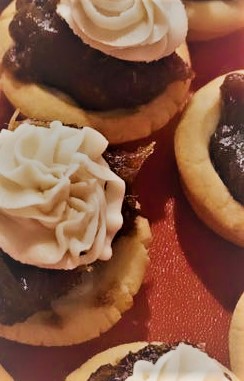
Cape Breton Pork Pies don’t contain pork, but they do resemble the hat1. The origin of this tiny tart, a shortbread base, filled with dates and topped with a carefully piped cap of maple icing is unknown, although some credit Acadians for inspiring them.

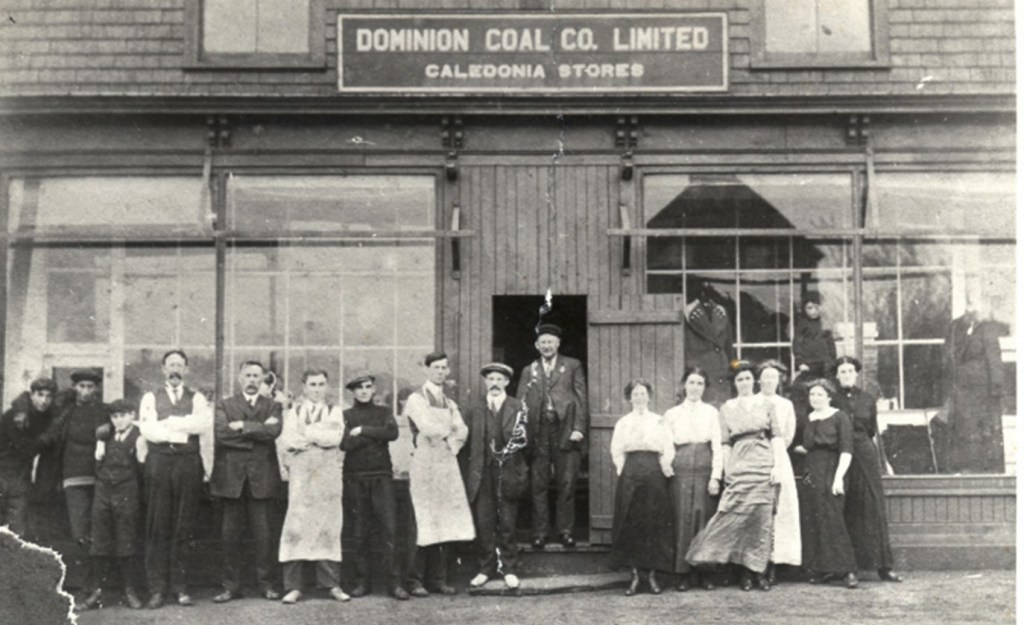
The company store and staff, Dominion Coal Co. Ltd c.1912 Photo courtesy of the Nova Scotia Archives and the Beaton Institute CBU, 80-13-4193.

There is little doubt that Acadian settlers to the region depended heavily on pork and pork fat in their diet. From the very beginning of Acadia, despite an abundant source of wild game and fish, pork was the preferred source of protein. After being forced from their homes and farms, some Acadian families fled to Cape Breton, joining two major settlements, Cheticamp on the north western coast and Isle Madame on the south coast of Cape Breton Island. Although fishing would largely replace farming as a means of providing for their families, raising pigs for food remained an integral part of life. There are many traditional Acadian dishes which contain pork and pork fat, including fruit desserts.

A group of Children learn the traditional craft of egg decoration Ukrainian style c. 1950

Despite both this association and the name, the fussy little tarts are made with shortbread a Scottish tradition, dates which originated in the middle east and maple, which is purely and completely First Nations in origin. So how did they come to be a Cape Breton Holiday tradition?

Cape Breton Pork Pie recipes began appearing in community cookbooks in the early 1930s, it is entirely likely they were developed during the first two decades of the 20th century. The new century which brought widespread social and political change, unprecedented growth, upheaval, and greater cultural diversity to Cape Breton would result in Cape Breton Pork Pies.

Whitney pier, Cape Breton Steel plant c.1900 Photo courtesy of the Nova Scotia Archives.

By the time Bessie Mauger arrived in North Sydney from her home community of Petites Newfoundland about 1890, the industrialization of Cape Breton was well underway. Mines, steel mills, construction of infrastructure, and housing were bringing workers from across the region and around the world to work in Cape Breton. Young women like Bessie found work in the homes of company officials, merchants, physicians, and in the company stores, hotels and boarding houses serving the growing number of workers.

Company homes in the Sydney coal fields c1890 Photo courtesy of the Nova Scotia Archives

Elizabeth McIsaac Topshee, her Syrian born Traveling merchant husband George, their four young children, Elizabeth’s Mother Lizzie and her brother Leslie McIsaac were living together on Robert street, Sydney in 1921. Lizzie and Leslie who were born in Boston, Mass returned to their parent’s Cape Breton home with their mother, after their father Peter died. A bright and capable person Elizabeth worked for while as a Teacher, before marrying George.

For women like Kathleen Bryan living in the neighbourhood of Whitney Pier provided opportunity to add to her family’s resources by taking in boarders. The large numbers of men, single and married flocking to the area for work had to be housed, some would lodge, others board in family homes, sharing the cramped and inadequate housing and food. Most families who took in boarders, took in those they knew, single lads from home, married men working to bring their family to Cape Breton from their homes in Newfoundland, Lebanon, Wales, Ireland, New England and the long list of local and exotic locales. Kathleen and her husband Lambert welcomed boarders from their home in the British West Indies.

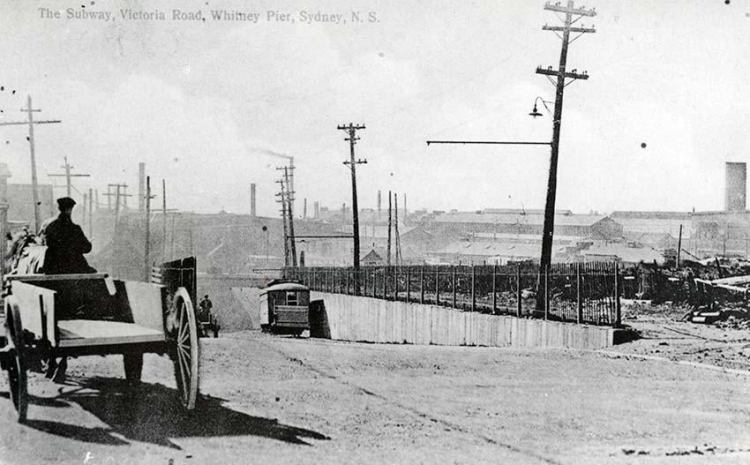
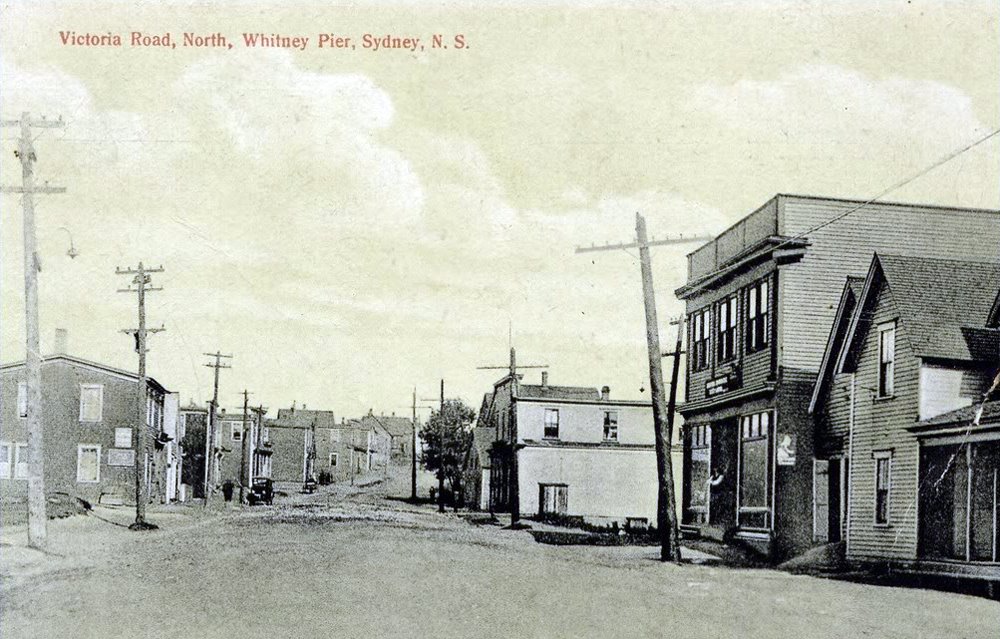
Victoria Road, North, Whitney Pier, Sydney, NS Nova Scotia Archives Beaton Institute Collection.

The system which favoured powerful white Protestant English speaking people2 over others left many Scots, Acadians, First Nations people and a growing number of others on the outside looking in. As industrialization took hold, the disparity between those who owned and operated the industries and the souls who toiled in them grew.

By 1921, Bessie and John had managed to purchase a home for their family in Dominion. With already more than 30 years in the industry John worked his way from miner to mechanic, improving his wages and vastly improving his family’s lot. A new social order and improvement in their living conditions, fostered new found independence and pride. In the 1921 census, for the first time in their married life John and Bessie openly declared John’s deep Acadian heritage. John’s ‘Young’ family had their name converted from the original Lejeune sometime in the early part of the previous century, as they struggled to survive in a social system which discriminated against Acadians and favoured those with English names.

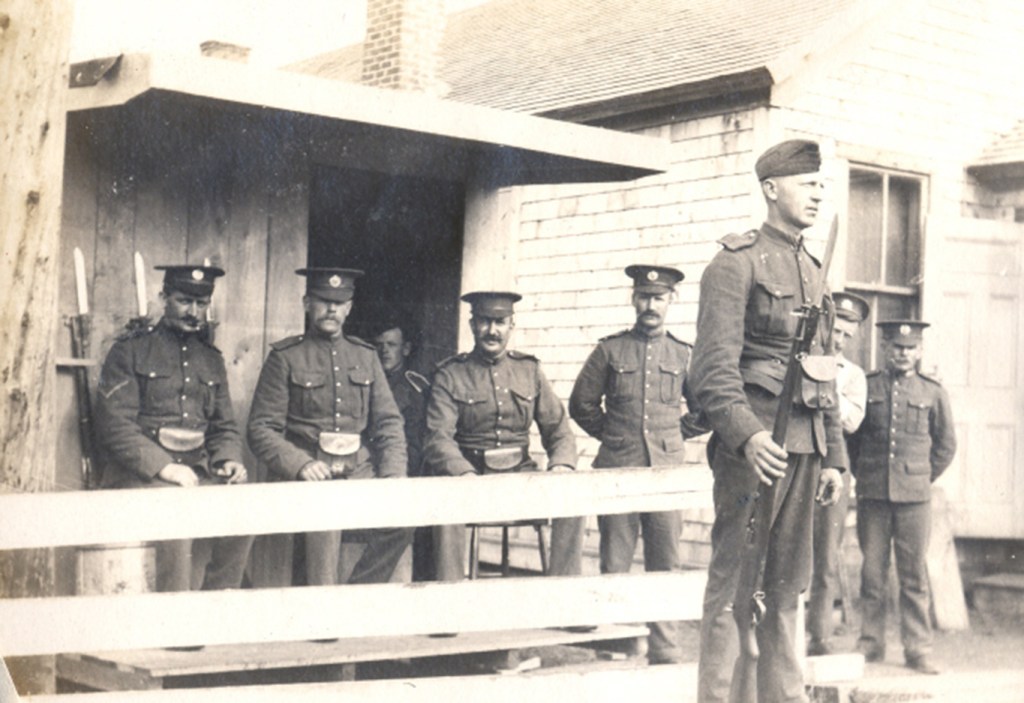
Dominion #3 c. 1909 Coal strike, Army officers stationed at Glace Bay, 12 July 1909. Photo Courtesy: Beaton Institute, CBU. Bourinot family collection MG12.16(E):78-735-2485

Despite nearly a century of being known as “Young”, John and his family managed to retain their Acadian heritage personally if not officially. The benefit realized by highlighting his mother’s Scottish heritage had not eroded John’s Acadian heritage entirely. His family name was lost, their language lost, yet he still identified as ‘French Acadian’. It is likely food, traditional Acadian food played a role in maintaining John’s Acadian heritage.

The struggles of the new century would continue in to the 1920s, the labour unrest which would see police, and military deployed against workers strained and severed traditional relationships but also fostered new ones. Solidarity between and among Union members was critical to their successful skirmishes against the company. When the entire community, women, neighbours, well to do, poor; Polish, French, English, Walsh, Assyrian, Italian, Ukrainian, West Indian, Scottish, etc. stood in solidarity, long term meaningful change finally took hold, and a more diverse identity was born.

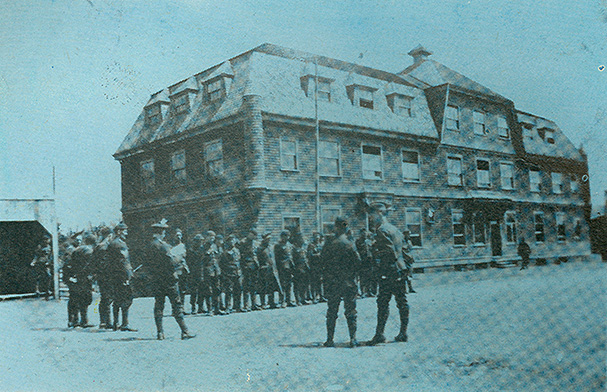
185th Battalion drilling in front of the Crown Hotel, Broughton, Nova Scotia 1916. Photo courtesy of the Nova Scotia Archives.

Dates have been grown in the middle east and Asia for thousands of years, during that time they became ‘staple’ in the diet of the region and spread as an imported food to other areas of the world. North American cultivated dates began appearing in the 1920s, just in time for the Cape Breton Pork Pie.

There has been much speculation about the relationship between the term pork pie and it’s suspected Acadian origins. Did the first pork pies contain pork? It is quite possible cooks like Bessie, Kathleen and Elizabeth sometimes made the shortbread base with pork fat rather than butter, it is also possible pork fat was added to the filling as a flavour enhancer.

The even more likely source of the relationship between the pork pie and Acadian culture is the maple icing. Maple sugar and flavouring are firmly rooted in First Nations culture, and by virtue of the longstanding and positive relationships between the two nations, in Acadian culture.

This Holiday season Cape Breton Pork pies will take their rightful place on our table, a wonderful way to celebrate a little of what it means to be from Cape Breton…


My Mother’s Cookbook’s…

Cape Breton Pork Pies

Pork pies are small tarts, about 11/2 inches in diameter, mini tart molds / cups are required.

Ingredients:
Base:
2 cups Flour
2 Tbsp Corn Starch
1/4 tsp Salt
1 cup Butter
1/2 cup Confectioners Sugar
1 Egg Yolk
1 tsp Pure Vanilla Extract
Filling:
2 1/4 cups chopped Dates
3/4 cup Brown Sugar
3/4 cup Boiling Water
1/4 tsp Salt
1/2 tsp Lemon extract
1/2 tsp Pure Vanilla Extract
Maple Icing:
2/3 cup Confectioners Sugar
2 Tbsps Maple Syrup
1 Tbsp Butter
Method:
1) Preheat oven to 325 degrees F (163 degrees C);
2) In a large bowl, cream butter and sugar until fluffy;
3) Beat in egg yolk and vanilla;
4) In a second bowl combine flour, cornstarch and salt;
5) Gradually add the dry ingredients into the butter sugar mix, kneading to a smooth dough;
6) Make 3/4 round balls of dough and press into 11/2 inch tart molds, pressing the dough evenly over the bottom and sides;
7) Bake for 15 minutes or until golden; set aside to cool;
8) In a saucepan combine dates, brown sugar, water, and salt over med heat until it reaches a boil, reduce the heat and simmer for 4 minutes, stirring regularly;
9) Remove from the heat, add lemon and vanilla, set aside to cool;
10) In a small bowl, cream butter and sugar, add maple syrup and whip to fluffy consistency;
11) Fill shortbread cups with date filling and cape with a dollop of icing.

Explanations and Resources:

1. The Pork Pie hat, or the porkpie, is a round hat with a turned-up brim and a flat crown.
2. The British Colonial settlement of Atlantic Canada favoured white, protestant community members over others, although the labour struggles and social actions of the early 20th century challenged the system, it did not translate into equal opportunities for all. First Nations people and others of visible minority groups continue to be disadvantaged and marginalized by a system which favours whites over others.
3. History of Acadie – Canadian Encyclopedia https://www.thecanadianencyclopedia.ca/en/article/history-of-acadia
4. Acadian History – https://acadie.cheminsdelafrancophonie.org/en/historical-capsules/


Acknowledgement: I acknowledge that the land on which I live and write about is the traditional unceded territory of the Wolastoqiyik (Maliseet) and Mi’kmaq Peoples. This territory is covered by the “Treaties of Peace and Friendship” which Wolastoqiyik (Maliseet) and Mi’kmaq Peoples first signed with the British Crown in 1725. The treaties did not deal with surrender of lands and resources but in fact recognized Mi’kmaq and Wolastoqiyik (Maliseet) title and established the rules for what was to be an ongoing relationship between nations.
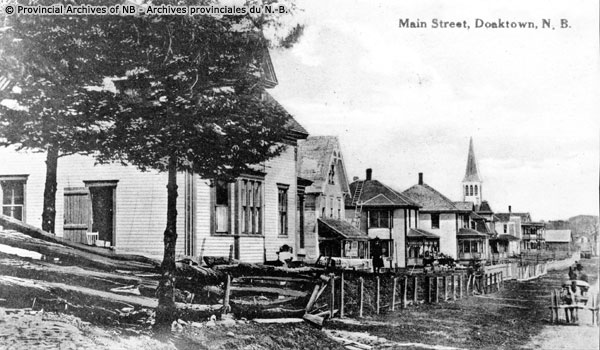
Blueberry Muffins…An Appalachian treat?

A classic recipe from the Northern Appalachian and Acadian region, wild blueberries grow through out the region from the Adirondacks to Newfoundland and Labrador.

One of my favourite recipes in the My Mother’s Cookbook collection is for a ‘traditional’ blueberry muffin. As a child I thought blueberries only grew near the railway… that this Blueberry muffin recipe came into the collection while our family was living in Cumberland County, NS some 60 miles(in 1968) from the nearest railway, is not coincidence.

Canadian Eastern Railway c. 1910 Train crew and others. Photo courtesy of the Our Miramichi Heritage Family Facebook site.

The first European settlement of the Atlantic region occurred on the coast and on the banks of navigable rivers and streams. From the earliest periods the building of roadways, were mostly to improve portages around natural obstructions or to create short cuts, roads as a primary transportation link did not appear until much later.

Chatham Train station c.1880 ~Photo courtesy of Our Miramichi Heritage Family Facebook site age Facebook site.

The railway’s arrival beginning in the mid to late 19th century served to open many areas previously isolated by their lack of access to water. Suddenly communities with names like Oxford Junction, Stephenville Crossing and Weaver Siding sprang up. The railway also served to provide the means for business and manufacturing to develop and for communities like Amherst, NS to thrive.

A single self propelled man cart c. 1900 Photo courtesy of the Our Miramichi Heritage Family Facebook site.

For communities like Carrolls Crossing, NB, the addition of ‘train tracks’ not only provided vital transportation link, it ingrained its self in to the community, the tracks were used for many purposes: short cuts, access to the best swimming hole, the location of entertainment on long summer evening walking up the tracks to the point where the darkening sky was just right for ghost stories, playing ‘tin can alley’ in the station yard, hitching a ride, (on the handcar) across the railway bridge on the way to pick blueberries.

Railway bridge c.1880 Blackville, NB Photo courtesy of the Our Miramichi Heritage Family Facebook site.

Amherst, Cumberland County, Nova Scotia was founded as a result of the New England Planters farming and fishing activity on the shores of the Bay of Fundy, by 1850 Amherst boasted a grist mill, tannery and other basic services. By 1880, the railway had arrived and the community’s reputation as a manufacturing center had began to build, boots and shoes, pianos, trunks, caskets and eventually engineered steel would be produced in Amherst.

New Brunswick farmer waving at the train as it passes his farm field c.1950 Photo courtesy of the Our Miramichi Heritage Family Facebook site.

Even as the railway was sending Amherst’s goods to market, it was drawing workers, farmers, fisherman, lumberman, miners, shipwrights, etc. to work in Amherst’s factories and those in other centers across the region. The railway also connected the region to New England states via land, for the first time providing an alternative to sea voyage. Access to larger markets came with increased out migration from those communities not served by rail service and from many which were, as younger people sought opportunities in larger centers.

Canadian National Railway engine c.1922 Photo courtesy of the Our Miramichi Heritage Family Facebook site.

Many young people including Edna Jane O’Donnell Babcock born in 1900, used train travel to expand her opportunities. In 1922 Edna left her home, the tiny railway hamlet of Carroll’s Crossing, NB to work as a domestic in Portland Maine. Her time in Portland would end with a train voyage back home to marry the Canadian soldier she’d met while in Portland. Eventually, Edna and her young family would settle in Amherst, NS, her husband William finding work as an inspector in the Robb Engineering factory.

The train would remain a vital link to home for Edna allowing her children to meet and spend time with their extend family at home in New Brunswick. Edna would not have found it difficult to locate blueberries to use in her baking at her new home, she might well have taken her children on blueberry picking walks on the railway tracks near her humble home on Cornwall street, Amherst, just as she had done at home.

a young traveler returning home to Chatham, NB c.1940. Photo courtesy of the Our Miramichi Heritage Family Facebook site.

Train travel also provided a reliable way for those who had moved to distant larger centers, Boston, New York and beyond to visit home. It is likely train travel figured large when in 1927 Gussie Deuchler Mills made her first visit to her new husband Carl’s home in Advocate Harbour, Cumberland county, Nova Scotia from her home is Staten Island, New York. Advocate Harbour is located on the Bay of Fundy in an area known as the Parrsboro shore. From the 1870’s to the late 1950’s a short rail line operated between Springhill Junction, NS and Parrsboro, NS. The line built originally to transport coal from the mines at Springhill to ships at Parrsboro and eventually other ports of call. By the 1880s, an interconnected web of short lines linked to the larger Regional and National lines providing extensive coverage through out much of the region.

Railway Construction crew near Blackville, NB c.1870 Photo courtesy of the Our Miramichi Heritage Family Facebook site.

Gussie, Carl and both Gussie’s Mother Louise and her sister Deal spent many summer seasons in Advocate Harbour before Carl and Gussie retired there in the late 1960’s. So where did Gussie’s Blueberry Muffin recipe originate?

It turns out blueberries do grow near rail lines, at least in those areas with poor soil (particularly where the Appalachian mountain range left bare large swaths of acidic soil). The regular cutting back of vegetation near rail lines to prevent fires, allowed the low bush varieties native to New Brunswick and Nova Scotia to thrive. It is also true that Blueberries grow in much of North America. However the acidic soil and cool sea breezes of the Northern Nova Scotia and Eastern New Brunswick, which is part of the northern Appalachian range, delivers natural Blueberry barrens. Cumberland county, Nova Scotia in particular has earned a reputation in recent years of being Canada’s wild blueberry capital as a result of being blessed with bounty of blueberry barrens.
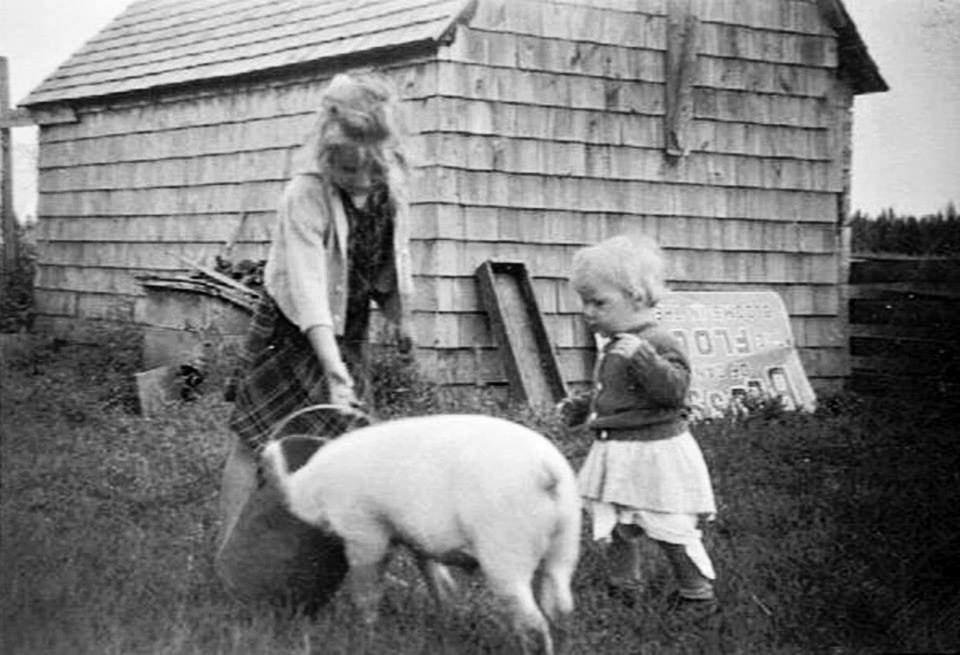
Blueberry muffins made with wild NB blueberries, this photo c. 2021 is courtesy of Lynn Lyons
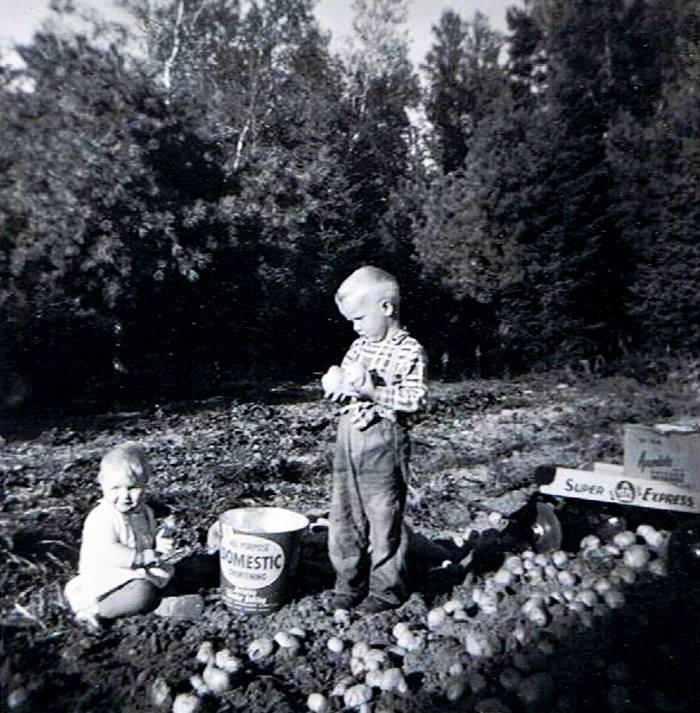
The history of muffins (the quick bread variety) is not entirely clear, the habit of using individually sized baking containers for quick breads appears to have begun in the United States some time during the last half of the 19th century.

So, the mystery of where Gussie’s blueberry muffin recipe originate deepens. Did the recipe begin with one of Gussie in laws during early years of blueberry farming on the Parrsboro shore? It is more likely the recipe is one which originated with Gussie’s family on Staten Island. Staten Island a borough of the mega city of New York owes its existence the Appalachian mountain range and like Atlantic Canada several varieties of blueberries grown naturally on there. It is likely that Gussie’s immigrant family learned early to use the bounty of the local area to augment their diet… just as they had done in Germany. Blueberries, both high bush and low bush varieties still grow in undeveloped areas of Staten Island, although increased development threatens their continued existence.

This recipe is a traditional muffin recipe. Commercially baked muffins have increased the overall size of muffins and have replaced traditional muffin recipes with those containing higher levels of sugar and fat, This recipe contains less sugar and fat. It is possible to alter the recipe further by replacing some of the all purpose flour with whole wheat and the fat with yogourt.

Gussie’s Blueberry Muffins


Ingredients:
1/3 cup butter at room temperature
1/2 cup sugar
1 egg at room temperature – lightly beaten
3/4 cup milk
2 cups of flour, separated
3 tsp baking powder
1/2 tsp salt
1 cup fresh wild blueberries, winded and washed
Method:
1. Preheat oven to 400 degrees F.;
2. In a medium mixing bowl, cream butter and sugar, add slightly beaten egg stir to combine;
3. In a separate bowl combine 1 3/4 cups of flour with other dry ingredients and stir to combine; add remaining 1/4 cup flour to a bowl containing cleaned blueberries;
4. Alternate adding the dry ingredients with the milk, folding to combine and being careful not to over mix; Add blueberries and gently toss to combine;
5. Fill muffin tins with muffin papers or grease and flour before adding batter.
6. Bake for 20 – 25 minutes, remove from pans after permitting to cool for 5 minutes.