War, lobster and Lottie

A sheep shearer’s war effort, and My Mother’s Cookbook’s lobster roll.

This blog is 3rd in the series Atlantic Canadian Women of the Cloth – Homebased textile production.

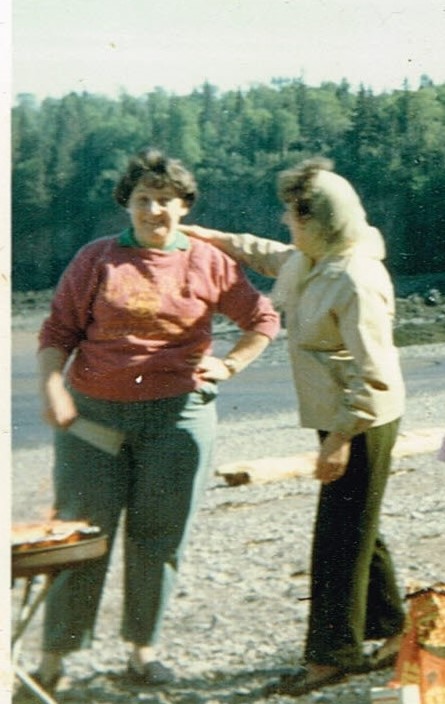
I have difficulty believing people order lobster in the shell in high end restaurants. It’s not that I don’t see lobster as luxury food, or that I don’t love the taste. For me a ‘feed’1 of lobster from the shell, is an outdoor activity. One that requires, all the tools, a newspaper covered picnic table, and freedom to let the juices drip off my elbows. Fortunately, I am local to two lobster fishing seasons, and to a large lobster processor. I have options and unless it is a family lobster boil, I usually buy fresh cooked (same day) and shelled by the processor. A feed of lobster is very much a luxury in our home.

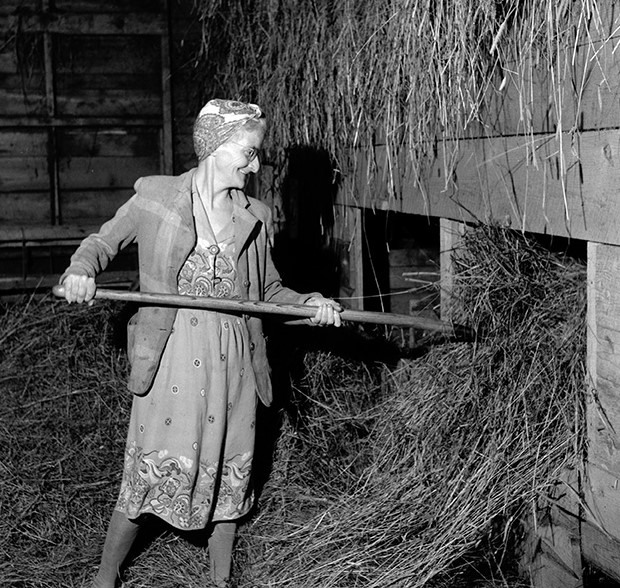
Marie Doucet feeding the cows in Cape St Mary’s 1950 Photography by John Collier, JR in the collection of Alexander H. Leighton NS Archives 1988-413 #2504-d

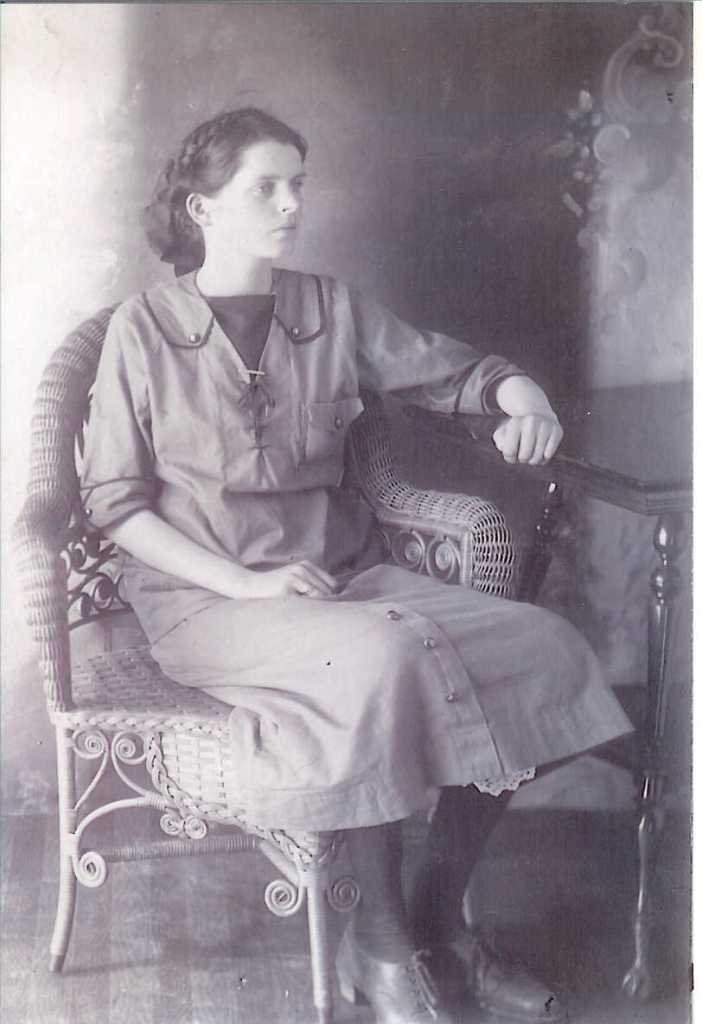
Charlotte (Lottie) Melanson2 loved the physical demands of farm life but when it came to suppling herself an income her options were limited. The time Lottie’s father John Melanson spent working as a carpenter, assured his children were well equipped with skills like, sloping pigs, milking cows, tilling, planting, harvesting crops, and shearing sheep. From an early age Lottie preferred outside work, and did not take well to life in the classroom or one involving refined womanly activities.

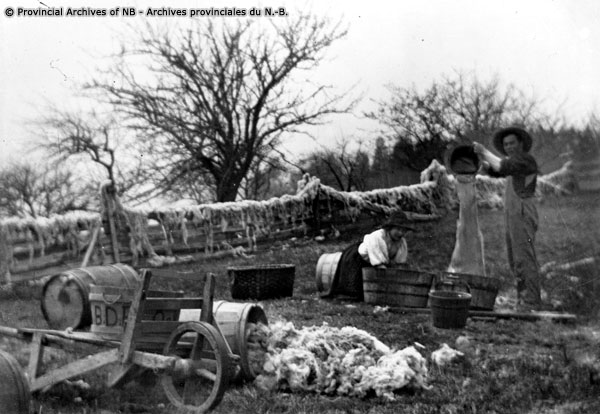
Wool being washed and hung to dry. Richards, Dufferin Collection: the Provincial Archives of New Brunswick Ref # P368-32.

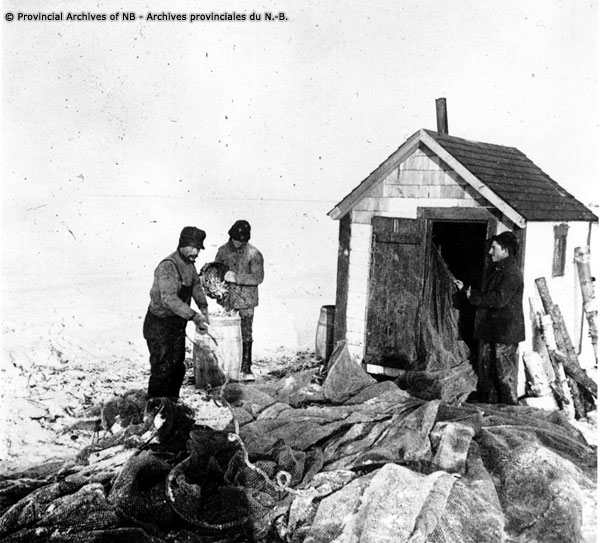
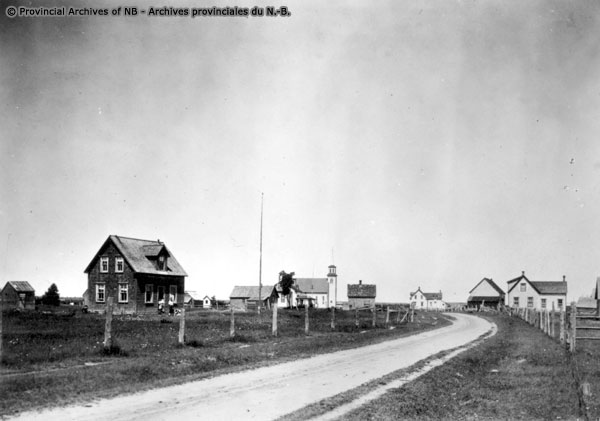
In 1930’s Nova Scotia paid work was still highly gendered, women could choose jobs in retail, as housemaids, as factory workers, they could be teachers, or nurses but not paid farm labourers. Acadian women like Lottie and her sisters, faced the additional disadvantage of open and accepted discrimination against them for nothing more than their being Acadian. Many single women left Atlantic Canada for work in the factories or large homes of the “Boston States”3. If like Lottie, they wanted to stay local it often meant working in a lobster cannery.

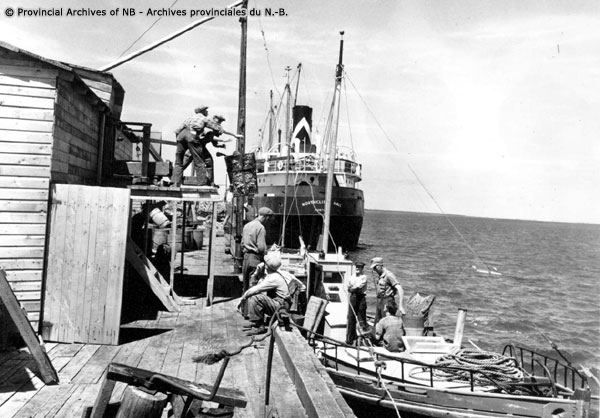
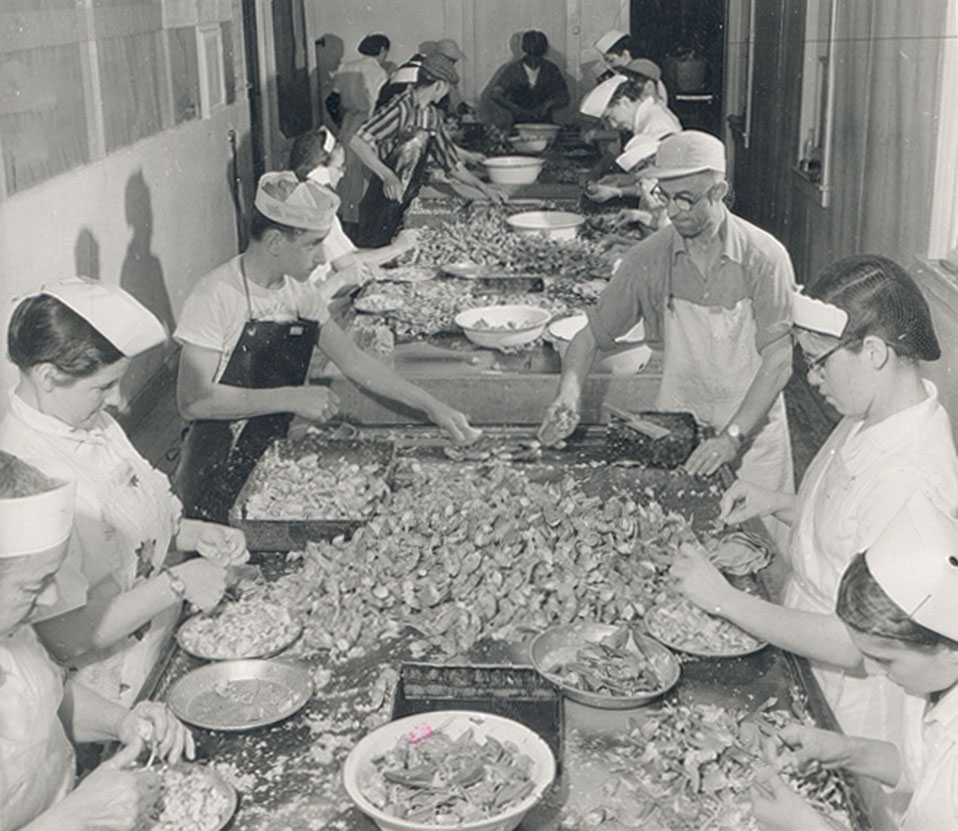
Lobster processing c.1950 Cheticamp, NS Nova Scotia Information Service – Nova Scotia Information Service Nova Scotia Archives #13392

Fishing lobster for export began in Atlantic Canada as soon as canning technology allowed the preserving of the tasty fish. When markets in New England and Britain beaconed, Atlantic Canadian fishers stepped up. The Lobster industry like any built on a luxury item, is subjected to market forces which are unpredictable and capricious4. Boom bust cycles effected fishers and processors alike from the very beginning. Market cycles which took lobster from ordinary food on Atlantic Canadian dinner tables to New York and London luxury restaurants, delivered it back with regularity5.

The period between the first and second wars was dominated by the Great Depression, high unemployment and widespread suffering. The depression halted a period of mechanization, the move away from subsistence farming and development of specialty farms. Textile production moved from spinning wheels to factories6 that depended upon imported wool. Although some farms still raised sheep, by the end of the 1930s they were in far fewer number.

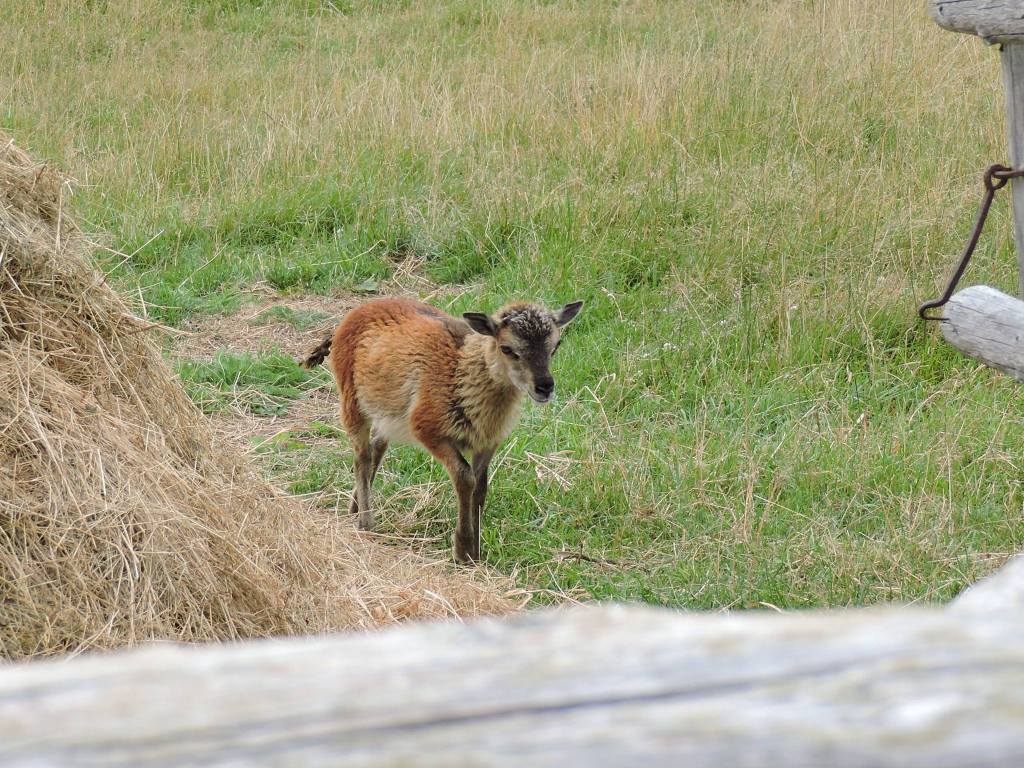
Bottle fed lambs at Portage Pork Plus Farm, Portage, Westmorland, NB. Owned and operated by Arndt & Gabriele Becker and family who supplied this photo

Canada’s declaration of war on Germany in 1939 further entrenched the austerity began during the Depression but finding work was no longer the problem. Self sufficiency intensified further, cows and sheep repopulated farms and front lawns became vegetable gardens. Choosing homegrown and homespun became patriotic7 again, and the lobster on dinner tables and in school lunch cans was rebranded as patriotic too.

Grazing sheep and Lobster pots. W.R. MacAskill Nova Scotia Archives 1987-453 Ref #1317.

The recruitment of troops from rural Canada, emptied farm fields of labourers and raised a new problem. Who would till the soil and raise the animals? Just like in armament factories, the answer was women, women were now welcomed as employees on farms and in farm fields. For Lottie the war was an opportunity, she put her skills to work in aid of her country and earned income while her husband John MacPherson served overseas. Lottie found her niche as a farm hand with a particular skill set, she was a fast, efficient and effective sheep shearer.

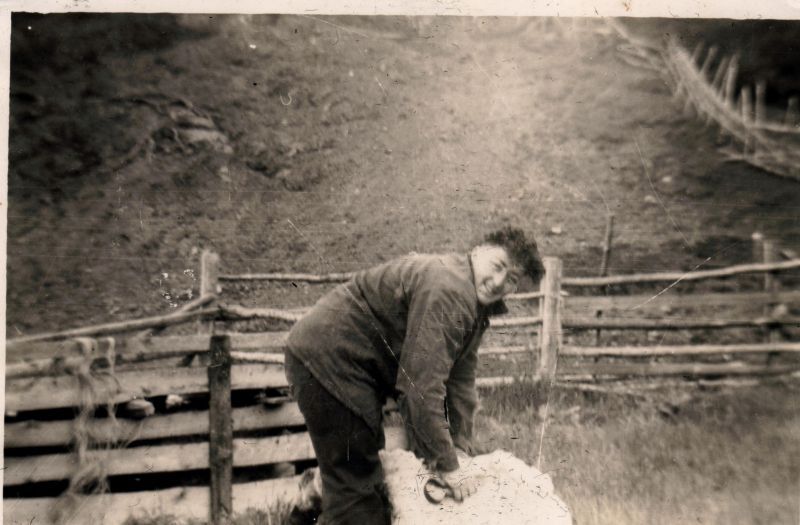
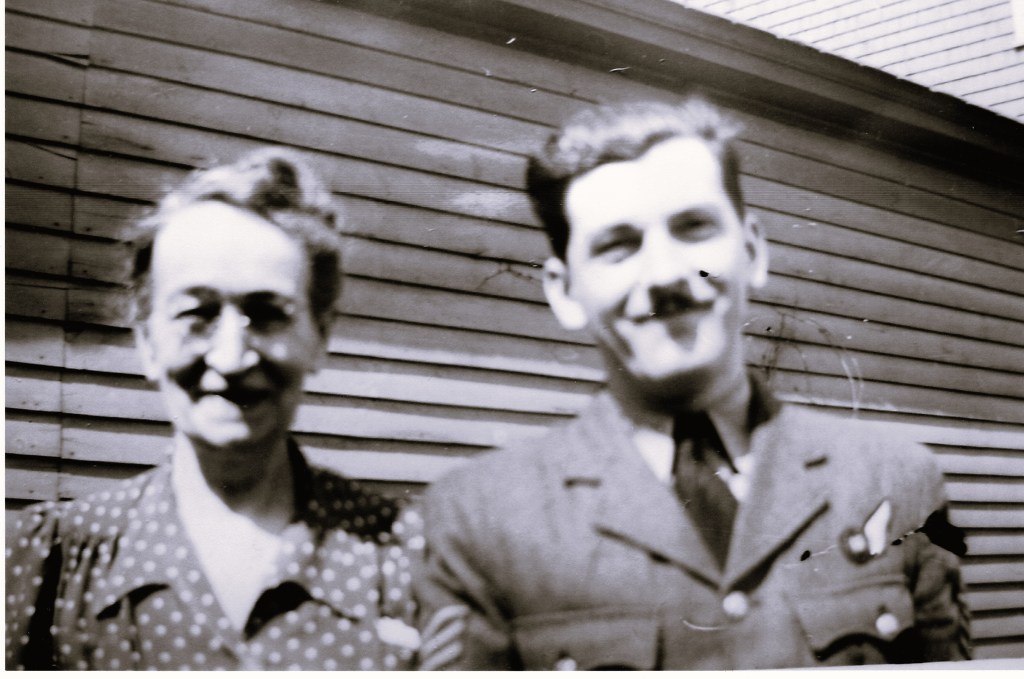
Charlotte (Lottie) Melanson MacPherson at work using hand powered shears c.1943 Photo courtesy of Find a grave and Photographer/Contributor David Phillips.

During shearing season, Lottie moved from farm to farm in Antigonish, Guysborough and Inverness counties shearing sheep as she went. As an itinerate worker, Lottie depended upon farm families to host her during her time shearing their sheep. Lottie took to life on the road well, she used her work hours to hone her skill as a shearer and spent her leisure hours enjoying the company of her host families, attending local parties and social events.

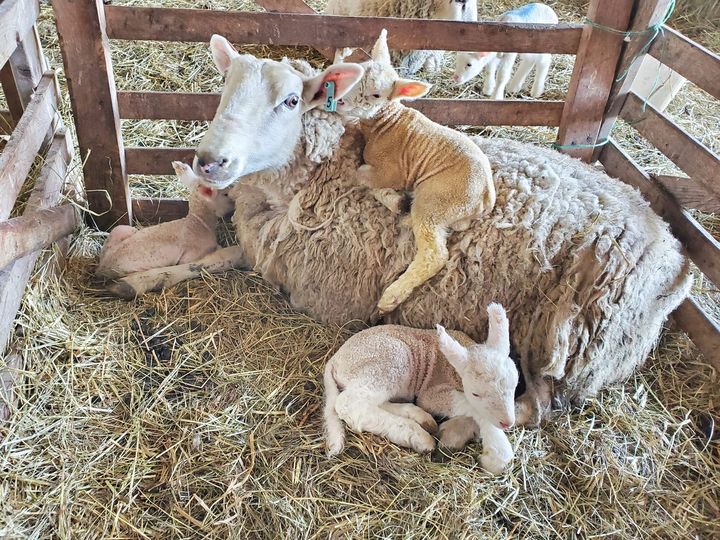
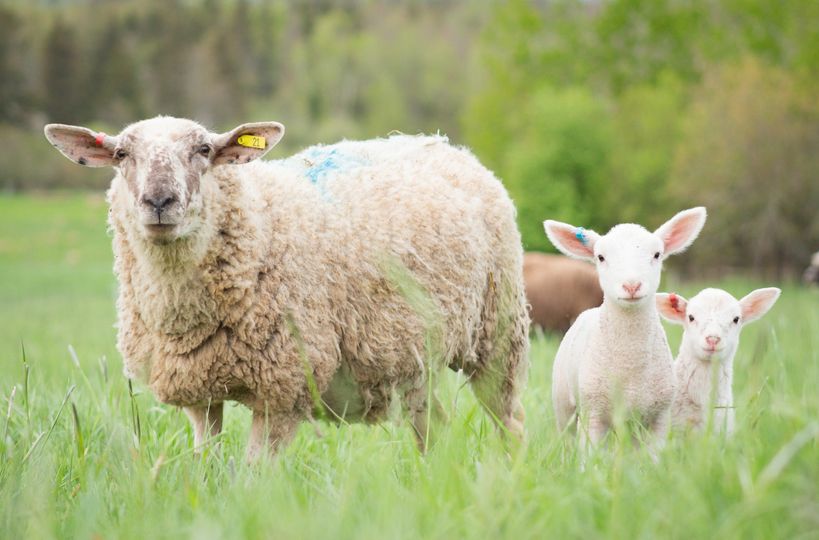
A tolerant Mama and triplet lambs -Portage Pork Plus Farm, Portage, Westmorland, NB. Owned and operated by Arndt & Gabriele Becker and family who supplied this photo

Lottie, was a sturdy farm woman, tall, strong and willing, she was also what my Mum called ‘rough around the edges’. Lottie challenged gender norms with a salty tongue8, and a reputation for being able and willing to use her physical strength to contain wayward men as easily as the sheep she was shearing. The strong affection for Lottie held by those who remember her from those years, proves Lottie was more than a man-ish woman with a skill set. Her love of telling ghost stories to the children in the families she visited, and the respect other women had for her proves a depth of character beyond her sheep shearing capacity.

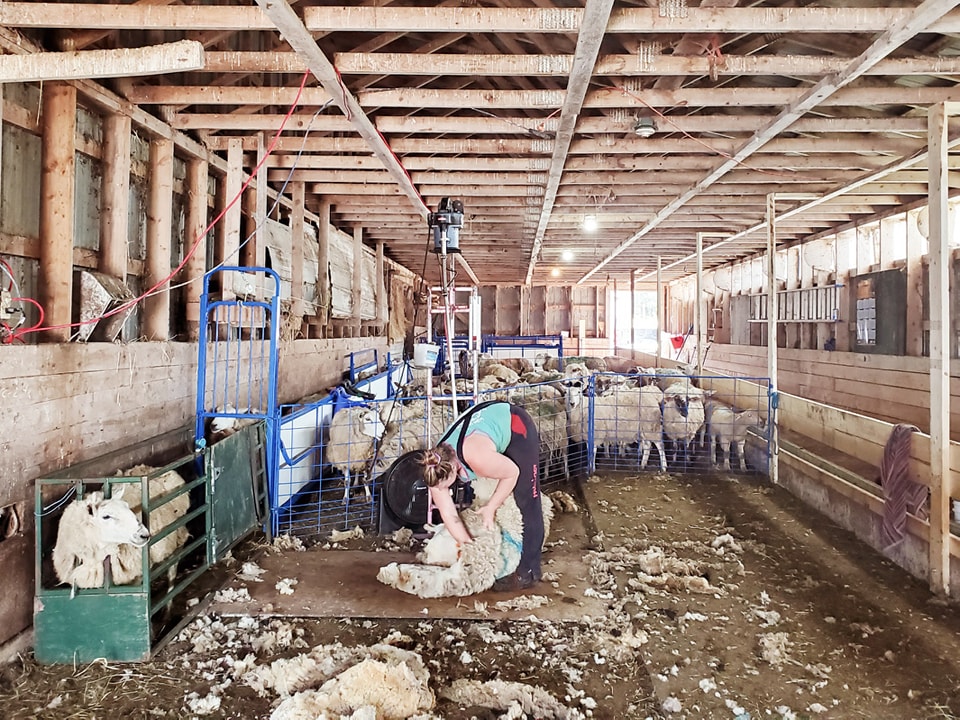
As a shearer few could surpass her ability, using only hand powered shears9, Lottie averaged about 80 sheep per day. In 1945 Lottie sheared more than 5700 sheep in her work season, and proved her capacity to shear a sheep in a record 2 minutes 45 seconds.

Shearing at Portage Pork Plus Farm, Portage, Westmorland, NB. Owned and operated by Arndt & Gabriele Becker and family who supplied this photo

The end of second world war began a period of intense modernity, sheep raising, and homebased textile production waned. Lobster stopped being a patriotic food choice and disappeared from lunch cans. Lottie’s war effort ended too, sheep ranching for textile production all but stopped in the region, only resurging minorly after Lottie was beyond her ability to shear.

By the time I encountered Lottie, her physical health was failing but her reputation as a champion sheep shearer remained intact. I wish I had taken more time to know her and learn more about her life, I might have confirmed the good possibility, that some of those farm house tables delivered Lottie a feed of lobster.

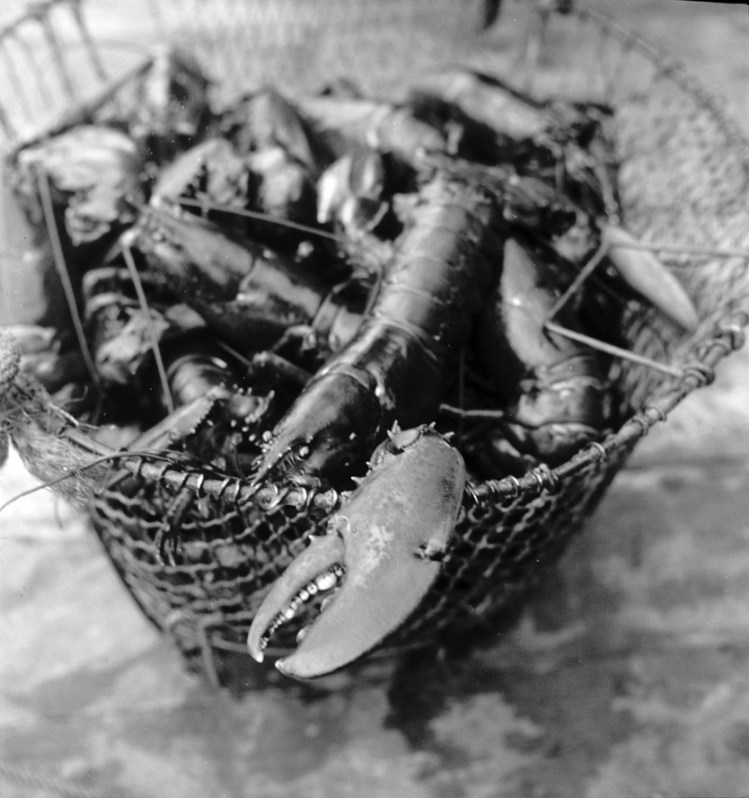
Because I purchase lobster already cooked and shelled, I can serve it as lobster salad or build a fancy version of the school lunch box sandwich, the lobster roll .

A buyer’s basket of lobsters Cape St Mary’s 1 Dec 1950. Photo in the collection of Alexander H. Leighton at the NS Archives 1988/413 #1317. Photographer John Collier jr.

My Mother’s cookbooks Lobster Salad / Roll:

Ingredients:
3 cups of chopped lobster
1/2 finely chopped celery
1/4 c My Mother’s Cookbook cooked salad dressing
up to 1/4 c Mayonnaise
salt and pepper
Method:
1. Place ingredients in a bowl and mix to combine, adding 1 T at a time of the mayo until it reaches desired consistency.
2. Serve with sides of potato salad, and mixed greens, or toast a brioche bun, slather with garlic butter and stuff with lobster salad.

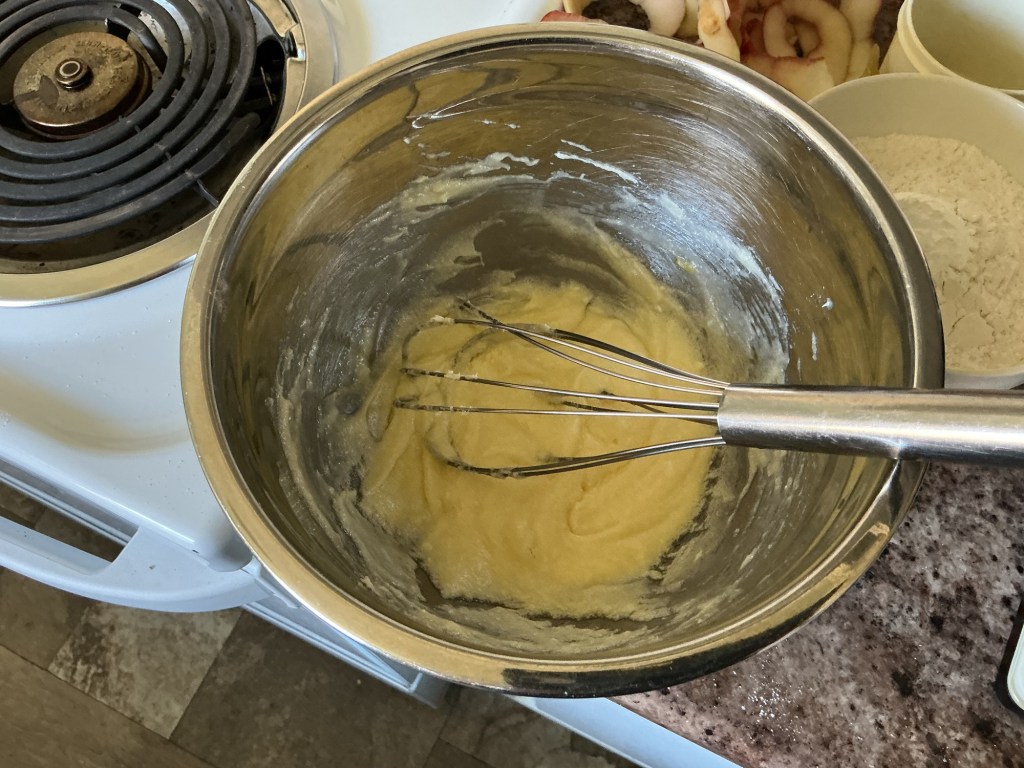
My Mother’s cookbook cooked salad dressing:

Ingredients:
3 T flour
6 T sugar
1 egg
2 tsp dry mustard
6T white vinegar
1/2 c milk
2 T butter
Method:
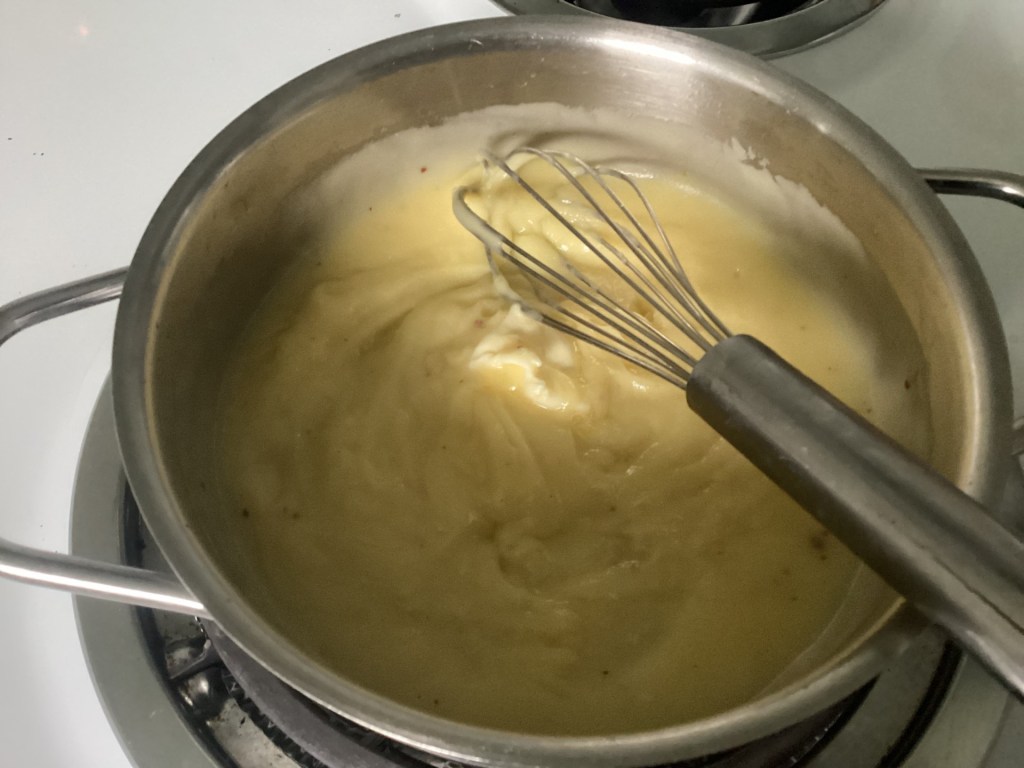
1. In a medium sauce pan, combine flour, sugar, mustard together and mix well:
2. Add vinegar and egg which has been beaten, mix well;
3. Add milk and place over medium heat;
4. Stir constantly until the sauce reaches a soft boil and thickened,
5. Remove from heat, add butter, permit to cool and refrigerate.

*** Homemade boiled salad dressing can be used to replace sweetened dressings in potato salad, chicken salad, Cole slaw, etc.

Boiled salad dressing – Photo Elizabeth Lyons Morrison

Footnotes:

  1. In our house lobster is a luxury, like many in our region the expense limits access. Instead of regular and frequent meals of lobster, we have 2 or 3 ‘lobster feeds’, a year. A feed is a meal where the focus is lobster, sides a minimal and mostly condiments, garlic butter, vinegar, mayo and crusty rolls to soak up the liquor. A feed of lobster always assures sufficient for a next day salad or roll. ↩︎
  2. Charlotte (Lottie) Irene Melanson MacPherson was born New France, Antigonish, NS in 1914, the daughter of John Melanson and Charlotte DeLorey Melanson. Charlotte died in 1990, in Antigonish, NS. I am unclear about when Lottie married John Roderick MacPherson, some online trees suggest they were married about 1934, I find this unlikely since John would have been only 14 years old at the time. Additionally, a 1945 newspaper article regarding her career, refers to her as Miss. Melanson. ↩︎
  3. “The Boston States” is a Maritime Canadian term referring to Northern New England, Maine and Massachusetts in particular. ↩︎
  4. The Lobster fishing and processing industry in Atlantic Canada has experienced what can only be described as a wild ride. Beginning with canned lobster, Canada’s first lobster cannery was built at Portage island at the mouth of Miramichi bay about 1845, less than five years after the development of the Stamp can. The movement from canned to live and eventually freezer pack processing were punctuated by crippling losses and low prices. In local terms lobster is a luxury, the cost of which is beyond many but most locals understand that when the price is low, fishers and factory workers are suffering. ↩︎
  5. Many Maritimers remember when taking lobster sandwiches to school in their lunch can was tantamount to declaring themselves poor. Such was the nature of the lobster market, on New York restaurant menus one month, scattered on farm fields as fertilizer the next. The processing industry began in earnest by the 1872 with 44 Canadian canneries, by 1900 the number had grown to 700 despites the ups and downs. Canneries were built on the Bay of Fundy, Northumberland strait, and the Bai du Chaleur where Acadian fishers and processors were and remain heavily involved in the lobster industry. ↩︎

  6. Homespun cloth and other textile production endured far longer in the Atlantic Canadian region, driven by the need for warm clothing and lagging investment in textile mechanization. By the end of the Great Depression, many families had packed their spinning wheels and looms away, expecting the march of ‘progress’ to continue. ↩︎
  7. The declaration of war put many things in flux, to mitigate the effects government developed programs designed to encourage and educate Canadians on how to aid the war effort. Eating lobster was sold as patriotic, just as saving fat and abiding by rationing were consider the least those at home could do to support the war. ↩︎
  8. The stories about Lottie’s manner endure, her salty tongue particularly while shearing might have had Mother’s banning children from the shearing shed, but those same Mother’s welcomed her in to their homes and allowed her to spend time with those same children when she was not working. Those who remember Lottie express awe at her physical strength, her endurance, they remember her gruff demeanor and talk about how they and their mother’s liked and enjoyed her time with them. ↩︎
  9. Hand powered shears are exactly that powered by the hand, the wrist and hand strength to sustain 8 + hours of shearing is mind boggling, despite this Lottie could and did out perform those using powered shears. ↩︎

Atlantic Canadian Women of the Cloth – Homebased textile Series Reference list:

  1. “Flax, Farming and Food: How Scottish – Irish Immigrants Contributed to New England Society in the 18th Century”, Worcester Historical Museum, Worcester, Mass. https://worcesterhistorical.com/worcester-1718/flax-farming-and-food-how-scotch-irish-immigrants-contributed-to-new-england-society-in-the-18th-century/#:~:text=Accustomed%20to%20spinning%20wool%20and,fever’%20in%20the%20local%20population
  2. Bitterman, R. “Farm households and wage labour in the Northeastern Maritimes” Labour/LeTravail, 1993. https://www.erudit.org/en/journals/llt/1993-v31-llt_31/llt31art01.pdf
  3. Rygiel, J. A “Women of the cloth – weavers in Westmorland and Charlotte Counties New Brunswick 1871 -1891”; UNPUL thesis Carleton University, 1998.
    https://repository.library.carleton.ca/concern/etds/37720d
  4. Rygiel, J.A. “Thread in Her Hands –Cash in Her Pockets; Women and Domestic Textile Production in 19th-Century New Brunswick” UNPUL thesis Carleton University,
  5. MacLeod, E. and MacInnis, D.; “Celtic Threads: a journey in Cape Breton Crafts”; Cape Breton University Press, Sydney, NS. 2014
  6. Introduction to the Spinning Wheels collection in the National Museum of Scotland https://blog.nms.ac.uk/2020/12/14/introduction-to-the-spinning-wheel-collection-in-national-museums-scotland/
  7. Goodrich, W.E. “DOMESTIC TEXTILE PRODUCTION IN EARLY NEW BRUNSWICK” Keillor House Museum.
  8. Toal, Ciaran “Flax to Fabric – The history of Irish linen and flax” Lisburn Museum https://www.lisburnmuseum.com/news/history-of-irish-linen-flax/
  9. Dunfield, R.W. “The Atlantic Salmon in the History of North America” Fisheries and Oceans Canada 1985. https://waves-vagues.dfo-mpo.gc.ca/library-bibliotheque/28322.pdf
  10. Wallace -Casey, Cynthia “Providential Openings – The Women Weavers of Nineteenth-century Queens County, New Brunswick” Material Culture Review. 46, 1 (Jun. 1997). https://journals.lib.unb.ca/index.php/MCR/article/view/17740/22230
  11. Eveline MacLeod and Daniel W. MacInnes “Celtic Threads: A journey in Cape Breton crafts” Cape Breton University Press, Sydney, NS 2014.
  12. MacMillan, A.J. “A West Wind to East Bay: Short History and a Genealogical Tracing of the Pioneer Families of the East Bay Area of Cape Breton.” Music Hill Publishing, Sydney, NS 2001.
  13. Campbell, Joseph “Information regarding the avalanche at John Campbell’s farm 5 Feb 1856”, a recording by Mrs. Archie MacDougall 25 July 1966. In the holdings of the Beaton Institute, Sydney, NS.
  14. Roach Pierson, Ruth. “Canadian Women and the Second World War” The Canadian Historical Association. Ottawa 1983.
Spring lambs and their Momma at Portage Pork Plus Farm, Portage, Westmorland, NB. Owned and operated by Arndt & Gabriele Becker and family who supplied this photo

Acknowledgement: I acknowledge that the land on which I live and write about is the traditional unceded territory of the Wolastoqiyik (Maliseet) and Mi’kmaq Peoples. This territory is covered by the “Treaties of Peace and Friendship” which Wolastoqiyik (Maliseet) and Mi’kmaq Peoples first signed with the British Crown in 1725. The treaties did not deal with surrender of lands and resources but in fact recognized Mi’kmaq and Wolastoqiyik (Maliseet) title and established the rules for what was to be an ongoing relationship between nations.

Work, Frolics and Tragedy

Cape Breton Oatcakes – A milling frolic favourite.

This blog completes… Homespun and Mrs. Campbell and is 2nd in the series Atlantic Canadian Women of the Cloth – Homebased textile production.

Today, crafters buy cotton / yarn in the colours they desire and get busy weaving, knitting, crocheting, etc. Homebased textile producers no longer need to raise and shear sheep, wash, pick, card, spin, dye, weave or full1 fabric. The tradition of women sharing work, particularly the activities of homebased textile production is well documented in many cultural traditions, none more than in Scotland.

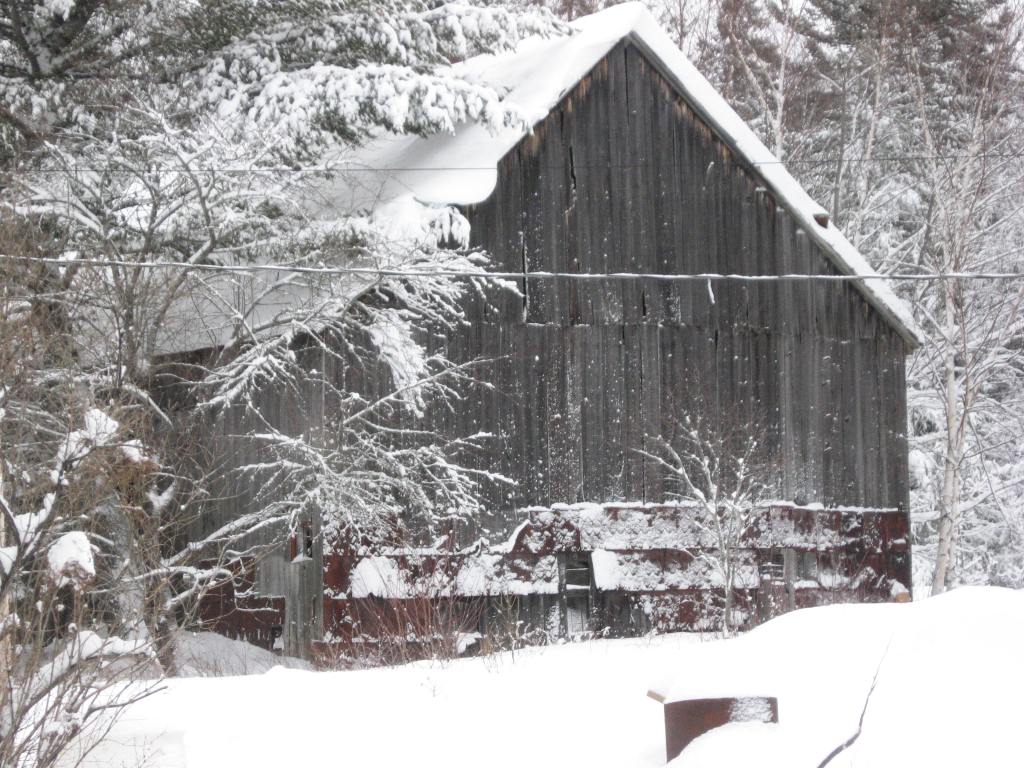
Winter in Atlantic Canada, a century old barn built by the Hovey family of Ludlow, NB.

The rich Gaelic tradition of songs and storytelling, combined with work were an important cultural vehicle. Assuring local history was recorded in memory if not in ink. From the shearing of sheep onward, where necessary and possible Scottish women shared their textile work, accompanied by their work songs, and food.

Janet Hendry MacDonald2 and Mrs. John Campbell3 willingly participated in work frolics hosted by family and neighbours, they knew they could count on a full house when they had laborious and/ or tedious work to do. Frolics not only provided a means to accomplish work, they provided an opportunity for social contact and alleviated the grind of the constant effort required to sustain a household.

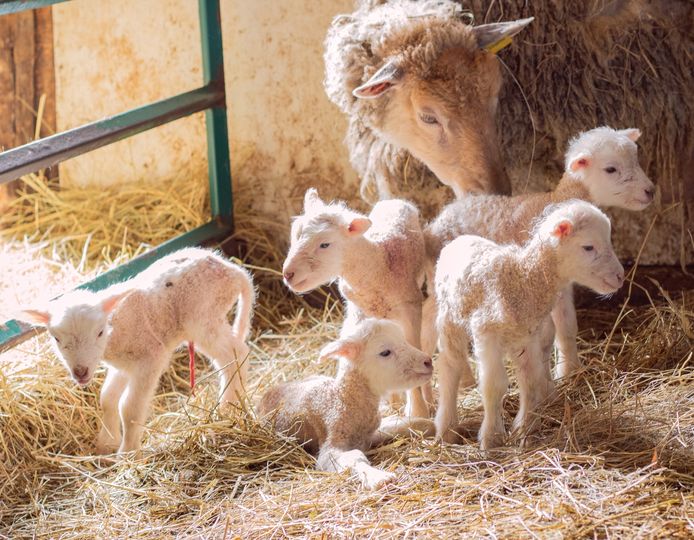
Mama Ewe ‘Big Red’ and her quintuplets. May 2024, Portage Pork Plus Farm, Portage, Westmorland, NB. Owned and operated by Arndt & Gabriele Becker and family who supplied this photo.

Despite having a Scottish born father, and a husband with roots in the Western Isles, Janet’s language of life was English not Gaelic. Janet was well read, enjoyed poetry, keeping up with current events and for a time kept written records of her daily life. Janet’s diaries give us a glimpse into her life and her production of textiles. In today’s terms Queens county, New Brunswick was not ethnically diverse but there was diversity of backgrounds, culture, tradition, experience, skills and resources. Among Janet’s neighbours were families with generations of history in North America, some like her mother’s family were Loyalists from New York. Others like her husband, Alexander MacDonald’s family were Scots who settled first in North Carolina, or Pennsylvania, as her Grandfather and father had planned to do.

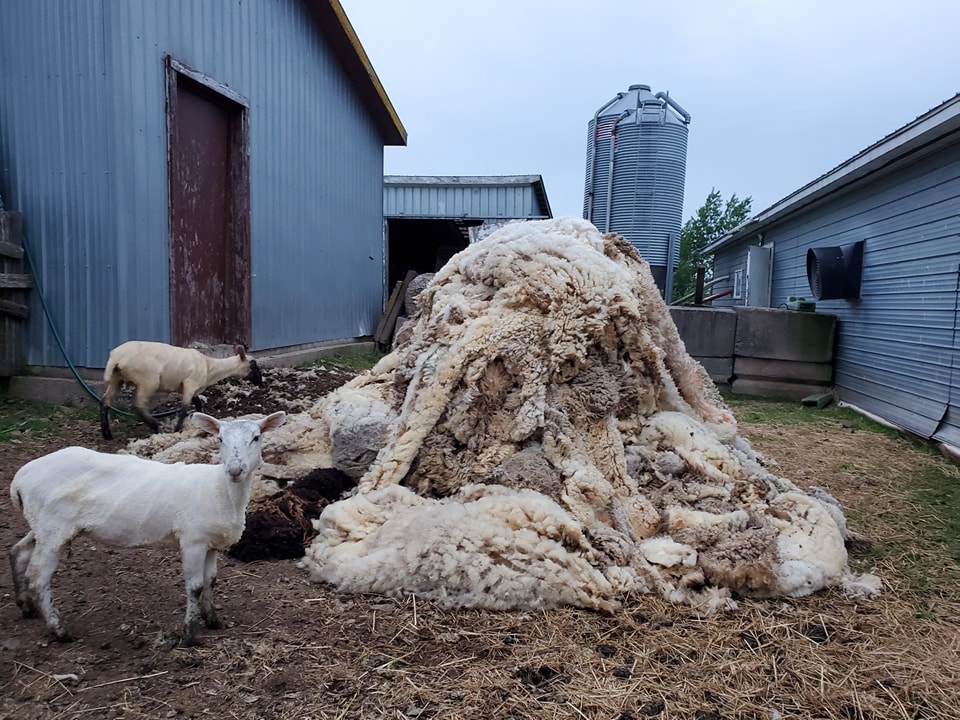
Newly shorn sheep and fleece. The first step in producing wool yarn and cloth. June 2024, Portage Pork Plus Farm, Portage, Westmorland, NB. Owned and operated by Arndt & Gabriele Becker and family who supplied this photo.

Janet’s diaries include references to spinning bees, quilting and sewing bees, but not carding bees or fulling frolics. By the time Janet and Alexander were establishing their homestead in McDonald’s Corner, Queens county, services like carding and fulling of wool cloth were being offered by local mill operators, who might also mill grain, or even lumber. The benefits to Janet’s textiles of machine carding, can’t be over stated, uniform carding leads to easier spinning and better yarn, better yarn leads to better…etc. Mechanical fulling saved loads of physical labour and assured uniformity of processing, which required skill if done by hand.

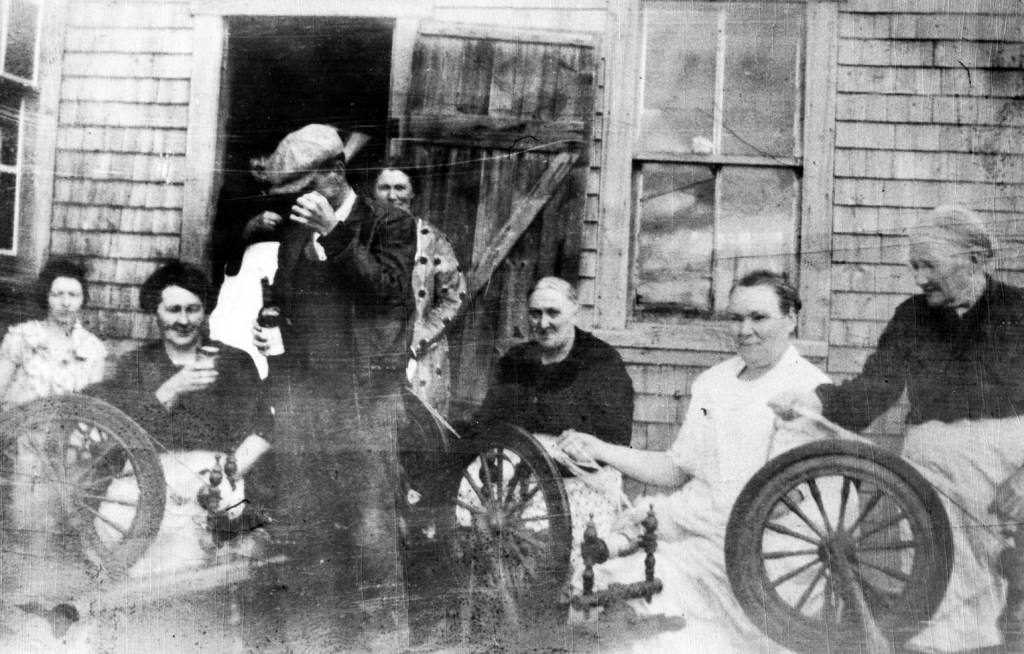
A spinning frolic at the home of Angus “Ban” MacFarlane. Featured in the image are: Mrs. Angus “Ban” MacFarlane (standing in doorway), Mrs. Duncan Y. Gillis (standing at back). Seated: Mrs. Sandy Gillis, Mrs. Malcolm Gillis, Mrs. Johnny MacLellan, Mrs. Dougald John MacFarlane, and Mrs. Hugh MacKenzie. c. 1928 Another example women being recorded by their husband’s name. Beaton Institute, Cape Breton University bi-79-1173-4153

Mrs. John Campbell was a Highland Gael, it is possible she might have spoken English, but her language of life was Gaelic. I can say these things with some confidence, despite the absence of specific documentary proof. The diversity inherent in Queens county, NB, did not exist in Big Pond Cape Breton in the 1850’s. Although Cape Breton island had initially seen European settlement by the French and Acadians, the 19th century saw large numbers of Highland Scots immigrate to the area.

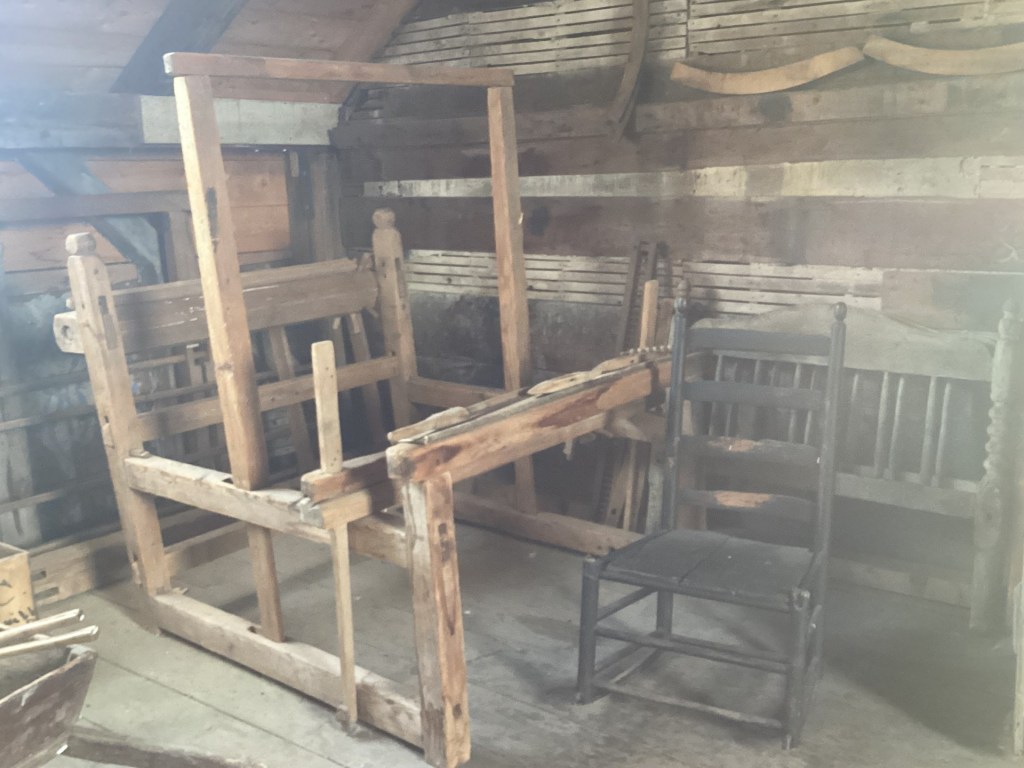
Loom frame, c. 1820 on display at Campbell Carriage house museum, Middle Sackville, NB July 2023 Elizabeth Lyons Morrison

Despite fleeing dire economic realities in Scotland, families like the Campbells, MacDougalls, MacPhersons, etc. did not receive support or assistance from the Crown. Any immigration incentives from their previous landlords did not extend to previsions. Their response to this insecurity was to choose locations near those they knew. So family and neighbours from home, became neighbours in their new home.

Many of those who Mrs. Campbell knew and shared life with were former residents of the Western isles of Scotland, like the island of Barra, as were both the Campbell and McDougall families. Of course Cape Breton Scottish enclaves did interact, but for a significant period following arrival, language and religion drove contact, relationships and economic development.

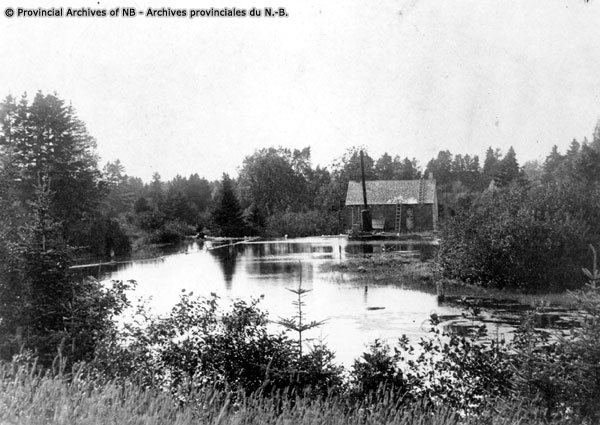
Flett Carding mill, Nelson, NB Built in 1850 the mill was one of the busiest of the region. The mill was dismantled in 1931. PANB reference # P194-237

Services like carding and fulling mills were slower to develop in some areas of the Atlantic region, unlike Queens county NB investment in the milling of wool in Cape Breton did not begin immediately. The combination of physical isolation, differences in language and religion served to create a unique cultural milieu. Mrs. John Campbell depended upon many of the traditional ways of producing yarn and cloth, just as she depended upon other women to help full her homespun.

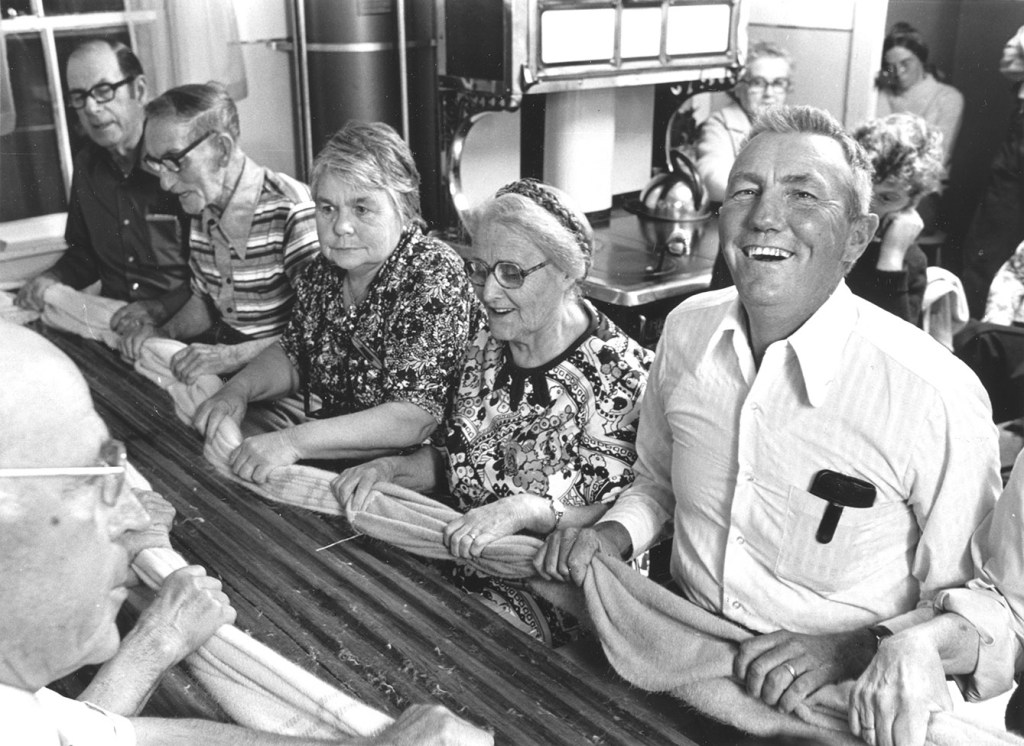
Featured in this iconic image from left to right: John Alex ( John X. ) MacDonald, Neil R. MacDonald, Gwennie Pottie, Jessie Mary MacLeod and Alex Kerr. c.1984  Beaton Institute, Cape Breton University bi-84-426-14526

7pm Feb 5th 1856 Big Pond Cape Breton.*

Gently swaying the whimpering child in her arms, Mrs. John Campbell reached to tuck a fringe of brown hair back beneath her Kerch4, she was sure it looked as tired and rumpled as she felt.

Turning toward the older woman who sat knitting in a chair to the left of the fire. “I am going to lay with the child awhile, maybe she will finally sleep.” Her voice sounding slightly hoarse to her own ears, too much singing and not enough sleep.

“I think you’d best just head to bed. I’ll be sending the girls to bed in the loft shortly. The men will soon be finished with the grain and want an early night. They’ll no be wanting women underfoot.” her mother in law replied, knowing with the house crowded, John and neighbour young MacDougall would bunk on the floor in front of the fireplace.

“I will” She replied thankfully, stifling a yawn. Biding John’s mother and nieces a “Oidhche mhath”5 she collected a candle from the mantle, pausing only briefly to light it before turning toward the bedroom.

Raising the candle high enough to peer in to the smaller of the two box beds6 which lined one side of the room, she was relieved to see both of the older children were sleeping soundly. The music and laughter had disrupted their sleep, leaving them tired and cranky. Just like baby Mary, she thought looking down into the child’s sweet face, grateful that she was finally quiet, if not sleeping.

Carefully sliding the child on to the larger bed she arranged the cradle next it, so she could transfer her later. Removing her kerch and outer clothing she blew out the candle and tiredly eased on to the bed beside her daughter, who seemed content to chew on her tiny thumb.

A soft smile of satisfaction crossed her lips as she mulled over the frolic. She was well pleased, her clo mor had actually drawn a compliment from her Mathair cheile7. The evening had been a great success, the arrival of MacPherson with his fiddle an unexpected treat. Even Mathair cheile seemed to enjoy herself, which was never guaranteed. The older woman, like many of her generation, preferred the old ways.

The only tension filled moment had been between MacDougall and her Mother in law. When the senior MacDougall, who taken over singing when the men joined the waulking8, made it known he considered the cloth needing only one more course to be fully milled, sparks flew.

Her Mathair cheile insisted there would be no seanchas, or dannsha9 until the her meur10 told her the cloth was milled. Thankfully, MacDougall agreed out of respect for the older woman, helped along by her being Grandmother to the MacPherson girl his son fancied11. John said he was sure, MacDougall nearly biting through his tongue when his mother held out for four full verses, would surely make it into one of his songs12. But the older women’s success put her in a good mood, the music and food met her approval, even the sweetened oatcakes. Yawning, her eyes closing as she drifted toward sleep.

A strange rumbling sound jolted awake her, she reached instinctively for the baby…

* This is a fictionalize account.

Sometime on the evening of the 5 Feb 1856, the John Campbell homestead was destroyed by a snow slide. When Stephen MacDougall did not return home as planned on Wednesday morning, his brother went in search of him. Finding no sign of a house or barns on the Campbell property, he raised the alarm.

Grand Bra D’or at Johnstown, Cape Breton 2014 Elizabeth Lyons Morrison

Stephen MacDougall, and John Campbell were found trapped in the debris and unable to aid the women and children. John’s mother Mary Campbell was discovered in a corner under a cabinet, she too survived the ordeal. Baby Mary was found unharmed lying next to her mother on the box bed. In total five people lost their lives, Mary Campbell, Mary MacPherson, Mrs. John Campbell and the two older Campbell children.

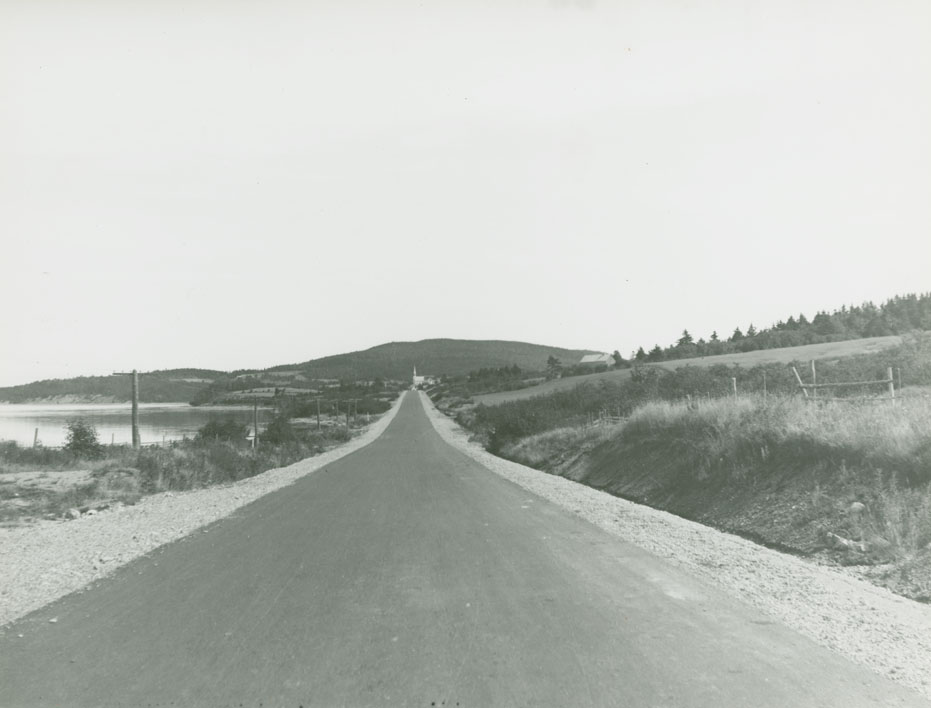
In the distance St Mary’s Roman Catholic church, Big Pond, Cape Breton 1936. Department of Highways Nova Scotia Archives 2009-023 no. 001 p. 8

The records of the tragedy at John Campbell’s farm are very sparce13. In the absence of victim names, details of destroyed buildings, livestock and potatoes being found more than 200 feet away, seem to our sensibilities a bit cold and lacking basic humanity. It would be wrong to view the past by our current experience.

Record keeping during the 1850s was uneven and reflected the social conditions at play. Newspapers of the time demonstrated a generalized disinterest in women’s lives, and marginalized further those who spoke Gaelic and were Roman Catholic. A tragedy that killed 3 women and 2 children engendered less interest in publishers than the cautionary tale about snowslides endangering other farms and livestock. So the personal memory of the event and those who died was left to family and community.

Washing and processing fleece. PANB RICHARDS, DUFFERIN: COLLECTION Reference # P368-32

It is hard to imagine the scars an experience like this leaves on survivors. John Campbell lost almost everything in the blink of an eye, in what can only be described as a freakishly rare event. His wife, two of his children, and his nieces, his house, farm, and most of his livestock, all gone. The older Mrs. Campbell lost 4 grandchildren and a daughter in law, she like John and Stephen would surely be haunted by the hours of helpless suffering as she listened to the desperate cries from her dying loved ones.

John Campbell eventually rebuilt a home and farm on the property, although his new house was located as far from the hill side and previous site as possible. He also remarried, his second family beginning to arrive some 5 years after the loss of his first wife and children. Sadly, John Campbell died himself in February 1870 leaving his wife to raise their young children aided by kin and community.

The tradition of milling or fulling frolics lingers today in Cape Breton. As was always the case milling frolics are about language, music, tradition, and the joy of sharing, the only thing missing today is the work. Cape Breton’s unique ‘Scottish’ culture should not be mistaken as just the result of people repeating what they knew. It was never the case, from the onset Scottish settlers adapted. They made modifications and adjustments in what and how work was approached, new techniques and resources were always being applied.

When Mrs. Campbell worried about her Mother in law’s love of the old ways, she might have been referring to everything from men being involved in waulking the cloth to whether frolic oatcakes should contain wheat flour and sugar. Traditions don’t continue without alteration and without a good reason. I would say both Cape Breton oatcakes and milling frolics have proven themselves to be good reasons.

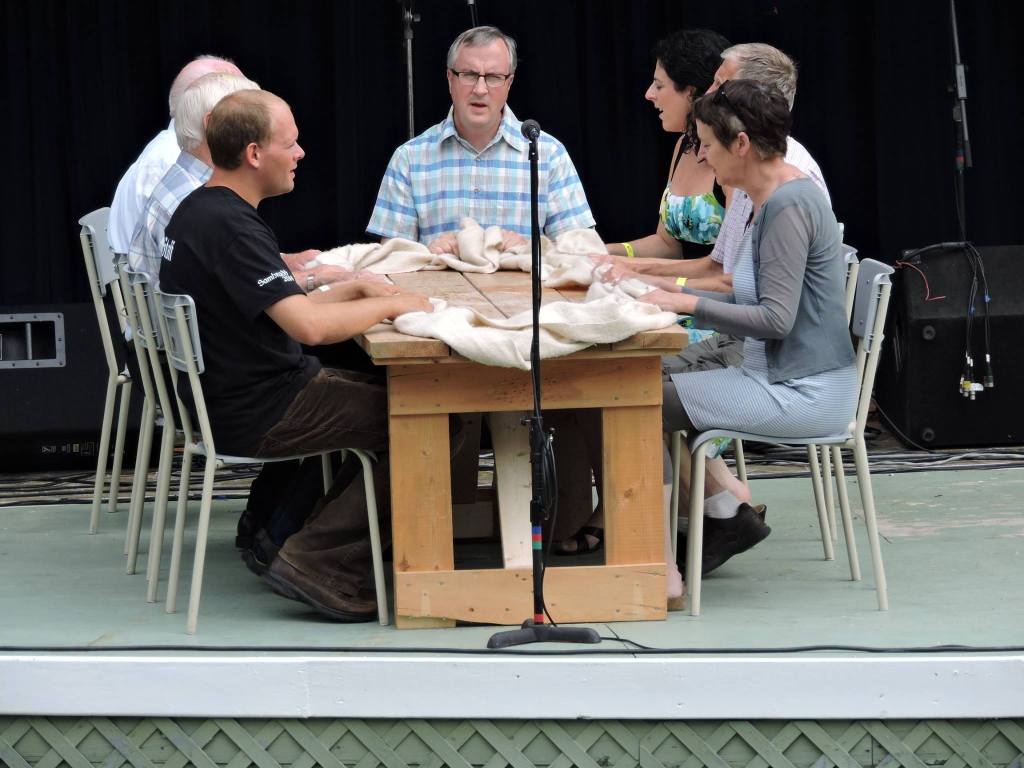
August 2014 Highland village Milling Frolic Iona, Cape Breton

My Mother’s Cookbooks Cape Breton Oatcakes

Ingredients
2 1/4 c scotch oatmeal or rolled oats
2 1/4 c whole wheat flour
1 tsp salt
1 1/2 tsp baking soda
1/4 c each brown and white sugar
1/2 c + 2 Tbsp cold water
1/2 c lard

Method:
1. Preheat oven to 400 degrees F.
2. Combine oatmeal, flour, salt, soda and sugar together in a bowl;
3. Cut lard into the dry ingredients;
4. Add water and stir to combine;
5. On a well floured board, pat into a rectangle, then roll out the dough to 1/2 inch thick;
6. Cut in to rectangles or continue to triangle shapes;
7. Place on a cookies sheet and bake for 12 -15 minutes or until golden brown.

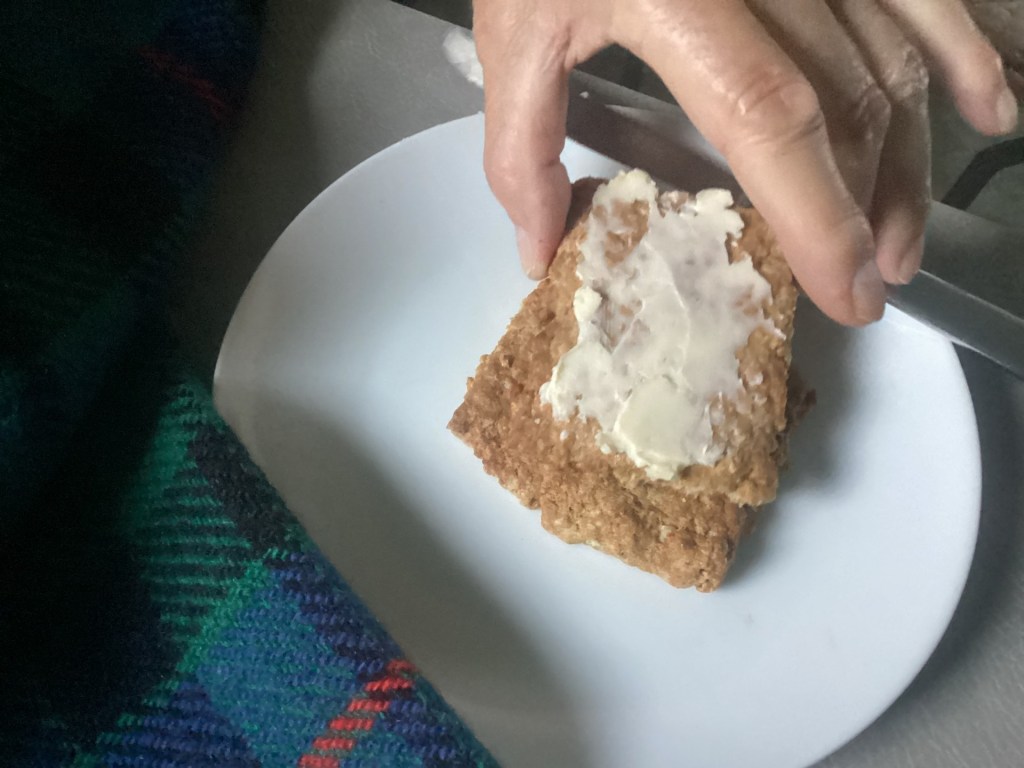
Cape Breton oatcakes with butter, a treat the Cape Breton Highland Gael in this house can’t resist. Oct 2024 Elizabeth Lyons Morrison

Footnotes:

  1. When homespun cloth is removed from the loom, the weave is course, rough, loose and thin. To convert cloth in to soft, warm and wearable cloth, mechanical agitation (beating and pounding) combined with either water or other substances like urine to shrink the fibers. All woolen Cloth required some milling, to reach Clo Mor stage, the cloth would be milled until is was thick and essentially water proof. ↩︎
  2. Janet Hendry MacDonald born 7 Feb 1795 Cambridge, Queens county, New Brunswick Canada, died 22 Apr 1887 McDonald’s Corner, Queens county, New Brunswick. Janet’s father George Hendry born c. 1764 Elgin, Moray, Grampian, Scotland died 1830 Wickham, Queen, New Brunswick. Janet’s Mother Susannah Belyea born c.1781 Cortland Manor, Westchester, New York. died 1842, Cambridge, Queens, New Brunswick. Janet married 9 July 1818, Alexander ‘Black’ MacDonald born 4 October 1794 Hillsborough, Albert, New Brunswick died 29 March 1880. Three of Janet’s siblings Elspeth, Mary and James Hendry married Alexander’s siblings, Lewis, Donald and Delilah MacDonald. The MacDonald family operated a grist mill in Cambridge, Queens, NB. Janet and Alexander MacDonald farmed the portion of George Hendry’s property which was her inheritance. ↩︎
  3. Mrs. John Campbell, birth date, location, and name unknown, died 5 Feb 1856, Big Pond, Cape Breton, Nova Scotia. She married John Campbell born ~1810 probably in Barra, Scotland died 22 Feb 1870 in Big Pond, Cape Breton. John was son of Donald and Mary Campbell, who settled in Irish Vale, Cape Breton. Some of John’s siblings settled in Middle Cape, and Grand Narrows, Cape Breton. ↩︎
  4. A kerch is a traditional head covering worn by married Scottish Gaelic women. Made of white cotton, the white crispness of her kerch was a sign of a woman’s quality. ↩︎
  5. Oidhche mhath – Good night greeting in Scottish Gaelic. ↩︎
  6. A box bed is a type of wood framed cabinet bed often incorporated in to the walls of a house. When equipped with curtains or shutters box beds offered additional privacy. ↩︎
  7. Mathair cheile Scottish Gaelic term for Mother in law. ↩︎
  8. Waulking, Milling, fulling cloth are terms used to describe the process of shrinking wool cloth. In the Western Isles, women were primarily responsible for milling fabric. The addition of men, and the extension of the activities into the evening hours contributed in large part to milling frolics continuing in Cape Breton even today. ↩︎
  9. Seanchas – storytelling, dannsha – dancing in Scottish Gaelic. ↩︎
  10. Meur is finger in Gaelic, determining how much shrinkage cloth had experienced involved measuring the cloth prior to milling and regularly during processing. The measurement tool was a woman’s finger. ↩︎
  11. Social events, including milling frolics were opportunities for courtship. ↩︎
  12. Gaelic milling songs, are essential to delivering a fine evenly milled cloth. The cadence of the song helped to assure consistent and even milling. Cape Breton singers and bards were inspired by real events, funny happenings, conflicts and excesses were the stuff of their creativity. When Mrs. Mary Campbell insisted on her finger measurement she risked regular embarrassment at the hands of local bard. ↩︎
  13. The details of the avalanche at John Campbells farm are those related for generations by the people of Big Pond. Written accounts, and recorded oral accounts were not contemporary to 1856, some only recorded more than 100 years later. Those written resources are provided in the reference list. ↩︎

Atlantic Canadian Women of the Cloth – Homebased textile Series Reference list:

  1. “Flax, Farming and Food: How Scottish – Irish Immigrants Contributed to New England Society in the 18th Century”, Worcester Historical Museum, Worcester, Mass. https://worcesterhistorical.com/worcester-1718/flax-farming-and-food-how-scotch-irish-immigrants-contributed-to-new-england-society-in-the-18th-century/#:~:text=Accustomed%20to%20spinning%20wool%20and,fever’%20in%20the%20local%20population
  2. Bitterman, R. “Farm households and wage labour in the Northeastern Maritimes” Labour/LeTravail, 1993. https://www.erudit.org/en/journals/llt/1993-v31-llt_31/llt31art01.pdf
  3. Rygiel, J. A “Women of the cloth – weavers in Westmorland and Charlotte Counties New Brunswick 1871 -1891”; UNPUL thesis Carleton University, 1998.
    https://repository.library.carleton.ca/concern/etds/37720d
  4. Rygiel, J.A. “Thread in Her Hands –Cash in Her Pockets; Women and Domestic Textile Production in 19th-Century New Brunswick” UNPUL thesis Carleton University,
  5. MacLeod, E. and MacInnis, D.; “Celtic Threads: a journey in Cape Breton Crafts”; Cape Breton University Press, Sydney, NS. 2014
  6. Introduction to the Spinning Wheels collection in the National Museum of Scotland https://blog.nms.ac.uk/2020/12/14/introduction-to-the-spinning-wheel-collection-in-national-museums-scotland/
  7. Goodrich, W.E. “DOMESTIC TEXTILE PRODUCTION IN EARLY NEW BRUNSWICK” Keillor House Museum.
  8. Toal, Ciaran “Flax to Fabric – The history of Irish linen and flax” Lisburn Museum https://www.lisburnmuseum.com/news/history-of-irish-linen-flax/
  9. Dunfield, R.W. “The Atlantic Salmon in the History of North America” Fisheries and Oceans Canada 1985. https://waves-vagues.dfo-mpo.gc.ca/library-bibliotheque/28322.pdf
  10. Wallace -Casey, Cynthia “Providential Openings – The Women Weavers of Nineteenth-century Queens County, New Brunswick” Material Culture Review. 46, 1 (Jun. 1997). https://journals.lib.unb.ca/index.php/MCR/article/view/17740/22230
  11. Eveline MacLeod and Daniel W. MacInnes “Celtic Threads: A journey in Cape Breton crafts” Cape Breton University Press, Sydney, NS 2014.
  12. MacMillan, A.J. “A West Wind to East Bay: Short History and a Genealogical Tracing of the Pioneer Families of the East Bay Area of Cape Breton.” Music Hill Publishing, Sydney, NS 2001.
  13. Campbell, Joseph “Information regarding the avalanche at John Campbell’s farm 5 Feb 1856”, a recording by Mrs. Archie MacDougall 25 July 1966. In the holdings of the Beaton Institute, Sydney, NS.

Acknowledgement: I acknowledge that the land on which I live and write about is the traditional unceded territory of the Wolastoqiyik (Maliseet) and Mi’kmaq Peoples. This territory is covered by the “Treaties of Peace and Friendship” which Wolastoqiyik (Maliseet) and Mi’kmaq Peoples first signed with the British Crown in 1725. The treaties did not deal with surrender of lands and resources but in fact recognized Mi’kmaq and Wolastoqiyik (Maliseet) title and established the rules for what was to be an ongoing relationship between nations.

Gratitude Season, Warm Spices and War

Mable Hunter Stewart’s war effort and her fruit cake.

The approaching harvest, Thanksgiving and Remembrance Day draws us toward feeling gratitude for nature’s bounty, for the effort, and sacrifice of others. Fall is a sort of Gratitude season that comes scented with warm spices. This guest blog post recalls a time when cinnamon, nutmeg, and clove were more associated with molasses, candied peel, dried fruit and rum, than pumpkin.

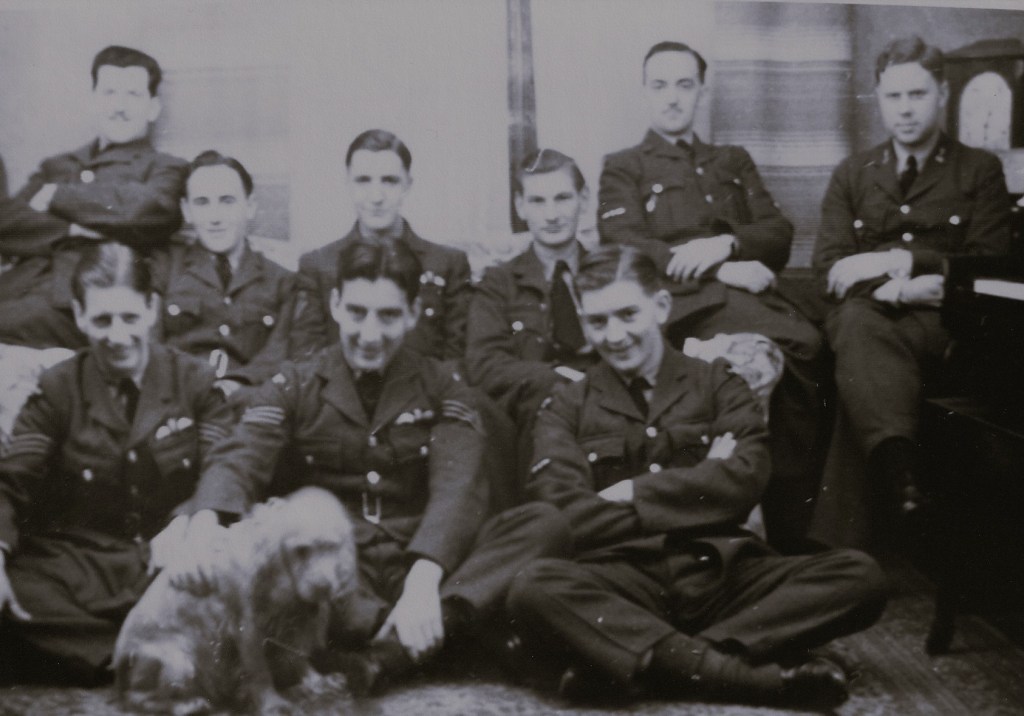
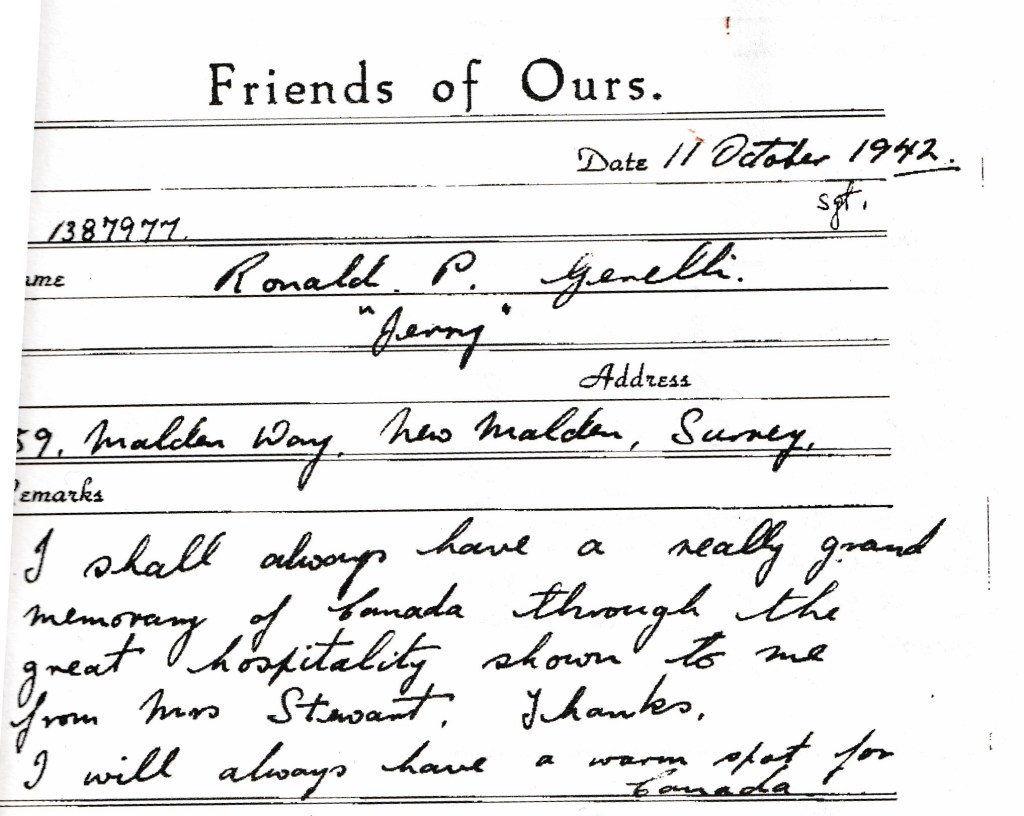
Mabel Hunter Stewart and Sgt. Ronald P. “Jerry” Gerelli

Janet Stewart Lindstrom does not remember her Grandmother well, she was only 8 years old when Mabel died. Mabel Jewett Hunter Stewart is no mystery to Jan, her quiet goodness and steadfastness remains vivid, thanks to memories of their shared time but more directly in the quiet, steadfastness and goodness inherent in a man far more familiar, her father. Jan describes her grandmother Mabel and her father Andy as deeply proud of their Hunter Family Highland Scottish heritage as well as tried and true Royalists.

A Highlander and a Royalist? That Mabel was a Royalist is not in the least surprising, despite the complicated history between the English Crown and Highland Scots. Mabel lived thru two world wars, wars fought for King and country. Mable knew well the sacrifice families made on both sides of the Atlantic. She understood the worry, loss and grief faced by families at home and she was grateful for the young pilots and flight crews training at the nearby Moncton site of the The British Commonwealth Air Training Program (BCATP)1. Mabel knew the risk these men faced, and that there was a good chance some would die in defense of King and Country. She made her war effort a personal expression of gratitude that came flavoured with warm spices.

A group of Airmen, gathered in the home of Mabel Stewart, Moncton, NB c. 1942

Jan wrote this short story about Mabel’s ‘War effort’ to share with her children and Grandchildren. I am thrilled she has agreed to share both her Grandmothers’ war effort and her recipe with My Mother’s Cookbooks.

Janet Stewart c. 1949

Mabel’s War Effort…

So…you say you don’t like Fruitcake…

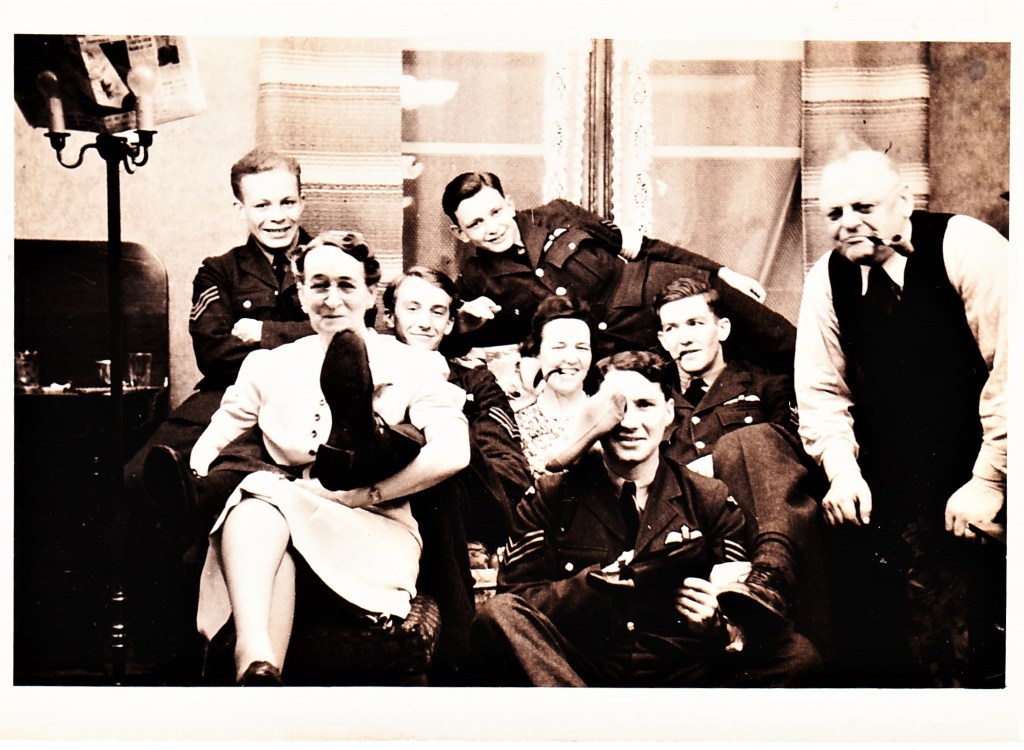
Picture this – Your Grandfather Stewart’s mother in her home in Moncton during World War II “entertaining the troops”. My Grammie at the piano playing for a sing-song, and leading good conversation, never allowing talk of religion or the war of course. This on top of serving a wonderful meal to the small groups of British airmen she hosted. My Grammie always called this her ‘war effort’. Grammie knew the young men, who were in Moncton getting their “wings” so they could return to the UK to take part in the war, would be lonesome for their families and wishing for a good family meal.

The Stewarts entertaining the troops Moncton, NB c.1942

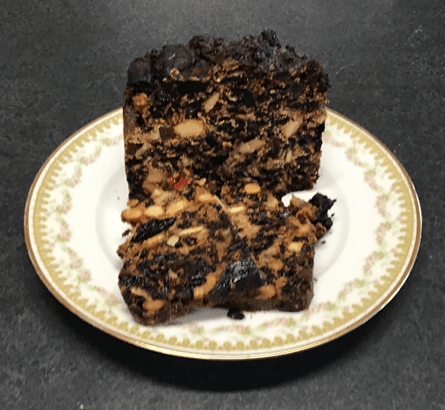
One of the highlights of the meal was the serving of a plate of her fruitcake on her prized Limoges China, just like in the photo above.

If you love a house filled with the aroma of a spicy, fruity, nut filled cake being baked or if you enjoy a quiet time with a cup of tea and a piece of cake, this cake is for you!

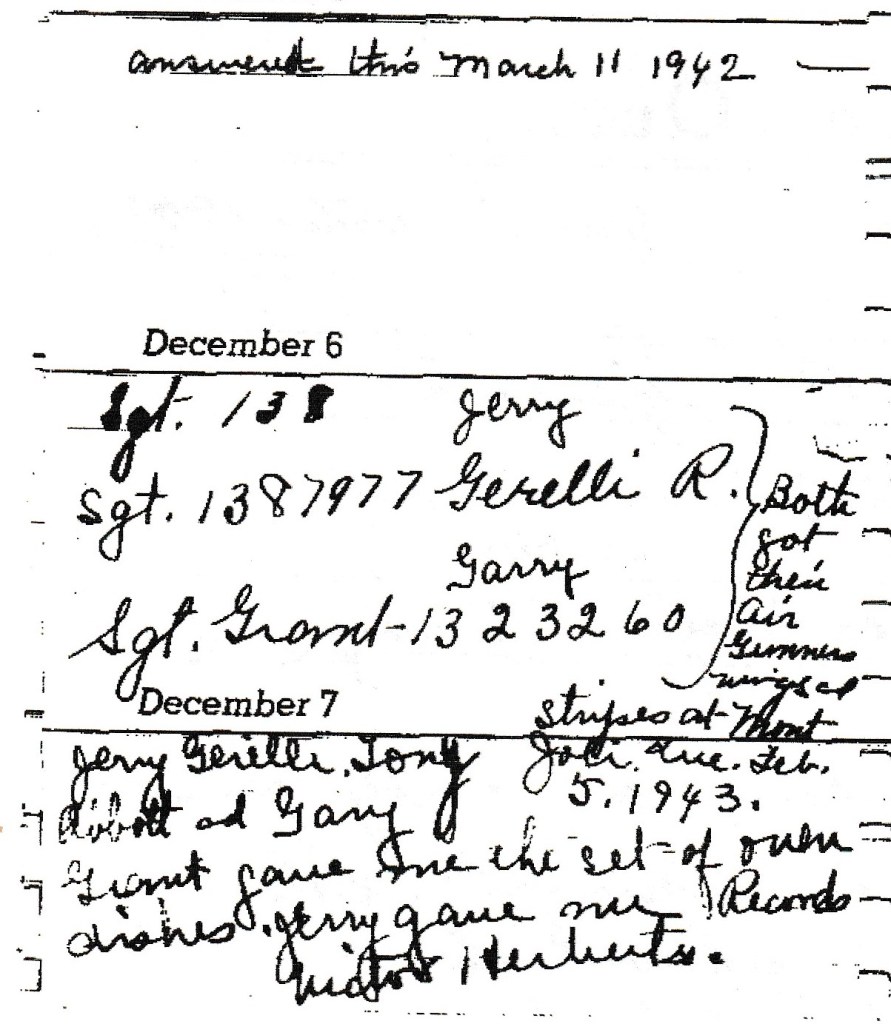
From Mabel Hunter Stewart’s Guest book, with notes and gifts of gratitude

My love of this fruitcake is not just because it was my Grammie’s cake but because of memories of Mum and I baking it annually, in October around Thanksgiving. Why so early, if it is intended for Christmas? It gives the cake time to “ripen”, and moisten, in it’s wrapping of cheesecloth soaked in rum or brandy!

Sgt ‘Jerry’ Gerilli and what Mabel Stewart’s war effort meant to him… It seems Jerry’s prediction was correct he remembered Canada since he remained in contact with Mabel’s family until his death in 2010.

I can see the three of us, getting out the fruitcake pans and lining them with greased brown paper. The large bowl filled with the carefully measured fruit pieces coated with flour. After mixing up the cake batter in a separate bowl, the fruit was poured in, and then came my favourite part…
getting my hands right in the bowl in order to mix it all together. Messy, but fun.

Its baking for four hours filled the house with that wonderful fragrance! If we could only bottle the smell!

I wondered how long fruitcake recipes have been around? So, I checked, some historians claim fruit cakes have existed since ancient Egypt, BCE (Before the Common Era)! We are told that Roman soldiers took them into battle and that fruitcakes were taken on the Crusades in the Middle Ages.

The church had quite an influence, regularly making pronouncements the faithful were expected to honor, like in the 1400’s when they prohibited butter during Advent. The boatloads of sugar which began arriving in Europe in the 1600’s saw its use in preserving fruit including for use in cakes. In the 1800’s when the church tried to declare fruit cakes “too decadent’, style won out when Queen Victoria served Fruitcake as her wedding cake,

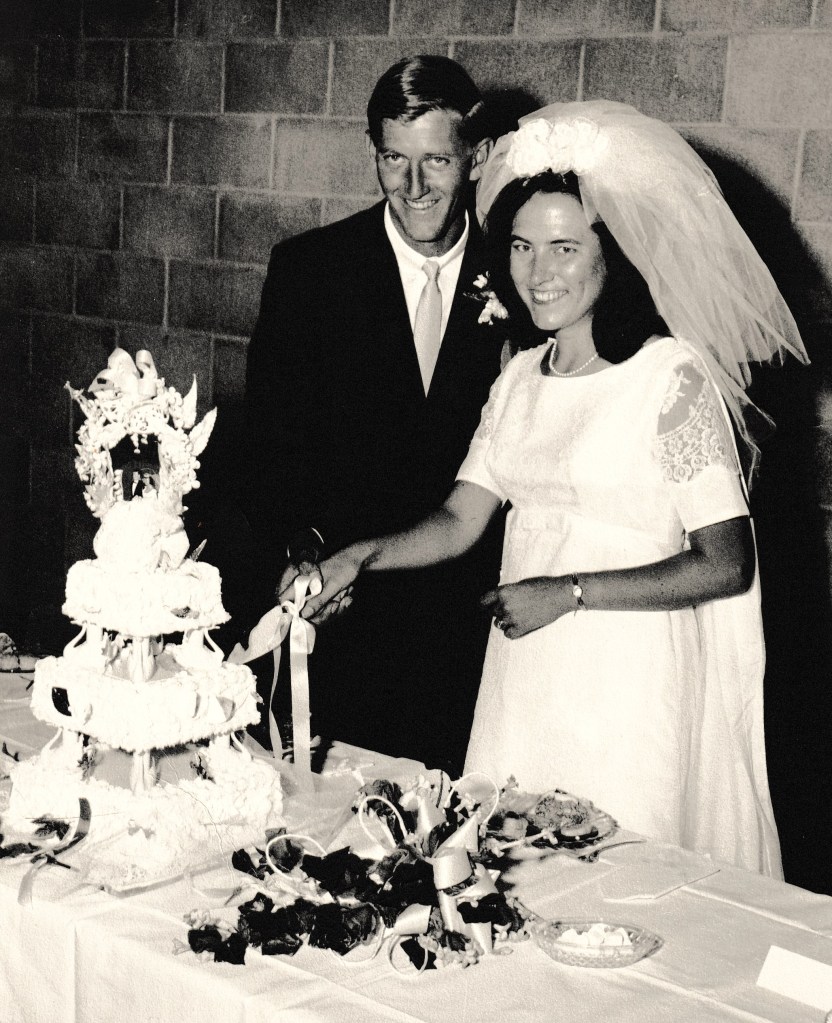
When your father (Papa) and I were married in 1967, we had a white wedding cake which we cut for guests to eat at the reception. We also had a fruitcake, cut up and sent home with the
guests to sleep on!

The Lindstrom’s c,1967

But, of course, you want to know where this recipe came from!
Well, I don’t know the origin, for me it will always be “Grammie Stewart’s Fruitcake”. The recipe is at least 80 years old. Not a lot has changed in the recipe in that time except….it
would have taken Grammie a lot longer to prepare than it does me: the recipe calls for 1½ lb of blanched almonds – she would have had to actually blanch the almonds, I can buy them already blanched; the recipe calls for 1 lb pitted prunes – she would have had to cook the prunes, let them cool and pit them herself, I can buy pitted prunes. Lastly, the recipe calls for specific measurements of lemon, orange and citron peels- which she could buy individually, but which more and more only comes as “mixed” peels. So things have changed!

Here is My Grammie Mabel Hunter Stewart’s Dark Fruit Cake
Ingredients:
1 lb. butter, softened
6 cups flour – use 4 of those cups of flour to mix with the fruit
9 eggs
1½ lb. (675 grams) citron
1½ lb. (675 gm) lemon peel
½ lb. (227 gm) orange peel
1 lb. (450 gm) pitted prunes
1½ lb. (675 gm) whole blanched almonds
1 cup strawberries
1 cup molasses
2 tsp each lemon flavouring and vanilla
2 tsp each cloves, cinnamon, allspice and mace
1 glass brandy or rum (2 oz)
1 tsp baking soda
4 lb. (1.8 kg) seedless raisins
4 lb. (1.8 kg) currants
1 lb. (2 cups) brown sugar
Notes and Method:
1) If you can’t find the 3 different types of peels, use mixed peel. I can usually only find the orange peel and so use a combination of that and mixed peel.
2) Cook the prunes in about 1/2 cup water until soft. Let cool.
3) In a very large bowl, mix together the fruit, fruit peel and almonds with 4 cups of flour.
4) In a separate mixing bowl, beat the eggs, butter, molasses, flavourings, spices, rum, soda, brown sugar and the remaining 2 cups of flour.
5) Combine the two mixtures in a very large bowl using your hands if necessary (I do!) until there is no sign of dry flour.
6) Pour into 3 brown paper lined and greased fruit cake tins and one 9”x9” cake pans. Put a pan of water on the bottom rack in the oven.
7) Bake at 280°F for 4 – 4½ hours. Remove and cool.
8) When cold, wrap in brandy soaked cheesecloth followed by plastic wrap and foil.
9) Let “ripen” for at least a month before eating.

The Stewart family – Mabel seated between her husband Charlie (center) and Jan’s Mum Marion, Dad, Andy in front.


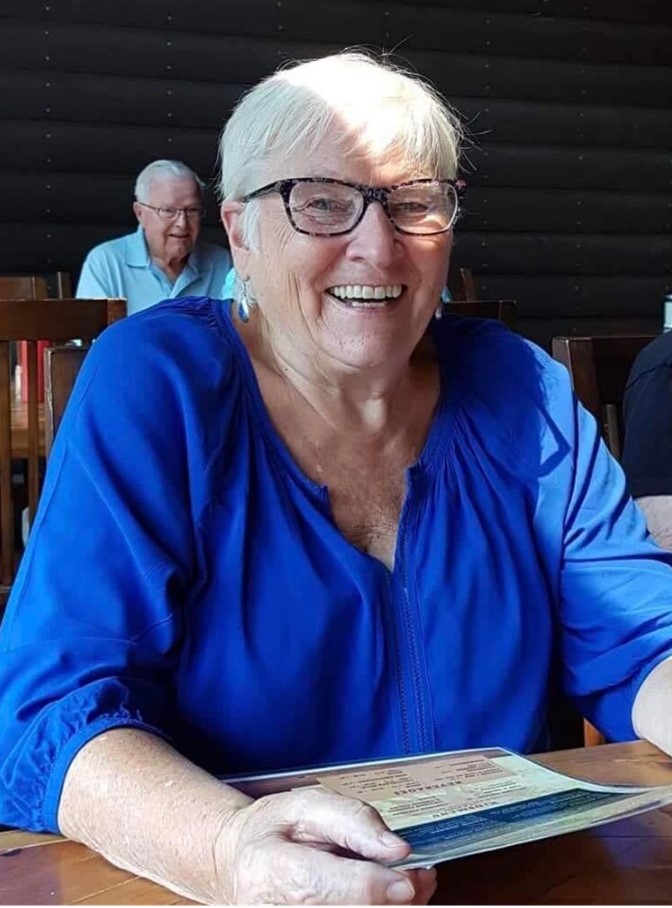
Janet Stewart Lindstrom describes herself as a Maritimer, despite being a resident of Northwestern Ontario for several decades. Jan prepares her Grammie Mabel’s Fruit cake each holiday season. Thank you Jan, for these memories, and gratitude in warm spices.

Janet Stewart Lindstrom c. 2024
  1. The British Commonwealth Air Training Plan (BCATP) was an agreement between the Canadian and British Commonwealth to provide training facilities and staff for the war effort. Sites were located across the country, with 3 sites in New Brunswick, Chatham, Moncton and Pennfield, with 2 supplementary air fields in Scoudouc and Salisbury to support the Moncton #8 Service Flying Training School. See this link for additional information on the Canadian program https://www.canada.ca/en/department-national-defence/maple-leaf/rcaf/2021/03/british-commonwealth-air-training-plan-carried-the-day.html and New Brunswick’s effort, https://nbaviationmuseum.com/bcatp ↩︎

Spindles, Spinning Wheels, and Potato Farls.

Atlantic Canadian Women of the cloth19th century and beyond – part 1

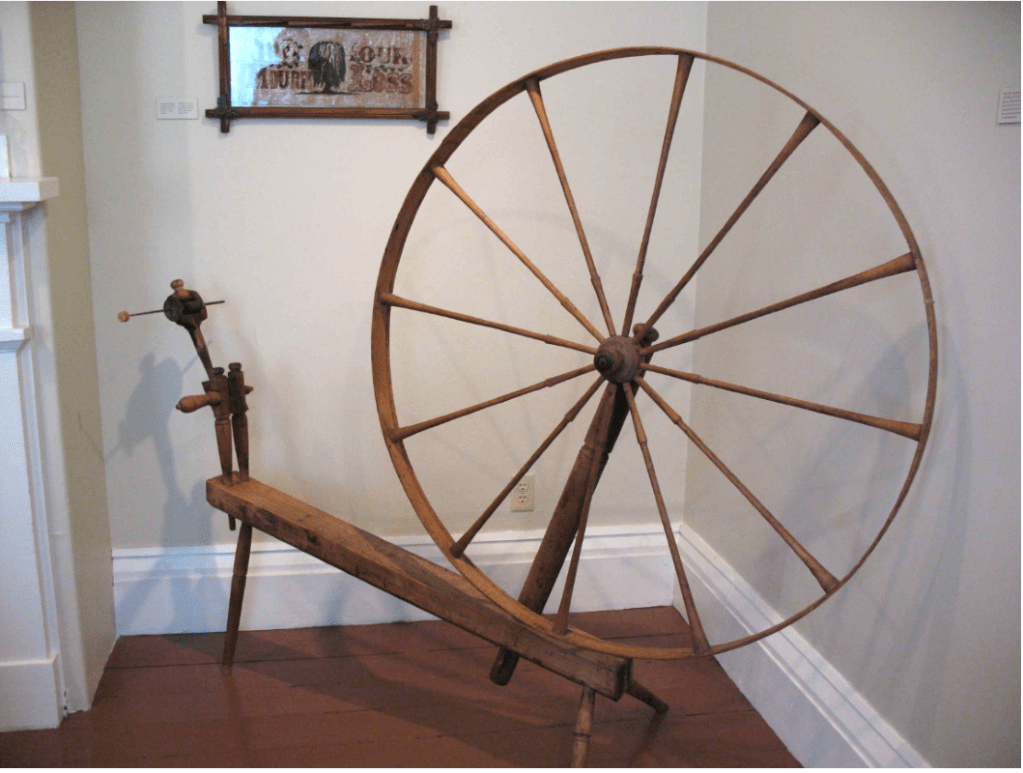
This hand driven spinning wheel was hand-crafted by Isaac Wry (1816-1879) for his wife Mary Fields Wry (1835-1916) for the occasion of their wedding on July 1, 1860. Mary Fields, from Shemogue, New Brunswick, was Isaac’s second wife, and together they had four children. Mary was an ardent craftswoman, and she became an expert weaver. She and Isaac raised sheep, and she would shear the sheep, card, and spin the wool herself before weaving blankets, bedding, and clothing. This spinning wheel was used in this process. Photo courtesy of Tantramar Heritage Trust / Boultonhouse Museum.

The running joke in our family was that it was breakfast, not the alarm clock that drove my Dad from bed in the morning. Dad loved breakfast, but his favourites were full on hot meals with loads of protein, quite often served with fried leftover potatoes. Although I eat protein at breakfast, the protein in my breakfast smoothie comes from dairy, vegetables, seeds/ grains, including hemp seeds/hearts and flax seeds1. Leftover potatoes often appear when I serve Breakfast for supper.

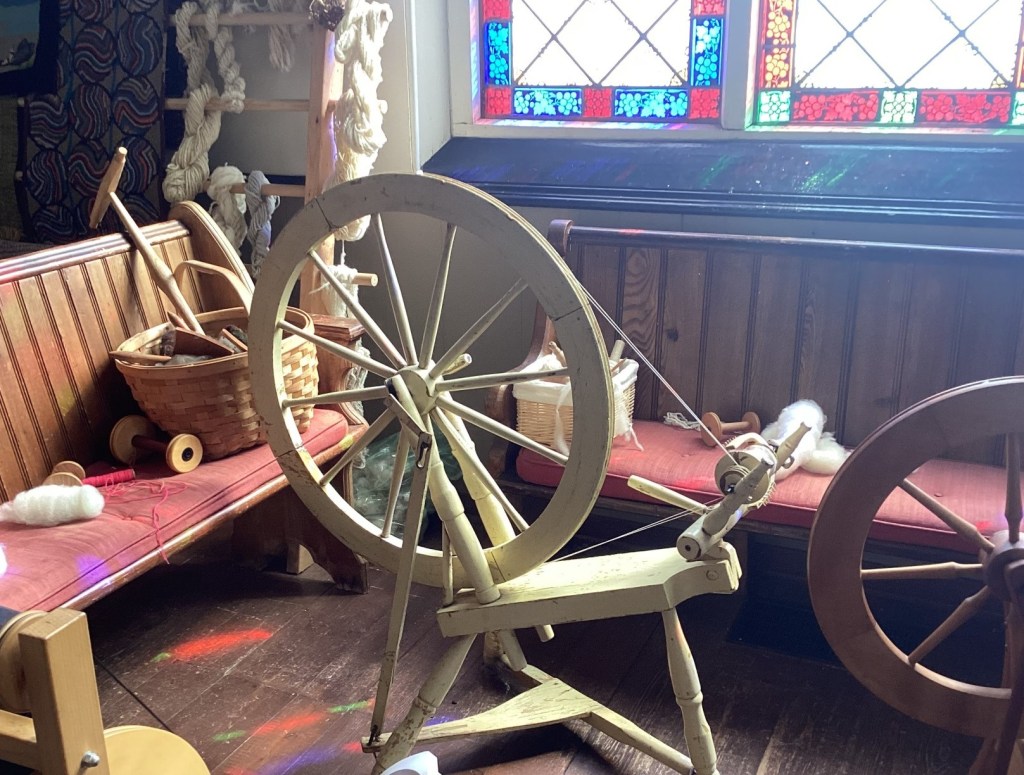
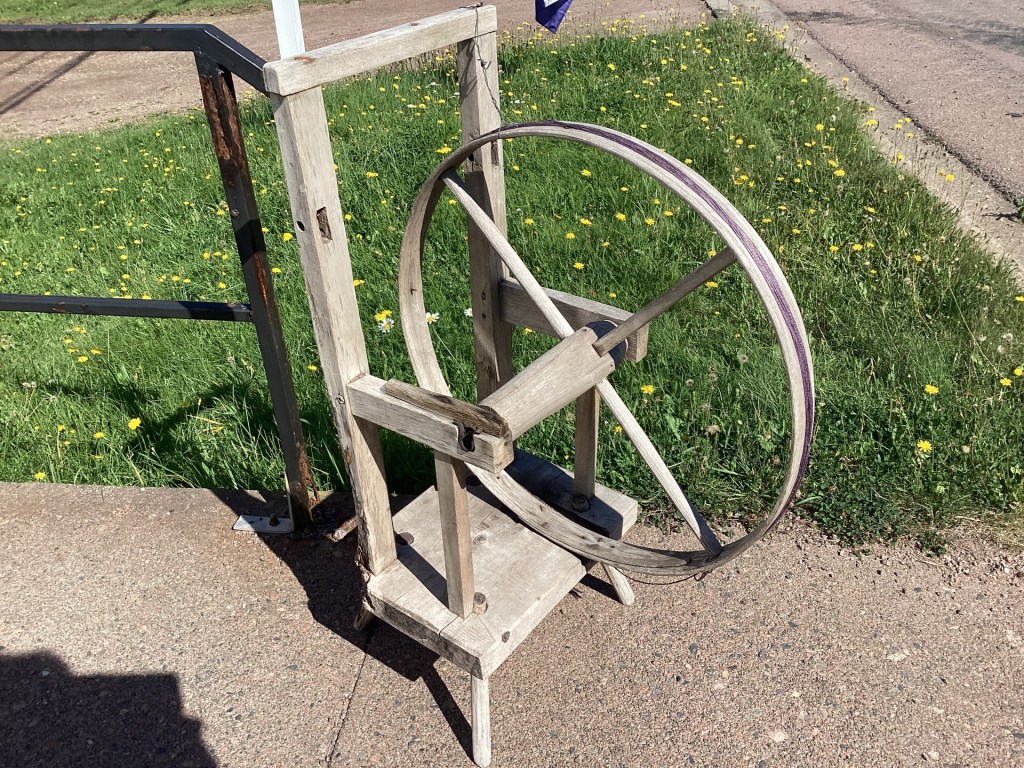
For more than a century spinning wheels have been a recognizable feature of our past. You don’t have to visit a museum to see them, although you will find more than one in most regional museums2. Spinning wheels still decorate grand old homesteads and suburban bungalows alike. Their success as decorative objects has made them representative of the entire homebased textile industry if not an entire era. In reality, spinning is a critical but single step among many in the production of cloth and other textiles. Even within the single critical step there is complexity and nuance which the story we know, misses. The first being not all spinning wheels are created equal, many are actually non-functioning replicas3.

Treadle spinning wheel – St James Textile Museum Aug 2024 Elizabeth Lyons Morrison

When Sarah Tucker died in 1893, at 90 years of age, her occupation was listed as ‘Knitting’4. This factoid conjures images of grandmotherly Sarah, being so identified with the pretty dainties she knitted, it had become her ‘occupation’. It is likely, even in advanced aged, income was Sarah’s practical necessity and the products Sarah knitted were woolen socks, mittens, and long johns. Sarah was able to knit, and provide herself an income, even though she could no longer draw the fiber and spin the wheel. Atlantic Canada’s harsh climate, timber harvesting, fishing, and farming kept the whirl of spinning wheel, the click of knitting needles, the thud of the loom and the income they produced particularly for women, a regular part of life, long after machine production had replaced it in other areas5.

Despite being well schooled in the techniques and equipment used to produce textiles from fiber in her Ireland home, new mother Sarah did not bring her spinning wheel with her to New Brunswick. Ireland of 1823 was not the best place to raise a family, few resources, little work, meant no prospects beyond life in a city slum and work in a factory6. Sarah and her husband Thomas Tucker chose instead to become settlers to New Brunswick. The cost of passage involved extra fees for baggage, and limited items they could bring with them. If Sarah packed a tool to spin with, it was probably a drop spindle7.

Hand powered spinning wheel – Musee Kent July 2024 Elizabeth Lyons Morrison

Sarah’s drop spindle, came in handy for spinning, plying wool and other fibers, making flax twine for fishing lines, and for twisting hemp for rope, all things necessary in an Atlantic Canadian settler homestead. A spindle is not as efficient or fast as a spinning wheel. To spin the amount of yarn and linen she needed, Sarah required a spinning wheel. Although she might have fancied an Irish style Castle treadle wheel with the drive wheel mounted on top of the spinning assembly, and not arranged on a table like most other spinning wheels, she would have settled for what was available, provided it would accommodate a variety of fibers.

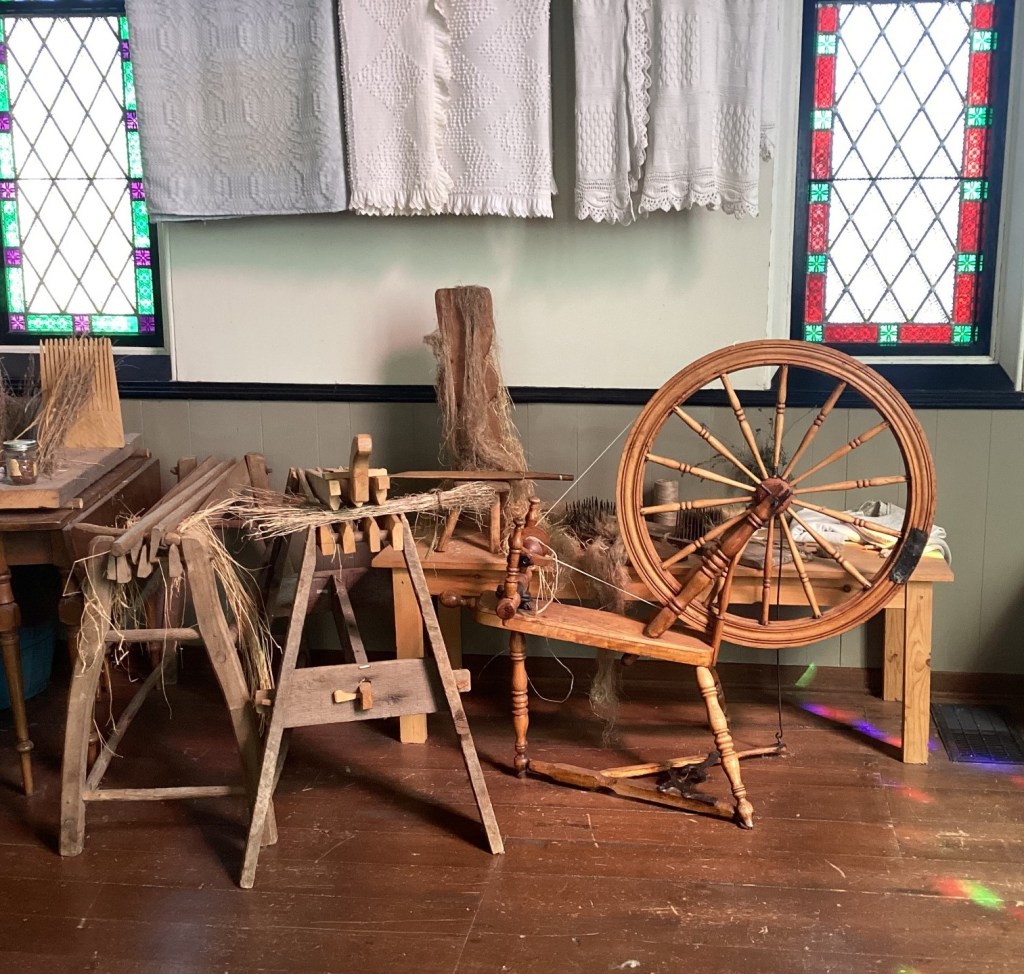
Equipment used in processing flax. Breaks St James Textile Museum Aug 2024 Elizabeth Lyons Morrison

Ellen Taylor Williston’s spinning wheel might have come from the old country, she might even have had more than one. Like most European settlers economic opportunity was impetus for her Taylor family to immigrate from Scotland to New Brunswick. Ellen’s family despite little financial means had material resources and they had time others did not8. Resources did not mean Ellen had servants to spin and weave cloth for her family. As a child, like Sarah she grew up watching, learning and doing her part. By the time Ellen married Luther Williston, the Taylor family had added to their means and influence, a spinning wheel might well have been among Ellen’s wedding gifts.

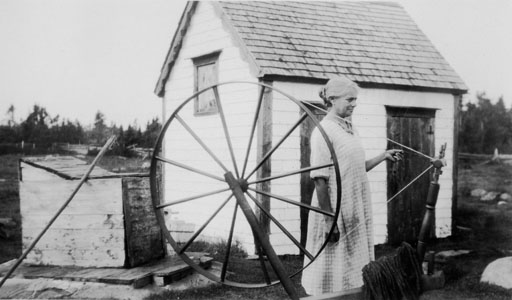
Mrs. Andrew Doane, Ingomar, Shelb. Co., with her walking wheel.. Walking wheels / Great wheel have a simple spindle assembly, which required an additional step to wind the thread on the spindle. Clara Dennis Nova Scotia Archives 1983-468 number 60

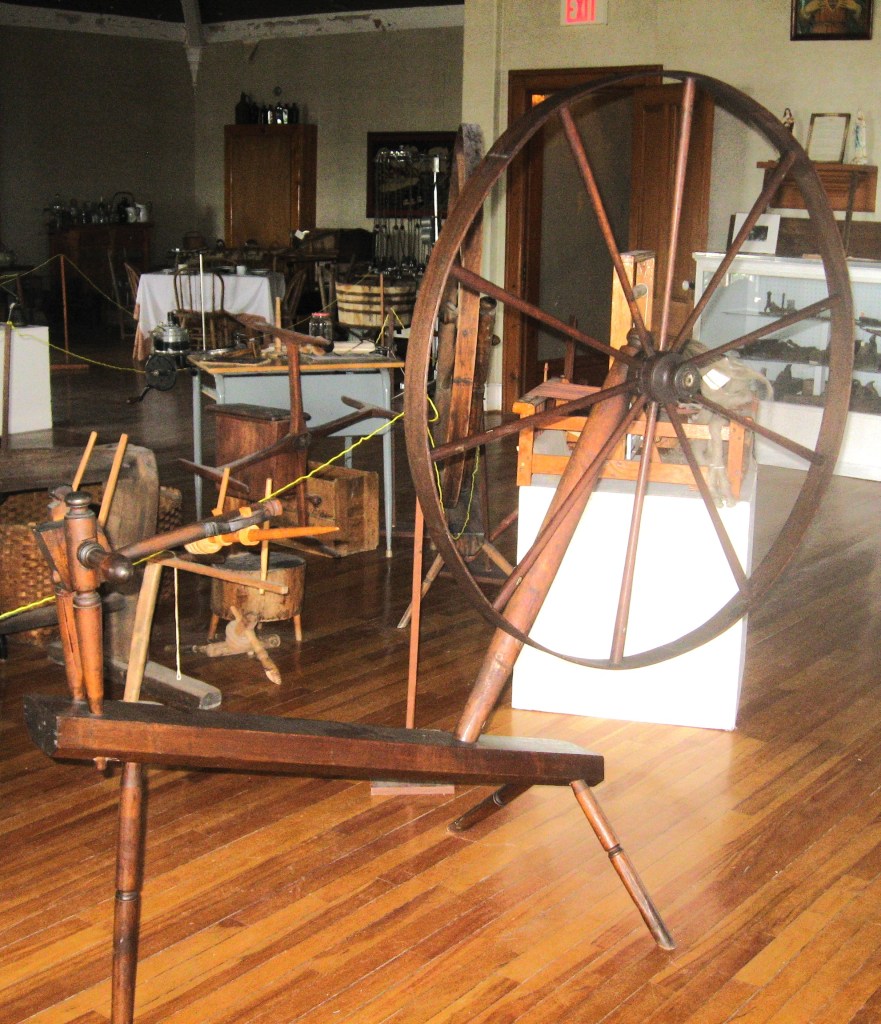
It’s possible Ellen used a Walking wheel9 for some of her spinning. Although wool made up the majority of the fiber she processed, until the 1840’s her spinning included linen, including for warp thread. Great wheels are hand driven and require the woman to walk to first spin and then load the thread on to the spindle. Small wheels with a flyer assembly allowed the thread to be both spun and loaded on the bobbin from a seated position. The great wheel does have advantages for some types of fiber processing, such as spinning wool, particularly Worsted wool or cotton. Smaller treadle wheels allowed the woman to use both hands to control the fiber, especially important when spinning longer fiber like flax. Shorter fibers like wool and cotton are more easily spun on a Great wheel, at least according to some spinsters.

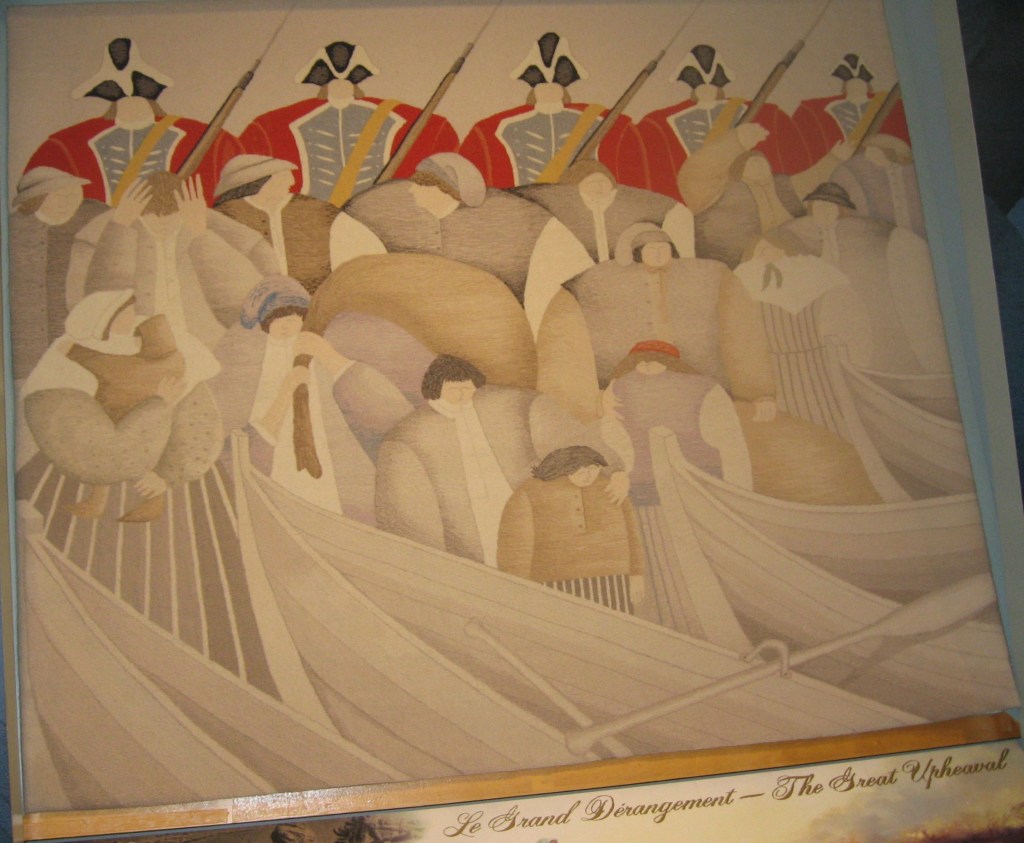
Despite a family history in North America of more than 200 years, Virginie Girouard Allain’s spinning wheel was not a family piece. If she chose a traditional Acadian style wheel, one with a flat rimmed drive wheel, a four legged straight table, and equipped with a distaff10, it was probably one made locally, possibly by her husband Thomas, using a wheel purchased from a local wheelwright. Virginie’s family’s expulsion from their homes in 1755 assured the tools in daily use in prosperous Acadia, did not survive for her to inherit and use.

The remnants of a locally made spinning wheel, its flat table and wheel rim suggest it might have been an Acadian style spinning wheel – St James Textile Museum August 2024 Elizabeth Lyons Morrison

Although Virginie didn’t have benefit of her Great great grandmothers spinning wheel, she did grow up absorbing the knowledge and skills necessary for using one. Virginie family’s experience in growing / raising and processing fiber of various types was deep, and continuous during and after the grand derangement. Acadian farmers had been the first in North America to cultivate a whole range of crops including wheat, hemp and flax, and it continued in their relocated homes. Traditional Acadian attire comprised of both wool and linen, was practical and affordable, especially if you grew/raised the fiber and did the processing.

Preparing wool for spinning is no easy task, but flax fiber is exponentially more difficult. The physical properties of Flax which make it advantageous even today made its harvest and processing into linen laborious and difficult. Virginie and Thomas Allain grew and processed flax on their farm, depending on their children and extended family to aid in its harvest and processing. Once ready for harvest, those with the strongest backs would pull the plants from the ground, beginning an investment in weeks of time and hours of physical effort just to get the flax fiber ready for spinning.

Scutching and Hacking tools for processing flax fiber with flax in various stages of processing. St James Textile Museum Aug 2024 Elizabeth Lyons Morrison

When Flax fiber is processed two types of fiber result, the long highly prized line fiber and the shorter tow fiber. True linen is made from line flax, which earned linen its iconic status. Line flax is long, strong, soft, beautiful, and ideal for cloth from which a host of industrial, household, and clothing products are made. Tow fibers are shorter and used for twines, rope and sack material. The longer tow and shorter line fibers were spun in to lower quality linen, which produced hard wearing, absorbent, quick drying clothing that was affordable, if more than a bit scratchy.

Even after cotton warps11 were in regular use, and most farmers stopped growing flax in Atlantic Canada, Its cultivation, processing into linen and linen cloth continued in areas where the population was of Acadian ancestry. Like Sarah’s knitting, this conjures for some a vision of downtrodden Acadian women, marginalized, hopeless, dressed in archaic traditional fashion rejecting modernity for the sake of maintaining old ways.

Reality of course was complex and nuanced. There is one fact which solidifies this complexity for me. Early Acadian settlers were self sufficient, they had to be, but self sufficiency came with the toll of constant monotonous effort, particularly for women.

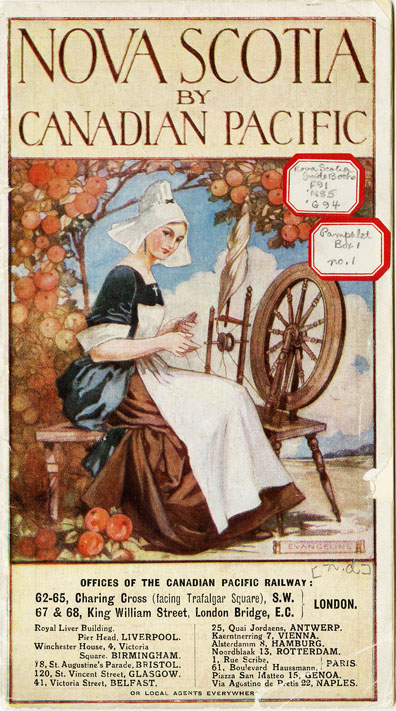
Illustrated Canadian Pacific advertisement with ”Evangeline” at a spinning wheel. Nova Scotia Archives Library: F91 N85 G94 number 1

The unearthing of 14 pairs of scissors in the archeological digs in areas of Beaubassin is interesting and revealing. The scissors which date from before 1755, range in size, function and form. Scissors sized for small hands confirm young girls were participating in textile production, that some of the scissors are for embroidery and others are heavily decorated suggest an inherent capacity and desire to find beauty and creativity in the mundane. Applying this basic desire to life after Expulsion, it does not take a stretch to imagine the desire to create and be with beauty helped motivate women like Virginie to engage the cultivation of flax and to produce the works of great beauty that is finely woven linen cloth.

Spinning wheels come in all shapes and sizes, some hand driven, some treadle powered, arranged on a slanted table or flat one, equipped with a distaff or not. A single style of wheel reigning supreme or belonging to a single country is as fool hardy as thinking a single version of a well loved recipe could top all others. Homebased textile production was a shared human experience, it benefited from exchanges of ideas, techniques, ingredients and technology.

I can say with confidence, Sarah, Helen and Virginie shared potatoes as well as spinning wheels. Potatoes grow well in many areas of Atlantic Canada and recipes containing them can be found in all major heritage groups of the region. Homegrown potato recipes, like all recipes have benefited from similar cross cultural influences as Homespun. Like homespun, recipes can have identical ingredients, same general method but a small adjustments in ingredients and/or technique can make a significant difference in the result.

Potato farls are simple potato based pancake, which are rolled, cut into 4 quarters or farls, fried and served with breakfast fare, eggs, bacon, etc. If Sarah called potato cakes farls, Ellen probably called them tattie scones… Virginie’s potato pancake recipe called for finely grated raw potatoes, combined with egg, flour, etc. and fried, Crêpes râpée! .

My Mother’s Cookbooks Potato Farls

Ingredients:
1lb / 450 grams of cooked mashed potatoes
3 Tbsp salted butter
1/2 c to 1 c all purpose flour (plus 2 T extra)
1 tsp salt
1 tsp baking powder
oil for frying
Method:
1. peel and pare 1 pound of potatoes, wash, bring to a boil in salted water, cook until tender;
2. transfer to a bowl, add butter and mash thoroughly;
3. add 1/2 c of the flour, salt and baking powder, mix thoroughly adding additional flour necessary to create a handleable and soft dough, divide into two balls, flatten and roll to 1/4 inch thickness;
4. cut into quarters, fry in a med hot pan in your oil of choice, butter, sunflower oil, bacon fat, etc. 3 mins each side.
5. spread with butter and serve with a full on hot breakfast.

Dough rolled and cut into Farls. (Red flecks are dried red pepper flakes) Be generous with flour on your board.
Potato farls fried in bacon fat, added flavour + savings in time and money!
Breakfast for dinner – Potato Farls keeping traditional company.

Did you miss the introduction to “Atlantic Canadian Women of the Cloth – Homebased textiles 19th century and beyond”? See Homespun and Mrs Campbell. Part 2 of the series and the ending of Mrs. Campbell’s story Work, Frolics and Tragedy will be released 19 October 2024.

Footnotes:

  1. Flax meal and hemp hearts are wellness superfoods. 200 years ago, flax and hemp were used by most everyone, but not as food. Among the earliest crops cultivated flax has iconic status in the textile world. From ancient Egypt to the age of sail, flax and hemp were there, in everything from clothing to sails. Flax, and Hemp, yield their bast (stem) fiber which requires significantly more processing than either wool or cotton. Domination of flax fiber ended with increased production of cotton and hemp’s production dropped significantly with the arrival of plastic fiber rope. Hemp’s reputation as a fiber/food stuff has also been both misunderstood and under appreciated because of its family relationship to Marijuana. Flax fiber makes its appearance today in everything from paper money to car parts, linseed oil extracted from flax continues to be used in paints and stains, etc. Hemp is making a resurgence not just because of its seeds superfood status but as a more environmentally friendly option to manmade fiber, it appears in clothing, bed sheets, rope, etc. ↩︎
  2. The Canadian Census of 1871 asked Heads of household if they owned a loom, 40% responded, yes. Agriculture and industry schedules report large amounts of homespun produced. Based on this data, it is estimated more than 90% of households had a spinning wheel. Many were eventually donated to local museums. ↩︎
  3. Centennial celebrations of founding both the US and Canada saw a surge in interest in each country’s history. Spinning wheels quickly became representative of not just textile production but the entire colonial / settler period. Suddenly spinning wheels which had laid idle for decades, acquired value as decorative objects. They came out of attics and sheds, were oiled, polished, put on display or sold for a tidy sum. For those who didn’t have one, affordable replicas were also available. ↩︎
  4. Knitting is a method of producing textiles that involves using long needles to interlock loops of yarn. The textile produced is flexible and moves more with the body, lending its self to use in hats, mittens, scarves, long johns, sweaters, etc. Knitting was also used as a technique for producing fishing nets. ↩︎
  5. Homebased textile production peaked in Canada about 1871, at least 25 years after the US. Decades before the mechanization of the textile production in Europe, had pushed homebased textile workers out of their homes and into factories. The reason Atlantic Canada’s homebased textile industry remained active is sometimes explained as the result of the region being traditional and conservative to the point of backwardness. This view is being refuted by historians, and the factors delaying investment in mechanization are now understood to be a complicated mix of external and internal influences. ↩︎
  6. Ireland’s history of hardship created by the British Crown’s use of punitive tariffs to please English farmers and merchants at the expense of the Irish economy and its people, is reflected in the Irish homebased textile industry. When Irish farmers were faced with tariffs against their lamb, farmers sold wool, when their wool faced unfair taxation they processed it into cloth, when it was taxed, they grew flax, and processed linen. The proliferation of textile factories in Britain beginning in the early 19th century, saw the end of widespread homebased textile production in Ireland. Although Irish linen remains a gold standard for quality linen. ↩︎
  7. Spinning fiber, is twisting fiber together to create a single piece of thread. Drop spindles are the earliest known tool for twisting fiber in preparation to producing cloth/ textile. There are thousands of styles of spindles, but the idea is simple. A spindle is a stick or small piece of wood with weight on one end so it can be twisted so it will draw the fiber in to one smooth continuous thread. Some styles of spindles use added stones or whorls to assure spinning, others are carved to assure an easy twist. ↩︎
  8. Ellen’s Grandfather Patrick Taylor was a well known member of the New Brunswick political elite who arrived in Northumberland county New Brunswick in the period just prior to the American Revolutionary war, with his large extended family. The Taylor family have a minor Royal connection, which provided a small income to their mother’s Gordon family for generations. By the end of the 18th century inflation had reduced the value of the allowance requiring the family to seek new opportunities in North America. ↩︎
  9. The first innovation in spinning wheels were hand driven, the Great wheel or Walking wheel. Smaller treadle wheels did not replace the great wheel but afforded benefits for spinning longer fiber, such as flax. The flyer assembly, afforded the capacity to both spin and wind the yarn on the bobbin. Equipped with a distaff, the new style of wheel let the woman make use of both hands to control the fiber. Both styles of wheels continued to be used because they delivered differing benefits. ↩︎
  10. Distaff is a tool made of wood on which textile fiber is wound, so that it can be more effectively controlled by the spinster, allowing her to drawn the fiber evenly into a smooth thread. Distaffs were first developed to help a woman contain the fiber while spinning with a spindle. The distaff was tied under her apron strings on one side of her body, the spindle by her opposite knee, she could spin, prepare meals and do other household chores. Just as spindles had been added to a drive wheel, distaffs were incorporated into spinning wheel designs, particularly when used for spinning linen. ↩︎
  11. The warp of cloth are the strands of thread/yarn which are mounted/tied lengthwise on a loom, the weft of the cloth are the strands of thread/yarn which are added using a shuttle and which run crosswise to the warp. The warp/weft might be made of wool, linen or cotton. In 1840’s cotton became available in sufficient quantities to become an alternative to linen. ↩︎

Atlantic Canadian Women of the Cloth – Homebased textile Series Reference list:

  1. Bitterman, R. “Farm households and wage labour in the Northeastern Maritimes” Labour/LeTravail, 1993. https://www.erudit.org/en/journals/llt/1993-v31-llt_31/llt31art01.pdf
  2. Rygiel, J. A “Women of the cloth – weavers in Westmorland and Charlotte Counties New Brunswick 1871 -1891”; UNPUL thesis Carleton University, 1998.
    https://repository.library.carleton.ca/concern/etds/37720d
  3. Rygiel, J.A. “Thread in Her Hands –Cash in Her Pockets; Women and Domestic Textile Production in 19th-Century New Brunswick” UNPUL thesis Carleton University,
  4. MacLeod, E. and MacInnis, D.; “Celtic Threads: a journey in Cape Breton Crafts”; Cape Breton University Press, Sydney, NS. 2014
  5. Introduction to the Spinning Wheels collection in the National Museum of Scotland https://blog.nms.ac.uk/2020/12/14/introduction-to-the-spinning-wheel-collection-in-national-museums-scotland/
  6. Goodrich, W.E. “DOMESTIC TEXTILE PRODUCTION IN EARLY NEW BRUNSWICK” Keillor House Museum.
  7. Toal, Ciaran “Flax to Fabric – The history of Irish linen and flax” Lisburn Museum https://www.lisburnmuseum.com/news/history-of-irish-linen-flax/
  8. Dunfield, R.W. “The Atlantic Salmon in the History of North America” Fisheries and Oceans Canada 1985. https://waves-vagues.dfo-mpo.gc.ca/library-bibliotheque/28322.pdf
  9. “Flax, Farming and Food: How Scottish – Irish Immigrants Contributed to New England Society in the 18th Century”, Worcester Historical Museum, Worcester, Mass. https://worcesterhistorical.com/worcester-1718/flax-farming-and-food-how-scotch-irish-immigrants-contributed-to-new-england-society-in-the-18th-century/#:~:text=Accustomed%20to%20spinning%20wool%20and,fever’%20in%20the%20local%20population
  10. Wallace -Casey, Cynthia “Providential Openings – The Women Weavers of Nineteenth-century Queens County, New Brunswick” Material Culture Review. 46, 1 (Jun. 1997). https://journals.lib.unb.ca/index.php/MCR/article/view/17740/22230
  11. Eveline MacLeod and Daniel W. MacInnes “Celtic Threads: A journey in Cape Breton crafts” Cape Breton University Press 2014.
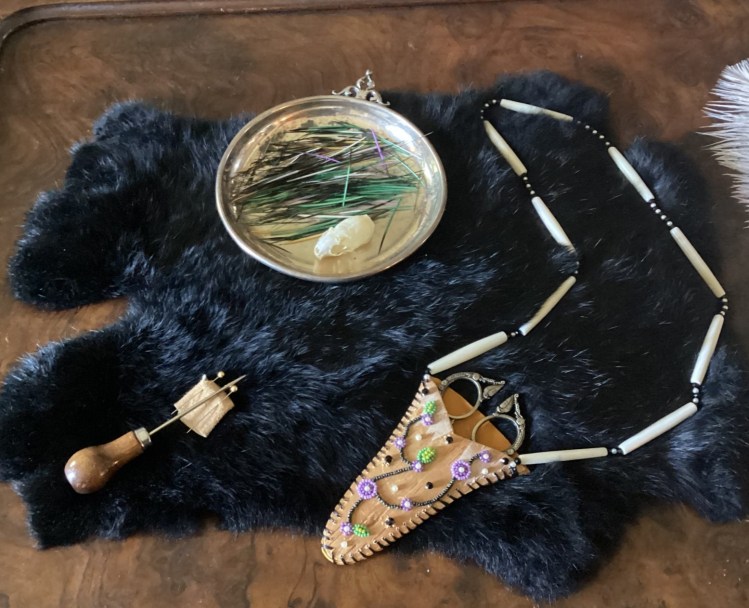
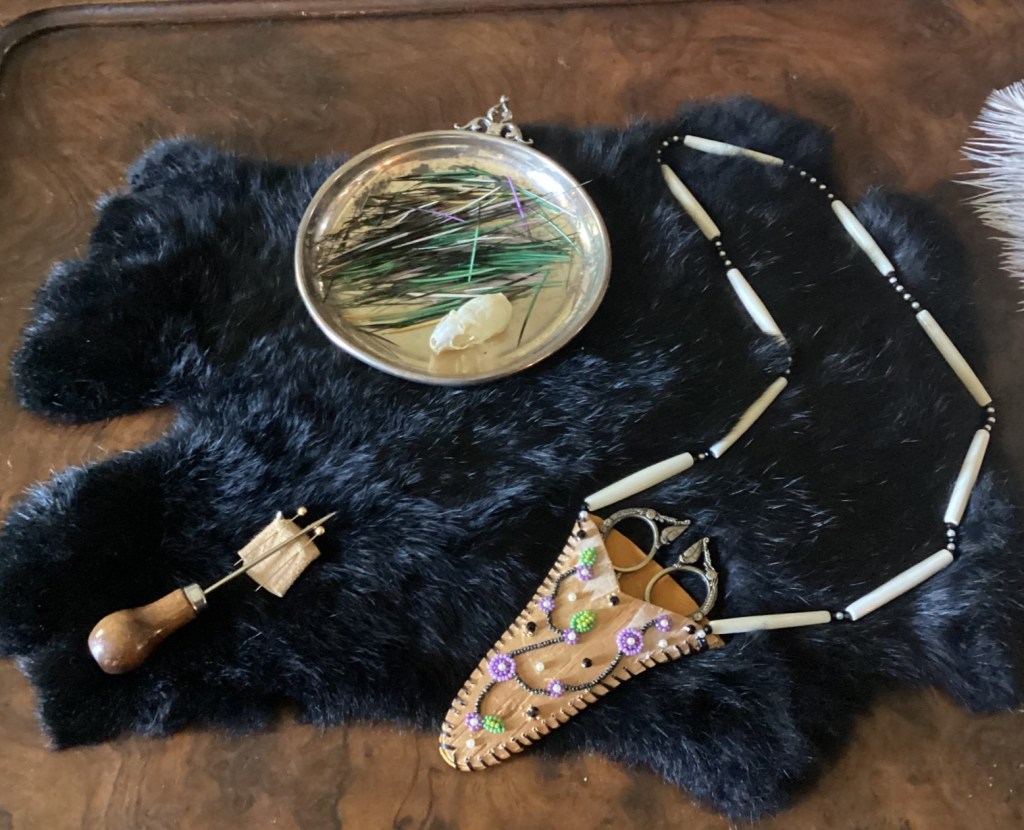
Traditional Mi’kmaq / Wolastoqiyik style beading, quill and leather work. These pieces were part of a thought provoking art installation at Keillor House Museum Soif d’illusion /Illusion of the self where they were displayed in conjunction with ‘Victorian’ bead work. Aug 2024 Elizabeth Lyons Morrison.

Acknowledgement: I acknowledge that the land on which I live and write about is the traditional unceded territory of the Wolastoqiyik (Maliseet) and Mi’kmaq Peoples. This territory is covered by the “Treaties of Peace and Friendship” which Wolastoqiyik (Maliseet) and Mi’kmaq Peoples first signed with the British Crown in 1725. The treaties did not deal with surrender of lands and resources but in fact recognized Mi’kmaq and Wolastoqiyik (Maliseet) title and established the rules for what was to be an ongoing relationship between nations.

Don’t miss out!

Hey Friends! I have had some questions about how to assure you see upcoming blog posts. You can choose one of two simple ways of being sure you don’t miss out.

  1. By adding your email to our subscriber list you will receive notification by email when a new blog is released. It is easy to do, go to the My Mother’s Cookbooks site and click the follow tab. FYI – We DO NOT sell our email subscriber list, EVER! https://my-mothers-cook-books.ca/2024/09/07/homespun-and-mrs-campbell/?_gl=1*1sa9e9b*_gcl_au*MTIwNDk4MzUwMC4xNzIyMjg5MDA5
  2. Or you can follow the My Mother’s Cookbooks Facebook page! When new blogs are released you will see the posts in your Facebook feed. https://www.facebook.com/HistoryinRecipes

If you enjoyed reading My Mother’s Cookbooks blog posts, consider sharing it on your FB or other social media site. We are on X, Tumblr, Threads, and Instagram.

Homespun and Mrs. Campbell.

Atlantic Canadian Women of the Cloth 19th century and beyond…Homebased textiles
And Fanny’s Frugal Food Hack – Planned leftovers: Mashed Potato Pancakes.
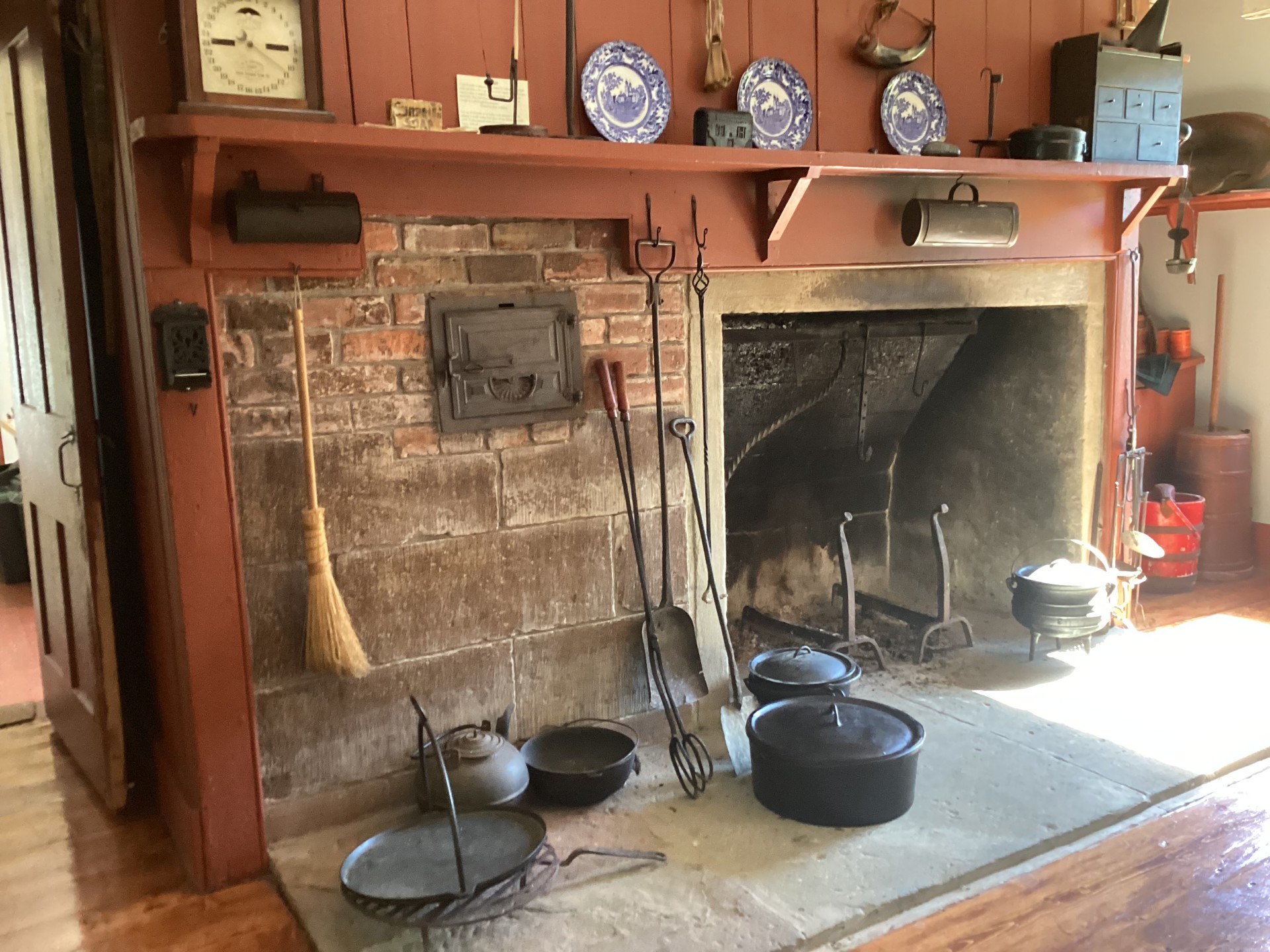
Kitchen Fireplace Keillor house c.1815 – Photo by Elizabeth Lyons Morrison August 2024

I consider myself a cook, not a crafter. Oh, I know the basics of knitting and crocheting, I have successfully made a few garments from scratch, but they were one ofs. Despite my lack of crafting credibility, I do appreciate beautifully handcrafted products and marvel at those who produced them. So, I began the research for the series I am calling Atlantic Canadian Women of the Cloth – 19th century and beyond, on homebased textile producers as a complete novice, with virtually no background in textiles, beyond living with them.

Of course I am used to information about ordinary people being very limited in the official record until recent years. However, the complexity of homebased textile production, made this research especially challenging. The lines between production of textiles for home use by women and production for sale usually attributed to men are blurry at best. For example how do we explain census takers recording thousands of yards of homespun produced on a single farm where no one is described as weaver1? The weaving was likely not done by Farmers, more likely by their wives and daughters. During this period the product of a woman’s effort, which was exchanged for money, was more likely than not, attributed to her husband or father2.

Often the only glimpses I get into a specific woman’s life come as a result of hardship and tragedy. A second wife and family might hint at the date of a woman’s death, a second child with the same name might indicate an early death of the older child. Sometimes, even tragedy does not loosen the grip of anonymity. The life of Mrs. John Campbell of Big Pond, Cape Breton, is a case in point3.

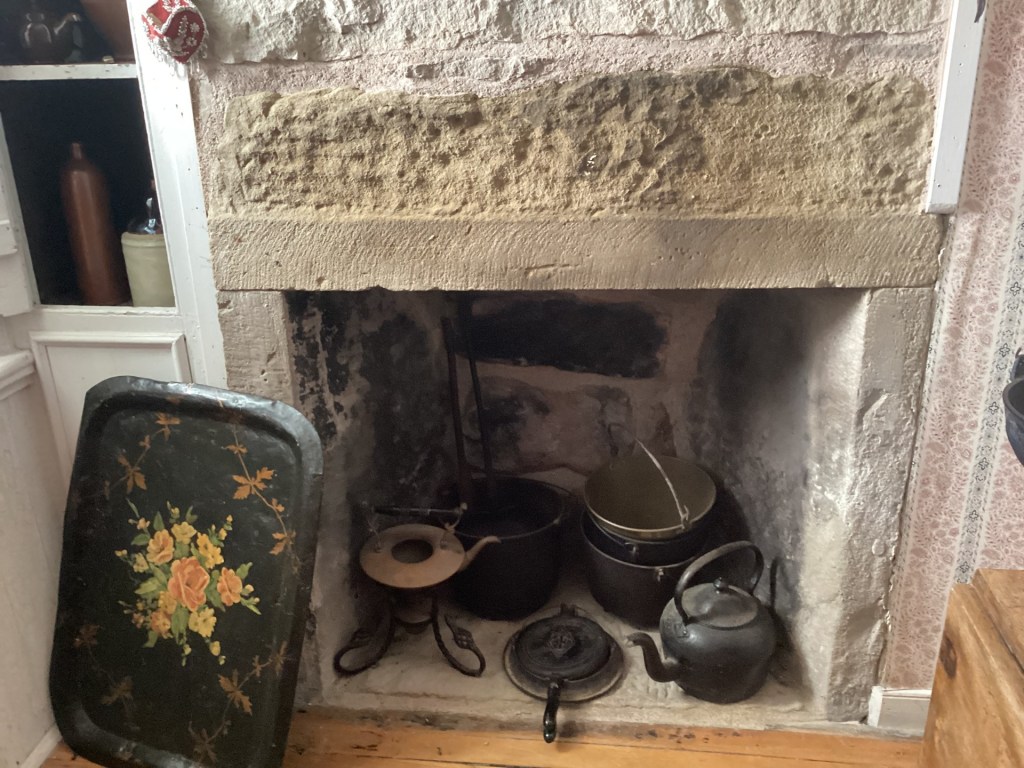
Keillor house museum c.1815 Pantry fireplace with kitchen implements. Photo by Elizabeth Lyons Morrison Aug 2024

Saturday, 3 February 1856

A weary sigh of satisfaction left her lips, as she threw the shuttle a final pass through the shed4. It had taken her longer to finish than she’d planned, but her winter’s work was all but complete. Just tying and winding off, and of course the luadh5 left to do. Becoming aware of the dim coolness of the tiny attic loft, she lifted the candle from its place on the loom, and stepped quickly to descend the ladder.

Clucking at her absent mindedness, she drew her shawl around her body and set to raking the embers. Her carelessness had nearly cost her the fire, a shudder passed through her at the thought of John having to make a trek to MacDougall’s for embers on a cold wet Sunday morning. Placing 3 strips of birch bark on the withering coals followed by small branches of meadow spruce, she rocked back on her heels, waiting for the fire to catch.

Yawning tiredly, she pondered the fulling frolic to come. It would be nice to see family and friends, but this mid winter thaw worried her. The unusually warm temperatures and rain made the heavy snow sloppy, and sledding difficult, although the lake ice had not yet weakened. Who knew what it would be like by Monday, if this thaw continues. Everyone was looking forward to the last chance to gather before the Lenten fast began on Wednesday. John’s sisters, and nieces would arrive just before noon on Monday, bringing the food for their kin. The men would come after their day’s work was done. Hopefully, MacDougall would be in fine form, and her cloth would be smooth and well milled Clo mor6. John promised to keep the frolic dry, but it was a good bet the extra batch of spruce beer he’d made would make an appearance. Adding two large pieces of hardwood on to the fire, she set the guard, and rising to her feet made her way to the crowded bedroom where her small family slept…

This fictionalized account is a departure for me, and is inspired by Mrs. John Campbell and other women who lived, laughed, died, and whose memory lingered only until, those who felt their loss were themselves gone.

I hope you will join me in this peek into the lives of spinsters, dyers, weavers, knitters, dressmakers, quilters, milliners, tailoress, among others and My Mother’s Cookbook Recipes their lives inspire. The first blog in the series Spindles, Spinning wheels and Potato Farls will be released 21 Sept 2024; with other articles appearing regularly. The blog featuring more of Mrs. Campbell’s story Work, Frolics, and Tragedy will be released on 19 Oct 2024.

Pantry table with kitchen implements. Keillor House Museum 30 Aug 2024. Photo Elizabeth Lyons Morrison

Fanny’s Frugal Food Hacks… Planned Leftovers

Mrs. Campbell and Fanny never met, and yet they had things in common. One of the things Fanny and Mrs. Campbell shared was the task of planning and preparing meals for their family, and leftovers played an important role. The term leftovers is largely inaccurate, oh sure I make meals from what is in the fridge that must go…but intentional leftovers are another matter entirely. Fanny and Mrs. Campbell like most women of their time were masters at avoiding food waste, they had to be, and planned leftovers played an important role, on days when finishing other work was a priority or on the day of rest.

On Sunday, 4 February 1856 Mrs. Campbell and Fanny could well have planned leftovers as a part of the advanced meal preparation. I know Sunday supper often has me making use of this recipe for ‘Mashed Potato Pancakes’. Squishy, crispy and delicious.

My Mother’s cookbook…Mashed Potato Pancakes

Ingredients:
2 cups of mashed potatoes (Mashed potatoes which are enriched with butter and cream make especially delicious pancakes -I often add garlic to my cooking water to an additional burst of flavour)
1/3 cup + 1 T of all purpose flour
1 tsp salt
1/2 tsp fresh cracked black pepper
1 egg
3 green onions chopped (or chopped spring onion, or finely chopped yellow onion)
1/2 c. Shredded cheddar (or other melting cheese) OPTIONAL
1 cup of panko, dried bread crumbs or cornmeal for dredging before frying.
Oil for frying
Method:
1. In a bowl assemble ingredients except bread crumbs, mix well;
2. Using a 1/3 c measure portion the potato mixture and form in to flattened rounds;
3. Dredge in bread crumbs or corn meal;
4. In a non stick, (cast iron is ideal) fry until brown in just enough oil to assure the pancakes do not make dry contact with pan, flip and fry on second side to an internal temperature of 165F /74C, keep warm until ready to serve.

Serving suggestions: Potato pancakes can be served as a side with any protein or if using cheese, serve with a salad and you have a complete meal. A favourite in our house is homemade cabbage rolls accompanied by My Mother’s Cookbooks… Mashed Potato Pancakes.

  1. The tradition of professional weaving being a male occupation was challenged by the reality of paid work in Atlantic Canada. Most immigrants who were professional weavers did not remain in the trade once they arrived in Canada. There is little doubt some of these men taught their daughters to weave and allowed them to take over the professional weaving role. However, while this was happening home weaving, knitting, etc. for home use and for barter was common place, much if not all of this textile production was done by women. We know this not by virtue of what the records explicitly say, but what they imply. Industry and agriculture schedules from census takers demonstrate farms producing far in excess of the amount of homespun needed for a single family, with no one attributed as weaver. One of the few distinctions between professional weavers and homebased weavers was that professional weavers produced cloth from yarn, thread and linen provided by their client. Homebased weavers who bartered their cloth, used fiber produced /raised on their home farm. During the years before carding mills, fiber preparation, spinning and finishing were the preview of women regardless of who did the weaving. ↩︎
  2. Victorian Era Newspapers provide interesting insight into the ‘ownership’ claimed by those keeping score at agricultural fairs. i.e. 3 January 1853 W.R. Price of Ludlow parish Northumberland county realized Best in All wool homespun; 2nd best in flannel cotton; best mitton Sample; 2nd best mitton sample; best woolen gloves; 4th best butter sample; 2nd best white beans, etc. The inclusion of butter is interesting and raises the obvious questions…we know women made butter, and their husbands and fathers took the credit, it is not a stretch to believe the entire list is comprised of the work of many including WR’s wife and children. ↩︎
  3. There are of course millions of human beings who have lived and died leaving no written record. It would be easy to tell ourselves that that was the way it was done. Yet, records do exist marking the birth and death, land transfers, etc. for ordinary people, from far earlier than 1856. So, was Mrs. John Campbell less deserving or were there other factors in play? That she was female, of Scottish immigrant stock, Gaelic speaking, Roman Catholic and living in a Highland Scottish enclave all served to assure, that even dying in tragic circumstances did not raise the vail of anonymity. ↩︎
  4. Shed – A loom is a tool for weaving fiber, it permits the weaver to efficiently pass the shuttle containing the weft fiber over and under the warp threads to create cloth. The shed is the temporary area created by raising and lowering the warp fibers, thru which the shuttle containing the weft is passed. ↩︎
  5. Luadh – Scottish Gaelic term for Fulling or milling fabric which is the process of shrinking and tightening the wool fibers of woven cloth. The freshly woven cloth is first moistened than beaten to shrink and interlock the warp and weft fibers. ↩︎
  6. Clo Mor – Scottish Gaelic for big cloth, was produced and used for outdoor clothing. Clo Mor as it was known to Mrs. Campbell was far superior in warmth and comfort to other fabrics, particularly those produced in early textile mills. Atlantic Canada’s cold climate, and resource industries assured homebased textile production continued well into the early 20th century. ↩︎

Atlantic Canadian Women of the Cloth – Homebased textile producers 19th century and beyond Reference list:

  1. Bitterman, R. “Farm households and wage labour in the Northeastern Maritimes” Canadian Committee on Labour History, 1993. https://www.erudit.org/en/journals/llt/1993-v31-llt_31/llt31art01.pdf
  2. Rygiel, J. A “Women of the cloth – weavers in Westmorland and Charlotte Counties New Brunswick 1871 -1891”; Carleton University Press, 1998.
    https://repository.library.carleton.ca/concern/etds/37720d
  3. Rygiel, J.A. “Thread in Her Hands –Cash in Her Pockets; Women and Domestic Textile Production in 19th-Century New Brunswick” Carleton University Press,
  4. MacLeod, E. and MacInnis, D.; “Celtic Threads: a journey in Cape Breton Crafts”; Cape Breton University Press, Sydney, NS. 2014
  5. Introduction to the Spinning Wheels collection in the National Museum of Scotland https://blog.nms.ac.uk/2020/12/14/introduction-to-the-spinning-wheel-collection-in-national-museums-scotland/
  6. Goodrich, W.E. “DOMESTIC TEXTILE PRODUCTION IN EARLY NEW BRUNSWICK” Keillor House Museum.

Acknowledgement: I acknowledge that the land on which I live and write about is the traditional unceded territory of the Wolastoqiyik (Maliseet) and Mi’kmaq Peoples. This territory is covered by the “Treaties of Peace and Friendship” which Wolastoqiyik (Maliseet) and Mi’kmaq Peoples first signed with the British Crown in 1725. The treaties did not deal with surrender of lands and resources but in fact recognized Mi’kmaq and Wolastoqiyik (Maliseet) title and established the rules for what was to be an ongoing relationship between nations.

Plant dyed wool, St James Textile Museum Dorchester, NB Aug 2024 Photo Elizabeth Lyons Morrison.

My Mother’s Cookbooks Blog, Relaunch!

Hey, friends and family! I am pleased to announce the relaunch of My Mother’s Cookbooks blog beginning Saturday, 7 September 2024 with the first installment of a multipart series called Atlantic Canadian Women of the Cloth – homebased textile producers: 19th century and beyond. This series will cover many of the familiar as well as less familiar textiles produced in homes across Atlantic Canada. Recipes from the My Mother’s collection, inspired by the featured women and their lives, will continue to appear with each blog post.

Leather scissor pouch with beading and quilt decoration – From Soif d’illusion /Illusion of the self art exhibit at Keillor House Museum, Dorchester, NB.

On 7 Sept, Homespun and Mrs. Campbell will provide an introduction to homebased textile production and in the same post, Fanny’s Frugal Food Hacks, Planned Leftovers – Mashed potato pancakes.

Wool dyed with natural and local plant based dyes. On display at St James Textile Museum, Dorchester, NB Aug 2024

So what is new at My Mother’s Cookbook blog?

There is a new feature at My Mother’s Cookbooks. I have not been totally inactive over the last months. I have been dipping my toes into writing fiction, which is a huge departure for this technical writer (Seriously, one of my former job titles). So, you can expect to see some of my efforts appearing from time to time. I will enjoy any feedback you can provide about any aspect of My Mother’s Cookbooks, but most especially what you think about my ‘fictional vignettes’.

Stay Tuned! Cheers, Eliza

Le Grande Derangement- The Great Upheaval – This beautiful textile uses Cheticamp Rug Hooking techniques to relate part of our painful past.
Design and Transfer: Jocelyne Doiron, Moncton, NB; Wool Dying: Marie-Louise Cormier, Cheticamp, NS; Hooking : Ethel Deveau, Marie-Adee Poirier and Sandy Roach; Cheticamp, NS; Production: Luce-Marie Boudreau on behalf of the Cooperative artisansale de Cheticamp, NS. Hooking is on display at Monument – Lefebvre National Historic Site, Memramcook, NB. Photo By Elizabeth Lyons Morrison July 2024.


Acknowledgement: I acknowledge that the land on which I live and write about is the traditional unceded territory of the Wolastoqiyik (Maliseet) and Mi’kmaq Peoples. This territory is covered by the “Treaties of Peace and Friendship” which Wolastoqiyik (Maliseet) and Mi’kmaq Peoples first signed with the British Crown in 1725. The treaties did not deal with surrender of lands and resources but in fact recognized Mi’kmaq and Wolastoqiyik (Maliseet) title and established the rules for what was to be an ongoing relationship between nations.

Christmas stockings, a potato and lemon nut loaf

My first Christmas stockings were Dad’s socks repurposed for the night. Don’t get me wrong I was not disadvantaged nor was I unusual, it was the 1960’s, and my parents believed Santa was not really what Christmas was about. Despite that, in the weeks leading to Christmas eve, I heard reminders about Santa’s naughty list and the threat of getting a potato and stick instead of an orange in the toe my Christmas stocking.

Merry Christmas from our home to yours!

I am not sure how the potato and stick family tradition began, (our family’s version of a lump of coal), but I know it started with my Mum’s family since Dad had no tradition of Christmas stockings. The Walls family of Blackville, NB were a tight knit group who loved to laugh and enjoyed playful interaction even as adults, with potatoes playing their part.

The William and Edith Walls family c. 1955 William (Billy) seated far right; Edith (Edie) seated front center, next to Edie, Ben, and Ted. Second row, left Dorothy, Elsie, Evelyn (peeking over Elsie shoulder) Louise, Royce, George, Steward and Ike.

Of course the potato was a logical choice as a booby prize at Christmas time. The humble and ordinary tuber compares poorly with the treat most often found in my Christmas stocking. Citrus fruits, lemons and oranges are not really ordinary or humble despite their being readily available to us.

The Tiny Tattler – 13 December 1933 vol 1 issue 19 Photo courtesy of the NS Archives.

The origin story of citrus fruits is a difficult one, there are various theories on where the fruit trees grew naturally and when their spread began. Regardless of where and when we know the sour sweet fruits have been valued and pursued for thousands of years. Citrus trees were introduced to North America early, probably by the Spanish, by the mid 1800’s oranges and lemons were growing in Florida and other southern US states. It would take major developments in refrigeration and transportation for citrus to become the available fruits they are today.

And yet citrus fruits have had a long association with Christmas despite the challenges of transportation and storage. Citron or candied citrus peel appeared in recipes for Christmas cake as early as 16th century. Drying with sugar preserved the fruit but required careful attention to avoid quality issues from variances in temperature and moisture during storage. Available, known and pricy added to their exotic and special nature, helping solidify citrus as prized holiday fare for north eastern North Americans.

Christmas morning, Irish Cove,, Richmond County, NS c,2015 Elizabeth Lyons Morrison

Potatoes have a world wide prevalence, citrus will never have. Despite being introduced to the wider world much later than citrus, their ability to retain freshness through months of storage made them a logical choice for seafarers. The ease at which potatoes grow in acidic soil made them a logical choice for settlers too. It took time for potatoes to grown in popularity in Europe but in North America need saw potatoes playing a key role in preventing starvation and hunger.

Nicholas Doucette, farmer-fisherman, harvesting his potatoes. Near Mavillette; November, 1950 Photo courtesy of the NS Archives Alexander H. Leighton Nova Scotia Archives 1988-413 negative number 819-d

Growing conditions in Maritime Canada are extremely varied, from province to province, county to county, farm to farm, field to field the variability in soil and weather seriously limits variety and productivity. Microclimates do aid in growing some temperature sensitive crops in specific locations but not lemons and oranges. Potatoes on the other hand grow readily provided the soil is well drained and a bit of sunshine is available.

Of course potatoes do make an appearance at Christmas, even when you have been a good child. They play their role in the traditional turkey dinner, and they are important ingredients in traditional feast foods like Poutine Râpée, Latkes, etc. It is likely that potatoes work well as the consolation Christmas prize in part because of their ordinariness, but the potato’s much darker association with hunger and famine, the Irish potato famine in particular plays a role too.

Four of the six bothers and tricksters – sharing a laugh. Left to right – Royce, Isaac, Ted and Steward Walls

The appearance of oranges, fresh oranges in Christmas stockings had to wait for transportation and temperature controlled storage improvements. By the late 1890’s fresh lemons and oranges began to appear most every where ships and trains served, including central New Brunswick. When Grandmother Edie was preparing for her family Christmas fresh oranges and lemons were well established as Christmas fare. Special and exotic oranges got tucked in to the toes of Christmas Stockings, and fresh lemons got made in to Christmas baking like Lemon Nut Loaf.

Food, Drink and the Pleasures of Eating in Old-Time Nova Scotia
Catholic Church Picnic Photo courtesy of the NS Archives Alexander H. Leighton Nova Scotia Archives 1988-413

My Mother’s Cookbook’s

Grandmother Edie’s Lemon Nut Loaf

Ingredients:
5 tbsp melted butter
1 c. white granulated sugar
zest of one lemon
1 1/2 tsp baking powder
2 eggs at room temperature
1/2 c. milk
1 1/2 c. all purpose flour
1/2 tsp salt
1/2 c. finely chopped walnuts or pecans
1/4 c lemon juice
1/2 c. sugar
Method:
1. preheat oven to 350 degrees F or 177 degrees C.
2. in a medium sized bowl blend butter and sugar
3. add eggs and beat well;
4. in a second bowl sift flour, baking powder, salt;
5. alternate adding flour and milk, (ending with flour) to egg butter mixture, fold gently after each addition; toss nuts in with the last flour addition and mix until blended. Over mixing will cause the loaf to be tough;
6. place in a parchment lined 5 x 9 in loaf pan and bake, until nicely browned and the top springs back from a light touch, about 40 minutes;
7. remove from the oven and let cool only while you mix lemon juice and sugar together in a bowl;
8. using a tooth pick poke holes in the top of the cake and then poor the lemon sugar slowly over the loaf,
9. Let the loaf cool completely before removing the loaf from the pan.

Grandmother Edie’s Lemon Nut Loaf.

Merry Christmas


Cranberry Croissants, holiday traditions, and change…

Recently, as I was planning the last bit of baking effort for this Holiday season, I encountered an old list tucked in to a book of recipes. In my dear Mother’s hand, the list carefully laid out the holiday baking she planned. One of the recipes, is one I recognized from the early years of our family Christmas celebrations, but not in recent years? Despite its being a wonderful recipe, delicious and easy, it had been removed from Mum’s Holiday baking list. A closer inspection revealed a number of family food traditions were missing from the list. Where were the butter tarts, the Welch cakes, the Cornish pasties?

Christmas Tree c. 1942 Photo courtesy of the NS Archives E,A, Bollinger 1975-305 #555-15.

It takes a dab hand to manage traditions, particularly holiday traditions, and more often than not it falls to the home cook. Some may question if it is even possible to manage traditions? And we are not supposed to break them! The old saw is common from home cooks ” I make the same Christmas treats year after year, and if I fail to make one thing all I hear is, ‘where’s the…?’ the one thing I didn’t make, Errrg!”

My Mum was a master at both making and managing traditions, especially at holiday time. Mum’s preparations for Christmas began in early fall, a bit of her time each week dedicated to making the long list of our family’s favourite holiday foods.

At first look, you could be forgiven for thinking her management style was to make everything anyone could ask for…but not really. Over the years new traditions and foods were added, while others no longer made the list. Mum’s talent was how she did it without anyone feeling disappointed.

The tradition of snow for Christmas is not guaranteed. c. 2019 Elizabeth Morrison

Mum seemed to understand that despite talk of ‘broken’ traditions… traditions are not fragile. Most long held traditions are amazingly flexible and even changeable. From Christmas trees to Santa Claus, the change is subtle, unnoticed until you go looking.

Home of Frank Hayes and Mary Eloise (Hughson) Hayes, décorated for Christmas, Bloomfield Station, Kings Co., NB ca. 1905 – 1906. Photo courtesy of the PANB HUGHSON – SHERWOOD PHOTOGRAPHS

So, subtle changes in tradition do happen…but is major change possible? I think so, provided it is organic, and flows from the nature of holiday celebration. Since holidays are about spending time with family and friends, changes to traditions are a natural extension of new experiences, new memories, new people to love and care about. Mum understood that creating new memories generates opportunity to manage expectation, insert change and create new traditions…

Christmas 1980, Oxford, NS – the family assembles to share a Maritime Christmas with the newest family member.

I can trace one long held Lyons family food tradition to a specific date and time. The 24 December 1980, Oxford, Nova Scotia my brother Keith, his wife Beverley and their young son Devin who had recently moved to Nova Scotia from Saskatchewan invited Bev’s parents, and our family to spend Christmas with them in their new home. A wonderful and exciting time, grandparents, aunts and uncles coming together to celebrate Christmas for the first time.

Bev was insightful when she planned an activity for the day before Christmas for her guests to share. The prospect of a houseful of family including in laws rattling around the house with nothing to do, required a plan. It was a risky move, bringing four cooks with differing ideas, experiences and opinions together to make one recipe might have gone wrong, but it didn’t. The recipe had just the right mix of challenge, unfamiliar and bit finickity but doable and delicious. It encouraged warm feelings, positive communication, crafted a memory and led to a new family food tradition. Cranberry Croissants have accompanied our Christmas morning coffee ever since.

Christmas night at Vian Andrews’. The living room. December 1950. Photo courtesy of the NS Archives Alexander H. Leighton Nova Scotia Archives 1988-413 negative number 2391-d

Of course adding new traditions is easier to manage than removing them…so how do things get taken out of rotation at Holidays? One of the reasons why Bev’s Cranberry Croissants became tradition is because we were open to it. No one expected Christmas of 1980 to be ‘traditional’ in the strictest sense. We knew the basics would be honored but because we expected it, we found it easier to embrace new ideas, experiences and traditions.

Children with their toys around a Christmas tree. Photo courtesy of the NS Archives Buckley Family Nova Scotia Archives 1985-386 no. 441

Mum’s adept management of expectation combined with her keen observation of who liked what, which things disappeared quickly and which lingered too long kept her list of Holiday baking manageable. Her communication, the debate, discussion and reassurance around what she planned to make, changes she suggested and her direct questions about certain foods helped her plan her work and helped manage expectation, her and ours.

Mum’s preparations and baking were a tradition into themselves, the planning, the effort and the results. Regardless of what her list included or excluded, it reflected one fundamental truth. Holiday baking and cooking was her gift of the season to others…peace, love and joy.

My Mother’s Cookbooks – Cranberry Croissants

Ingredients:
2 c. fresh cranberries, washed, dried and chopped fine (or ground);
1 c. sugar
1 tsp orange zest
4 c. flour
6 tsps baking powder
1/2 c. shortening
1/2 c. sugar
2 eggs at room temperature
1 c. full fat cream
Method:
1. Preheat oven to 400 degrees F.
2. In a bowl mix flour, baking powder and the 1/2 c. sugar;
3. Using a pastry blender cut the shortening in to the flour mixture to a pea sized crumb;
4. Beat the eggs with the cream in a measuring cup and then add to the dry mixture;
6. Stir to combine, to create a sticky dough (add extra cream as necessary);
7. Turn on to a flour board and knead just until a smooth ball;
8. Cut the ball in to 4 equal pieces, wrap each in plastic, form in to a round disc, set aside in the fridge;
9. In a second bowl mix 1 c sugar, zest and cranberries together and set aside.
10. Roll each ball in to a 12 inch circle, cut each circle in to 8 equal wedges;


11. Place a tsp of the filling on the outer portion of the wedge about 1/8 in from the edge;
12. Beginning at the outer edge, roll each wedge towards its point;

Rolled crescents require a parchment lined sheet pan to assure they don’t burn.


13. Place on a parchment lined baking sheet with the point down, turn the ends to create a crescent shape;
14. Bake for 15 -20 minutes on the upper middle rack, until golden, being careful to avoid the fruit juices burning;
15. Remove from the pan and allow to cool completely on a wire rack. Serve warm or cold. Freeze well.


Are you wondering about the other recipe? The one removed from our Christmas holiday baking list, stay tuned for Christmas Stockings, a potato and Lemon Nut Loaf – it will be released on Thursday 22 Dec 2022.

Plum pudding, Cook Scows, and Bake Ovens.

Cast iron cookware seems everywhere at the moment, although only skillets and frying pans and not the large pots, bake – ovens1 (aka Dutch Ovens) and utensils once common in households. Cast iron cookware retains heat wonderfully, and provided it is properly seasoned is non stick2! Although the newly manufactured variety come pre-seasoned, many people choose vintage cast-iron cookware. Yes, cast iron cookware is durable too.

Hearth cooking methods used 1850 – Photo courtesy of the NS Archives Ref: Highland Village Museum H2013.30.37

My Dad and his brother’s learned early to cook, or at least sustain themselves with minimal parental intervention. After my Grandmother Florence died, Grandfather did not remarry despite having 6 young sons to raise. Grandfather Tully was a woodsmen, a teamster with a knack for getting the best from horses. His gentle and quiet style earned him high respect from both man and beast but delivered little in the way of monetary benefit. Most Logging industry Walking Bosses, the successful ones at least, understood good horses and teamsters, were as important as a good cook to a logging operation. That knowledge did not however translate in to high wages for either teamsters or cooks, especially in central New Brunswick of the 1930s.

Lumber camp c.1900 – Photo courtesy of the PANB ERB, Isaac C-Photographs # P11-71

When Betsey and her husband Jeremiah Lyon moved to what would become Carrolls Crossing, Northumberland County, New Brunswick she brought her kitchen furniture with her. The move which ended more than 30 years of displacement for her family3, solidified their dependance on the region’s natural resources, particularly timber.

Logging Cook house c. 1900 Photo courtesy of the Our Miramichi Family Heritage FB site – Charles Asoyuf Album

Betsey’s first Miramichi home was humble, made of freshly felled trees and boasting at most a window, door and fireplace. It took a variety of implements, fire irons, utensils, pots and Dutch ovens (aka bake ovens) and lots of know how for Betsey to produce food for her family. Some of the cast iron Betsey depended upon, she might have inherited, since it was common for kitchen ‘movables’ to be included in wills during the colonial period.

Some of the original Jeremiah Lyons land grant of 1809 at Carrol’ls Crossing c.2020. Photo courtesy of Catherine S. Colford on the Family Connections of the Upper Miramichi River Valley, FB site.

By 1809, Betsey’s family had already begun to dabble in the timber industry, harvesting and selling timber, as well as buying and selling timber land, but they did not ignore the other resources the land provided. Food was both foraged and grown, Betsey’s table included fish, game, wild fruits and greens from the natural environment along with buckwheat, oats, barley and potatoes from the land they cleared and farmed.

Iconic Atlantic Salmon – The Southwest Miramichi River once teamed with fish, jumping and rolling their way up river to spawn. This photo courtesy of the Our Miramichi Family Heritage FB site – Charles Asoyuf Album

Trade in timber was not the family’s only industry either. When a natural sand stone quarry was discovered on their son Daniel’s adjoining property, they became stone cutters as well as timber harvesters and bosses. For Betsey cash income helped build a permanent wood frame home in a familiar Colonial style, equipped with two fireplaces4. It also meant Betsey was able to purchase familiar food stuffs including spices5 to add variety to their largely monotonous diet.

Fish Stone Quarry at French Fort Cove, Northumberland county, NB. c.1890 Photo courtesy of Our Miramichi Family Heritage FB site – Charles Asoyuf Album

Despite the remoteness of Betsey’s home in Carrolls, ‘industry’ inserted traders and merchants in to the mix, and gave her access to products from all over the world, all be it limited access. Sugar and molasses from the West Indies, rum and corn meal from the United States, indigo from Spain, spices like mace, nutmeg, cinnamon, from the Spice Islands, ginger from South East Asia, were all available provided she had cash (or could arrange credit). Of course access was limited, once or twice a year at most, with cash in hand Jeremiah and their sons would make a trip to the trading centers at the mouth of the river, or to the capital Fredericton to collect supplies for the family.

Interval land along the Southwest Miramichi River at Carrolls Crossing, was included in the land granted to Jeremiah Lyons, 1809. During the spring freshet, interval lands flood as the winter’s snow melt and fills the steep valley. Photo courtesy of Catherine S. Colford on the Family Connections of the Upper Miramichi River Valley, FB site.

For much of the year the absence of roads thru the dense forest meant several days journey, by canoe and portage. In spring however things changed, the melting snow and resulting rise in water levels made the Miramichi river system navigable. The Timber which they had cut and yarded was ‘driven’ down river to the port and awaiting ships. The log drive provided opportunity to pick up a bit of spice which could be tucked in to a pocket for the trip home, but only as money or credit allowed.

Betsey used her stash of spices, dried fruits, wheat flour and other value ingredients to maximum effect, carefully assuring a reserve for the Christmas celebration. In colonial New Brunswick, there was neither the tradition nor capacity for lavish celebrations even at Christmas. The one exception was food, foods too ‘dear’ for daily consumption, were used to make the Christmas season.

What Betsey prepared depended upon what she had available, but it had also to be manageable over a fire. Feast food like pies and cakes required Betsey to use her Dutch Oven (aka bakeoven). The lidded cast iron pot with legs was large enough to accommodate a second pot or pan. Betsey would strategically place the bake oven in to the fire, using the additional insulation it provided the smaller vessel which contained a pie, tart or a cake, to create an oven effect. Betsey’s supplies might well extend to treats like blueberry pie(reconstituted) and mincemeat tarts, but only after the Christmas pudding6 was complete. For plum pudding Betsey’s dutch oven was used as a steam bath, filled with water to surround and moisten the fruit pudding as it cooked.

Large cast iron pot on an outside hearth, Gabarus, NS c.1930 Photo courtesy of the NS Archives – W.R. MacAskill NS Archives 1985-452 #4183.

Eventually, the cast iron pots no longer needed legs or hanging handles, fire irons and cranes were removed from the kitchen as cast iron cook stoves appeared in their place. The old style cast iron pots were often modified for use on top of the cookstove. Even the larger pots and bake ovens did not go far, despite their drop in value.

Over time change effected industry too, the timber trade became lumber trade, ships made and sailed out of foreign ports, were replaced with those built in New Brunswick. Eventually, the railway arrived meaning more jobs and local mills producing every thing from shingles to windows. Despite these changes, the industry still demanded a large work force to fell, deliver and process the logs in to lumber.

Mill Cook (in white) Bernard Lyons s/o Hollingworth Tully Lyons and Florence O’Donnell Lyons with Tim Story. C. 1947 Photo courtesy of Manny Stewart and the Family Connections of the Upper Miramichi River Valley Fb Site.

By the 1930’s and 40’s when Dad and his brothers were entering the work force, options were few, camp life or mill life. Since Grandfather Tully could not supply them with horses, becoming a teamster was out of the question, that left cooking. Only the oldest Marple avoided a career in the cookhouse, although Dad spent only a short but memorable period as a cookie, before moving on to harvesting and eventually mill work before and for a period after the war.

Two teams hauling logs to the yard. c. 1900 Photo courtesy of the PNAB ERB, Isaac Photographs # P11-75.

Lumber camps were hard places, requiring hours of physically demanding work. As Dad loved to point out, working in the cookhouse ‘looked’ like easier work, but it was just a ‘different kind of hard’ work. What his brothers Gerald, Bernard (Bun) and Leonard (Len) avoided in the way of the physical demands of felling, and yarding trees was replaced with long hours spent toiling over a hot fire, driven by deadlines, balancing likes and demands of both bosses and harvesters. The harvest crew worked from just after sunrise to near dark, with meal breaks mid morning, and again at noon, before heading back to camp for supper. Four meals each day were prepared and delivered on time and as necessary on location. The Cook who had to brew the coffee and prepare breakfast before the men rolled out of their bunks for the day, was woken by his cookie who had already built and lit the fire, every man in camp did their part.

Riverside camp site Photo courtesy of Our Miramichi Family Heritage FB site – Charles Asoyuf Album

As a Cookie, Dad tended fires, peeled potatoes, washed, cleaned and prepared basic foods. Nothing was more ‘basic’ in the diet of lumbermen than baked beans. All day everyday beans were in various stages of preparation. Cheap, high in protein, and carbohydrate, beans played an essential part in fueling the industry for more than 100 years. In camp or on the drive, beans were placed before the crew of more than 20 hungry men at every meal. With pancakes and biscuits for breakfast, with stew at lunch and with meat and potatoes at supper, beans appeared in their huge cast iron Dutch oven. Of course there were also pans of cakes and cookies, biscuits, and bread, because the cookhouse of a the 1940’s had a stove with an oven. So why the continued use of the heavy cast iron?

Camp cooks did not spend time preparing for Christmas. There was no need, weather permitting the men and horses, harvesters, cooks and walking bosses returned home for the holiday season. After Christmas, the harvest would continue until the snow began to melt and the focus became getting the yarded timber to market. The drive presented challenges to everyone, the water was cold, snow, ice and mud combined to make an already perilous job even riskier still. It was no easy feat to produce and deliver sustenance to the crew while afforded the conveniences of a cookhouse, the cookscow was whole new challenge and those old cast iron Dutch ovens played their part.

If the logging camp cookhouse was a rough and tumble place, a cook scow was even more so. A cooks scow consisted of a rudimentary cookstove precariously perched on a raft of timber, and covered by a make shift roof and walls comprised in part by canvas. The scow would be pulled along by horses, delivering the cook to the next camp site in time to prepare and deliver the next meal. The cast iron dutch oven filled with beans would stay warm for hours, and could be hung over an open fire when necessary. Although heavy and cumbersome they were durable enough to take the abuse the cookhouse and cookscow entailed.

A Sabbies River(a tributary of the Southwest Miramichi) Cook scow c. 1938 Photo courtesy of Our Miramichi Family Heritage FB site – Charles Asoyuf Album

I make no claim about Betsey’s cast iron being used in her family’s logging operations. There is no doubt that logging and wood camps played an important role in supporting her children, grandchildren, and great grandchildren. Even today many of Betsey’s descendants make their living from harvesting timber. So who was Betsey? The answer is we really don’t know much about her origins. We know her husband Jeremiah was born in Colonial New York, and that he served with the New York Volunteers a Loyalist unit during the Revolutionary war. Hollingworth Tully Lyons descended from two of Betsey’s sons, Joseph on his mother’s side and David on his paternal line. Patterns of marriage and intermarriage with other early Miramichi families assures a bit of Betsey lives on in a large number of us with roots in Northumberland county, the Upper Miramichi River Valley particularly.

My Mother’s cookbook’s Plum Pudding

Ingredients:
1 pint of dried bread crumbs
1 c. all purpose flour
1 c. brown sugar
1 pound seeded raisins
2 c. mixed fruit
2 c. cherries
1 pound dates
1/2 pound of raw suet
1 c. molasses
1 tsp soda
2 Tbsp hot water
2 well beaten eggs at room temp
Juice of 1 lemon
Method
1. Roll and sift 1 pint of dried bread crumbs, place in a large bowl;
2. Add flour, sugar, fruit, cherries, dates, suet, molasses;
3. Dissolve soda in hot water and add to fruit mix;
4. Add the eggs and lemon juice;
5. Line a heat proof bowl or mold with 3 layers of cheese cloth fill with pudding;
6. Place the bowl in a large Dutch oven;
7. Place Dutch oven in a 280 degree oven, fill the pan with boiling water about 1/2 way up the side of the bowl, cover with aluminum foil and the lid to seal the steam inside, Steam 3 hours, add more water as needed.

References and Sources:
1. Bake – oven also known as a Dutch oven, was a large lidded cast iron pot, with legs which permitted it to be set directly in a fire. The Dutch ovens we know today are very different, they don’t have legs, and are much smaller. Cast Iron Dutch ovens today are almost always lined with ceramic.
2. Seasoning cast iron is required if the cast iron is not lined with ceramic and has not been seasoned. Seasoning involves building up a film of oil on the interior of the pot / pan which is cured with high heat. After use cleaning involves washing the pot/pan, and retreating it with oil and time in a hot oven.
3. Exactly when Jeremiah and Betsey married is as yet unknown. Jeremiah and his wife Elizabeth sold the land he had been granted on the Keswick River in 1787. Since most of the older children were born in the Nashwaak River Valley, York county, NB, it is probable they lived on property owned by Jeremiah’s brother Daniel Lyon in Penniac, NB until relocating to Northumberland county. The brief two years, Jeremiah owned the grant in Keswick represents the only period of land ownership until 1809, the pattern of displacement appears to have haunted the refugee family.
4. The foundations of the first wood framed house on the land grant in Carroll’s Crossing, were integrated into a barn after the house was replaced about 1900. The foundations were removed later and revealed two chimney’s at either end of the house, remeniscent of colonial style homes of the period.
5. Spices and spice routes: https://en.unesco.org/silkroad/content/what-are-spice-routes
6. Christmas Pudding – By 1800 even those with Puritan heritage had begun to celebrate Christmas once again, Plum Pudding and/or its cousin the Christmas Cake (dark fruit cake) was found in most English speaking homes in North America as well as Britain.