
“There are no bad biscuits, just some better than others.”
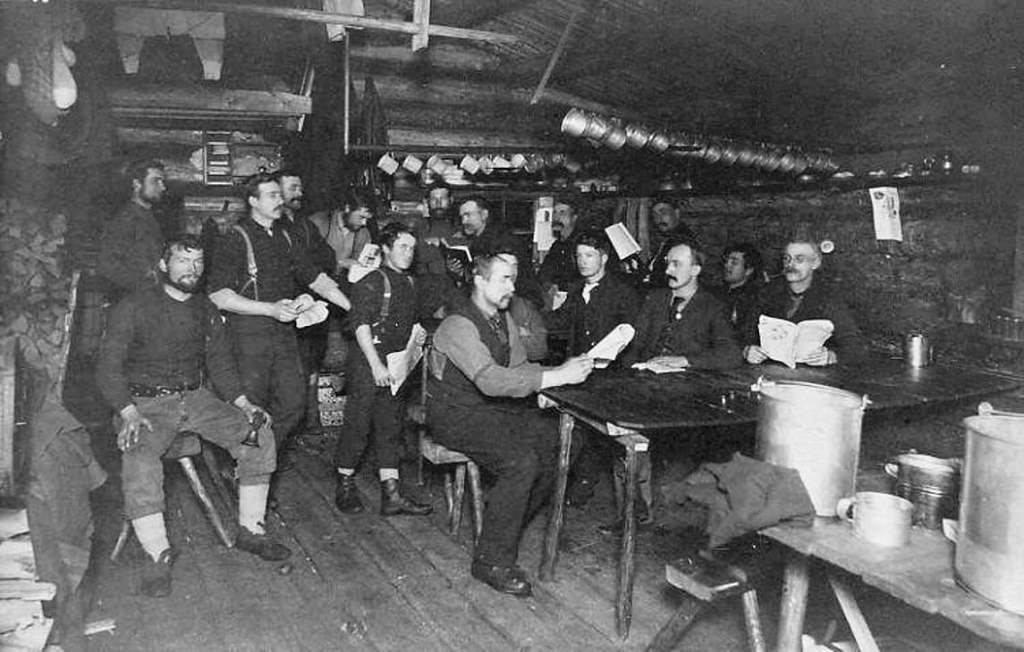
My Dad was not a fussy eater, but he loved biscuits of any kind. I am not exactly sure where his love of them began, but I know his appreciation of them took a walk through a lumber camp or two. Dad’s ‘career’ in the cookhouses of central New Brunswick lumber camps ended a few months before his 18th birthday, which he celebrated on board a ship bound for war-torn Europe. Those formative years in the backwoods of Northumberland County not only gave him a fine appreciation for biscuits but also the telling of a good tale. Dad did not talk about his wartime service or experiences, which was strange given his love of a good yarn.
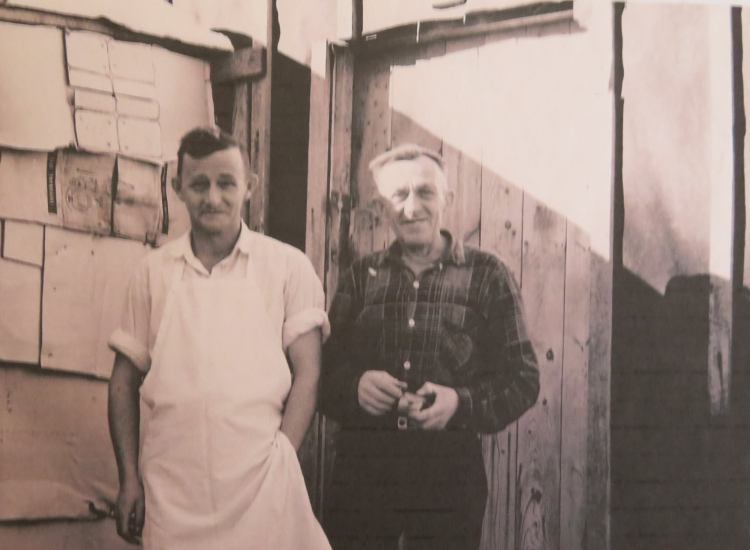
To say Dad had a conflicted relationship with this period of his life and with all things military is an understatement. Willard Bruce Lyons was born in central Northumberland County on October 9, 1925, and entered service with the Canadian Army in the later stages of the war. Despite fibbing about his age, he arrived in Europe well after D-Day. It is this timing that served as the foundation for some of the conflict he felt, especially leading up to Remembrance Day. Dad was highly reluctant to ever suggest his experience in any way compared to the service of others, especially those who served and died.
Dad also hated anything military—the pomp, the ceremony, and the power differential based on rank. As a United Church minister, he was obligated to participate in Remembrance Day events, but also in memorials and funerals for veterans, often involving the Royal Canadian Legion. Few, if any, knew the feelings of contempt for power and authority based on rank that stewed in his gut. He offered blessings and prayers for the veterans and their families, many of whom never knew he was also a veteran. He simply wanted nothing to do with anything that remotely approached celebrating war.
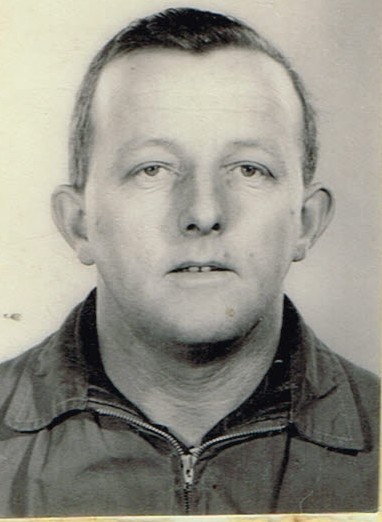
CFB Renous Badge Photo c. 1965. Military life followed him into civilian life. His intense distaste for military hierarchies was honed further as he navigated their legacy in small-town politics and rigid management styles of CFB Renous.
Of course, a major part of Dad’s issue with Remembrance Day activities and celebrations centred around drinking alcohol. Both my parents had strong anti-drinking stances. Mum’s was rooted in her strict Presbyterian upbringing. Dad’s view was more nuanced and, in his mind, resulted from my grandmother who, upon meeting him for the first time and smelling the beer he’d consumed earlier, declared, “You are welcome in my home, but not when you have been drinking.” Dad respected her wishes and decided to stop the habit he’d formed in the army. It would be decades before he permitted even the smallest bit of alcohol to pass his lips. So, participating in the socials after the Cenotaph services was not something Dad engaged in, ever.
So how did someone who spent more than 12 months of service in Europe during the war escape wartime trauma and war tales? The answer is he didn’t. He simply did not allow himself to go there—to remember. But there were clues: the chronic nightmares of exploding bombs he suffered in the early years of my parents marriage. Backyard fireworks ending abruptly with Dad writhing on the ground, screaming, “Take cover!” And during the Falklands War, his sleep was ravaged at the thought of his sons and other boys facing the same fate as he and his brothers in arms.
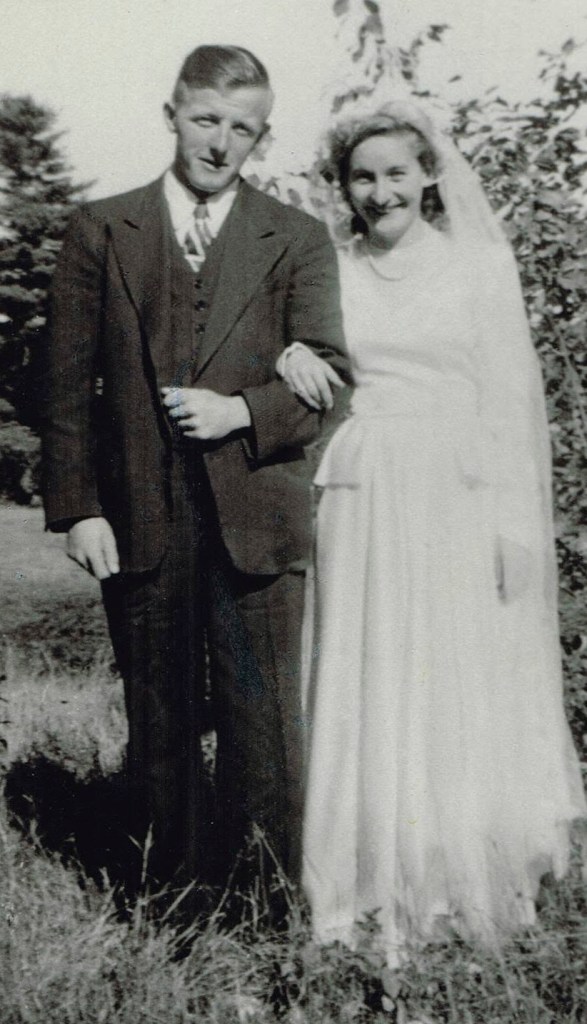
A rare, candid snapshot capturing the beginning of a partnership that would weather church manses, a changing world, and the beautiful ordinariness of family life.
Over the years as a minister, Dad developed a reputation as a “man’s minister,” building bridges and ministering to the men of his congregation where they were—in the potato fields, at the wharf, and at the local garage. His refusal to regularly visit the local Legion’s watering hole did not limit him. He loved people and enjoyed nothing more than a cuppa and a biscuit with an elderly church member—his real people. He also had a reputation for being opinionated and difficult, especially with anyone who bullied or attempted to exceed their power over others. He disliked political players and viewed big businessmen as worthy of suspicion; he did not hide his contempt.
One event in particular highlights Dad’s ordinariness. When I was in high school, Dad owned a lime-green Ford Comet. God, how I hated that car. That aside, the community of St. Eleanor’s, PEI, had both a Legion and its own police detachment. A local regular at the Legion drove an identical lime-green Comet.
One Friday evening, I was attending a dance at the high school in Summerside. My parents, who were old-fashioned and very uncool in my world view, decided I would not travel home with friends. They would stay in town, and arrive at the dance’s end to collect me. Which they did—I can see him yet, well past his usual bedtime and the wait had taken its toll. His hair and clothing were rumpled, and his eyes red from rubbing the sleep from them in an effort to stay awake. We headed back to Bideford, a 30-minute drive away.
Just outside St. Eleanor’s, the RCMP had a roadblock. Dad being Dad, it never occurred to him he could pull the power card and tell the police who he was. When the officer asked him if he’d been drinking, his reply was, “Yes, a coffee,” to which the officer took exception, demanding Dad exit the car and walk the line. I remember vividly my embarrassment, very aware of my teenage friends in the car immediately behind, watching him prove his sobriety. Then I noticed a second cop, who’d been interviewing my friend the driver, turn and approach the one assessing Dad. It seems my friend had asked why they had the teetotalling2 UCC minister walking the line.
Suddenly we were free to go. Needless to say, the community knew about it before we arrived home—and this was long before cell phones. It wasn’t at church that the questions first presented, but at the counter of Jim Burleigh’s general store on Saturday morning. The rumor mill was helped along beautifully by Jim’s daughters, Heather and Georgie who happened to be my high school classmates riding in the car immediately behind us.
When asked by Jim and others about it, his reply was, “Well, if he could accuse me, I could prove him wrong. Why should I get a pass for being a minister?” He did enjoy telling the tale, though. Years later, that same general merchant, James “Jim” Burleigh – who, it turned out, was a fellow WWII veteran born in the exact same year as Dad—would play head chef to Dad’s returning Cookee3 (see photo).
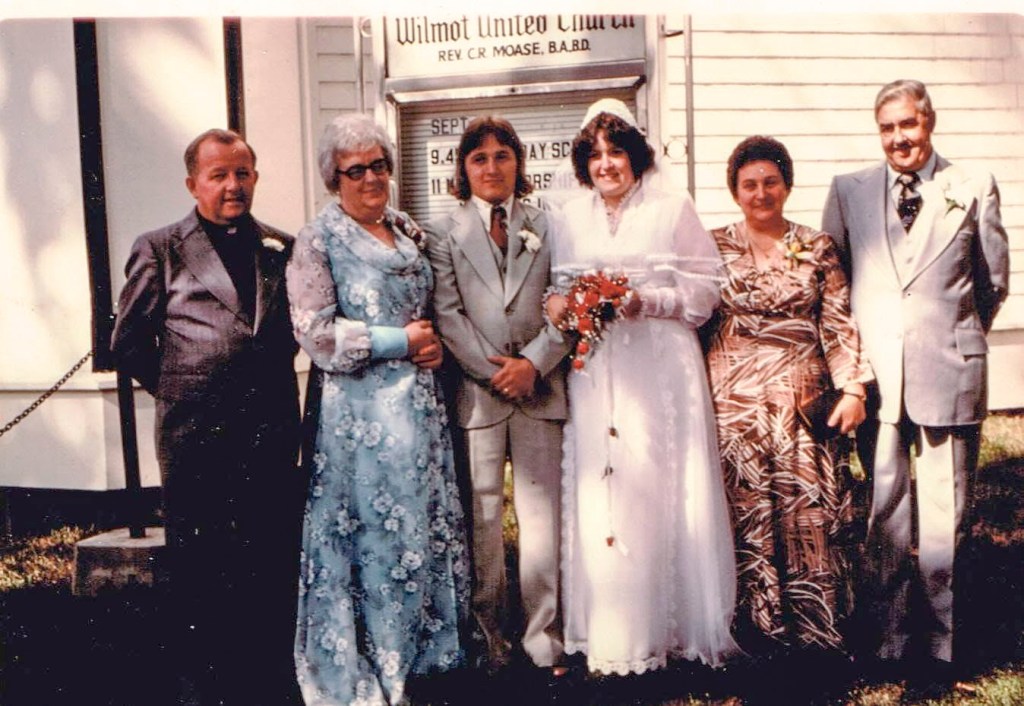
Standing outside the church after presiding over my brother’s wedding, he wore the collar with dignity for his family—even if he was always far more comfortable rolling up his sleeves.
Even in later memory writings, Dad did not allow himself to remember the house-to-house clearing, the ragged refugees, the starving children… He did recall the parade squares, kitchen duty, and drill sergeants—the busywork and the power for power’s sake that armies do to keep inactive troops on their front foot while awaiting orders. I can see now that his hatred of the entire military process—its structures, its rules, and its hierarchical power—was a tell. Even his swearing off of alcohol was a repudiation of his time in the army. He wrapped his memories in an intense dislike of the structures that send young men to their deaths, and in resisting the control humans like to exercise against the rights of the less powerful. He was not always perfect in how he executed his mission, but he was always motivated by his love of people, especially “real” ones.
My Dad was a man of his time. The lad who’d escaped the cookhouses of New Brunswick’s lumber camps found himself on KP duty4 in Germany— a man who responded to the death and destruction around him by finding a different calling… another kind of service that moulded his life.
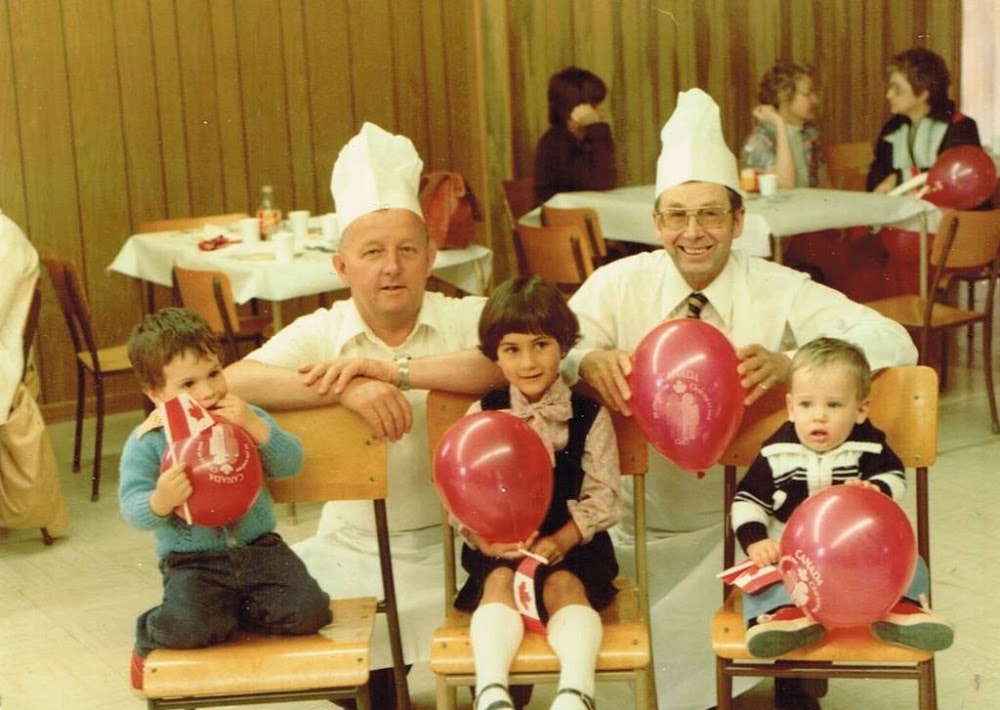
Dad was happiest participating in ordinary life, even when it meant donning his cookee garb. I’m not sure who the children are, but James Burleigh (right) was head chef. Bideford / Ellerslie PEI c. 1989.
Although Dad did not talk about his war service, we did hear tales of his time as a cookee in the lumber woods: building fires, doing dishes, and the biscuits. I learned to cook and bake from my Mum, but the desire to produce a really good biscuit and to write about “real people” is something I learned from my Dad. He told me once that the secret to good biscuits was in not forcing or overworking them; a good cook values a half biscuit as much as a full one.
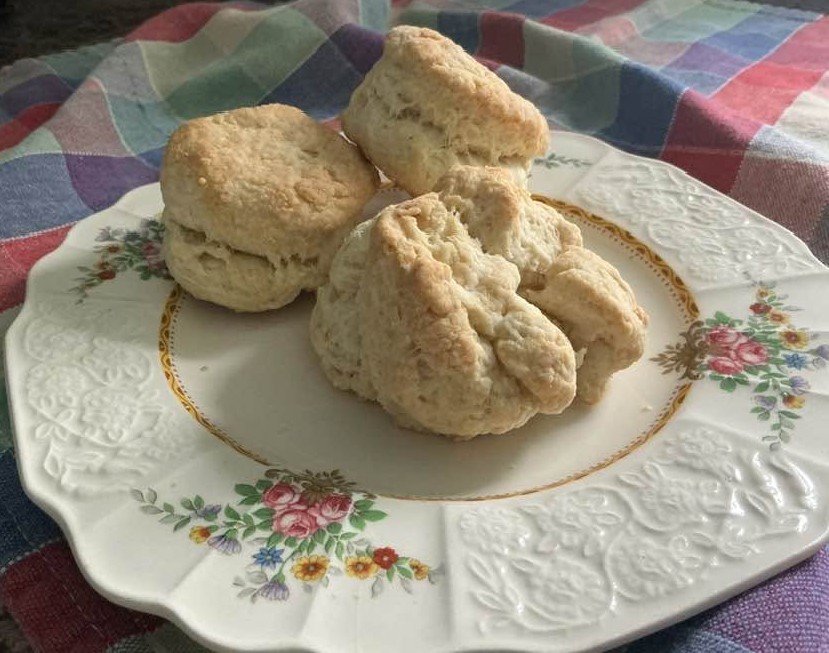
There really isn’t anything more ordinary or real than a Maritime Tea Biscuit. Tea biscuits are made of a few pantry ingredients; they are quick to make and filling. In lumber camp cookhouses, biscuits were a staple; a cook could churn out biscuits to accompany meat and veggies in quick order, while yeast-raised breads took hours. The simple combination of flour, salt, minimal fat (butter or lard), minimal milk, chemical leavening and maybe a bit of sugar, in the right hands becomes something beyond ordinary.
Although Dad would point out, ordinary is good too.
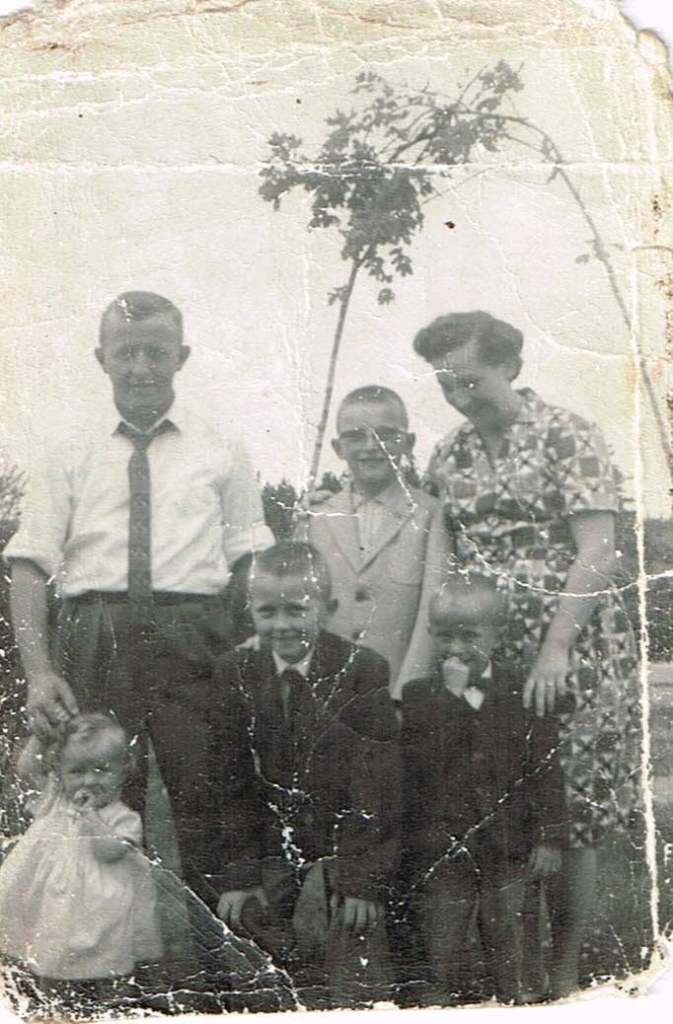
This portrait of our family, my Dad and Mum with my brothers and me —he carried it in his wallet until the edges softened and creased—the “real people” who anchored his life.
Maritime Tea Biscuits
Prep time: 10 minutes | Bake time: 12–15 minutes | Yield: Makes ~10 square biscuits
Ingredients
- 2 cups all-purpose flour
- 2 tsp cream of tartar
- 1 tsp baking soda
- ¼ tsp salt
- ¼ cup cold butter
- Up to ¾ cup milk
Method:
- Whisk the dry ingredients: In a medium bowl, combine the flour, cream of tartar, baking soda, and salt. Mix thoroughly to ensure the leavening is evenly distributed.
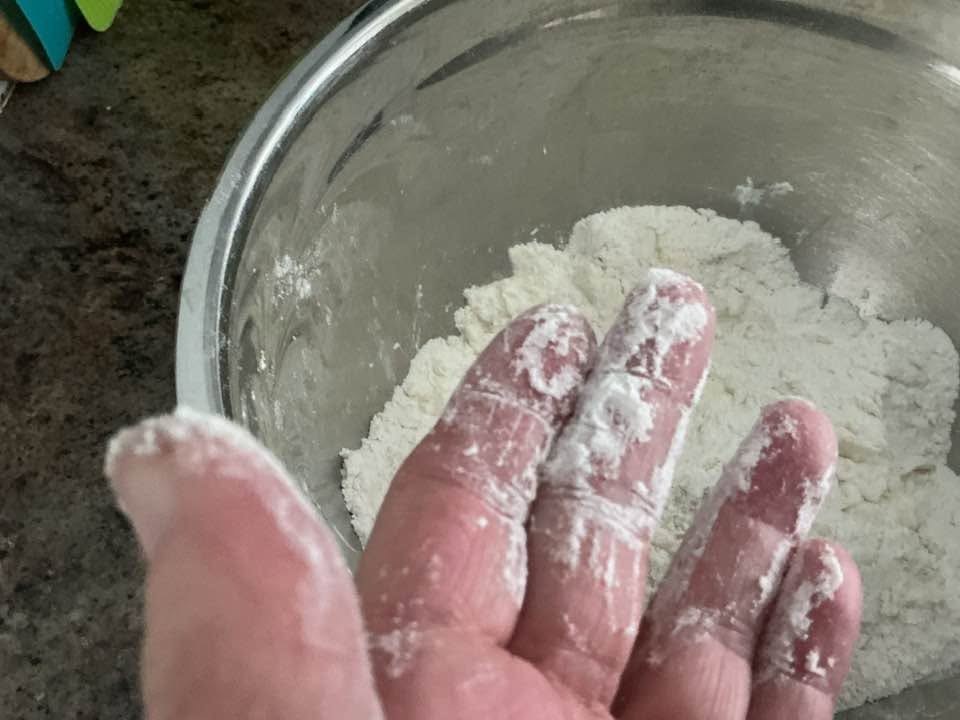
- Cut in the butter: Add the cold butter. Using a pastry blender or the tips of your fingers, cut it into the flour mixture until the butter pieces are the size of small peas.
- Add the milk: Gradually pour in the milk, adding only enough until the dough just comes together into a rough, shaggy dough.
- Shape with care: Avoid over-mixing. Tip the dough onto a lightly floured surface. Gently bring it into a cohesive ball and knead it exactly six times—no more.
- Flatten and cut: Using a rolling pin or cold hands, gently flatten the dough into a rectangle about 1 inch thick. Cut the dough into 1½-inch squares.
- Bake until golden: Place on a baking sheet and bake in a preheated 400°F (205°C) oven for 12 to 15 minutes until the tops are a beautiful golden brown. Cool on a wire rack.
Dad’s Secret: The secret to good biscuits is in not forcing or overworking them. A good cook values a half biscuit as much as a full one.
About Dad: Reverend Willard Bruce Lyons
Willard Bruce Lyons was born on October 9, 1925, in Carrolls Crossing, New Brunswick, the son of Hollingworth Tully Lyons and Florence Marjorie O’Donnell. The second youngest in a family of six boys, Dad felt the loss of his mother deeply when he was just ten years old. Grief continued to dog the little family when his younger brother, Clark, tragically died of polio in 1941.
Leaving school after completing Grade 9, Dad joined his older brothers in the lumber woods. The Lyons men were well-known lumber camp cooks but Dad was not a natural cook and disliked his time as a cookee—though it did teach him what makes a good biscuit.
With war raging in Europe, he decided to enlist alongside many of his local peers. Though he was still a few months shy of his 18th birthday, recruiters willingly overlooked his age—he was, after all, already an independent, hard-working man. Following basic training in Canada, Dad went overseas with the North Shore (New Brunswick) Regiment for advanced training in England before deploying to mainland Europe. He saw front-line service in France, Belgium, Holland, and Germany, and decades later, he was formally honoured by the Netherlands and received the Medal of Remembrance in Relation to the Liberation of Holland.
Upon his discharge and return to Canada, Dad went back to the lumber industry, working in local sawmills. It was while working at the mill in Blackville, NB, that he met Mum. After a courtship while she finished school and spent a year teaching in a one-room schoolhouse, they were married in 1949. Dad, like many veterans, later took a civilian position at HMCS/CFB Renous5.
In 1966, driven by a deeper calling, he began upgrading his education, earning his GED in 1967 to enter the United Church of Canada’s Special Course for Ordination6. He began serving as a lay supply minister in Advocate Harbour, Nova Scotia, in 1968. By 1972, while balancing ongoing summer school and extension courses, he accepted a call to the Sheffield pastoral charge in New Brunswick.
In October 1974, he was officially ordained into the United Church of Canada. Over the next twenty-five years, Dad dedicated his life to serving small, rural Maritime communities, including Bideford, PEI; Collingwood, NS; Millstream, NB; and Stanley, NB.
He retired in 1999, allowing them to return to his beloved Miramichi home in Ludlow, New Brunswick. Following Mum’s passing in 2005, Dad was able to remain independently at home, supported by his family and Veterans Affairs Canada (VAC), carrying his quiet wisdom, his love for real people, and his appreciation for a good biscuit until the end.
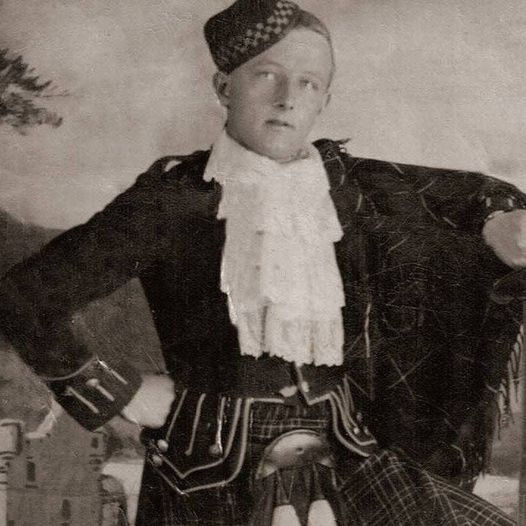
This photo was taken while Dad was on leave and seeing the sights with fellow soldier Henry Leblanc. Sadly the chums lost contact after the war… Is there a companion photo of Henry in the same photographer’s costume?
c.1945 in Edinburgh, Scotland
Terms and References:
- Civi-Street: A traditional Canadian and British military slang term referring to civilian life after being discharged from active duty. ↩︎
- Teetotalling: Complete abstinence from alcoholic beverages, a movement historically championed by many rural Maritime church communities and temperance societies. ↩︎
- Cookee: A cookee should not be confused with a cookie or a cook. The term “cookee” in the lumber woods of New Brunswick referred to the cook’s assistant. The cookee’s duties included building and tending fires in the cookhouse, and washing the mounds of dishes and huge pots and pans used to prepare the meals. The cookee did all of the potato peeling and vegetable preparation, as well as basic cooking under the direction of the cook. A lumber camp owner’s success was directly tied to the cook and his cookee; attracting and keeping good workers demanded a steady hand in the cookhouse and cook scow. ↩︎
- KP Duty: Kitchen Patrol is a military assignment assisting mess hall cooks with food preparation, dishwashing, and heavy cleaning, typically handed out to junior troops or used as a disciplinary task. ↩︎
- HMCS Renous: https://www.unb.ca/nbmhp-database/northumberland-county/points-of-interest/renous-naval-ammo-depot.php ↩︎
- Special Ordination: In the 1960s the UCC began providing alternate educational pathways to ordination. Although the pathway was different from traditional undergraduate degree and Masters of Divinity pathways, once ordained the ministers were recognized as equal. Being a mature individual was one of the requirements. A combination of summer school, extension courses and on the job coaching and training were the alternate pathway my Dad followed. Six years of study, while working full time. ↩︎
Acknowledgement: I acknowledge that the land on which I live and write about is the traditional unceded territory of the Wolastoqiyik (Maliseet) and Mi’kmaq Peoples. This territory is covered by the “Treaties of Peace and Friendship” which Wolastoqiyik (Maliseet) and Mi’kmaq Peoples first signed with the British Crown in 1725. The treaties did not deal with surrender of lands and resources but in fact recognized Mi’kmaq and Wolastoqiyik (Maliseet) title and established the rules for what was to be an ongoing relationship between nations.

